Food Sensitivity Testing for Inflammation: Uncovering Your Body’s Hidden Triggers
Updated: Sep 8
What if the organic spinach and almonds you eat every day are actually the hidden drivers behind your constant fatigue and joint pain? It's incredibly frustrating to do everything "right" only to have your doctor tell you your labs are normal while you still feel terrible. You've likely tried every diet, but without food sensitivity testing for inflammation, you're often just shooting in the dark. We understand that heavy feeling of being overlooked by a system that only masks symptoms rather than finding their source.
You deserve answers that go deeper than a standard blood panel. This investigative approach allows us to stop the guesswork and start measuring your unique cellular responses. Even the most celebrated superfoods can act as triggers if your immune system perceives them as a threat. In this guide, we will explore how to uncover your body's specific inflammatory blueprint. You'll learn why "healthy" is a relative term and how a targeted list of foods to avoid can finally help you reclaim your energy and restore your long-term health. It's time to stop guessing and start healing.
Table of Contents
The Silent Link Between Food Sensitivities and Chronic Inflammation
You have been told your blood work is fine. Yet, you wake up every morning feeling like you have run a marathon. Your joints ache; your head feels heavy; your skin is breaking out. This disconnect between how you feel and what your labs say is often rooted in The Silent Link Between Food Sensitivities and Chronic Inflammation. While conventional medicine is excellent at finding acute allergies, it often overlooks the subtle, delayed sensitivities that keep your body in a state of high alert.
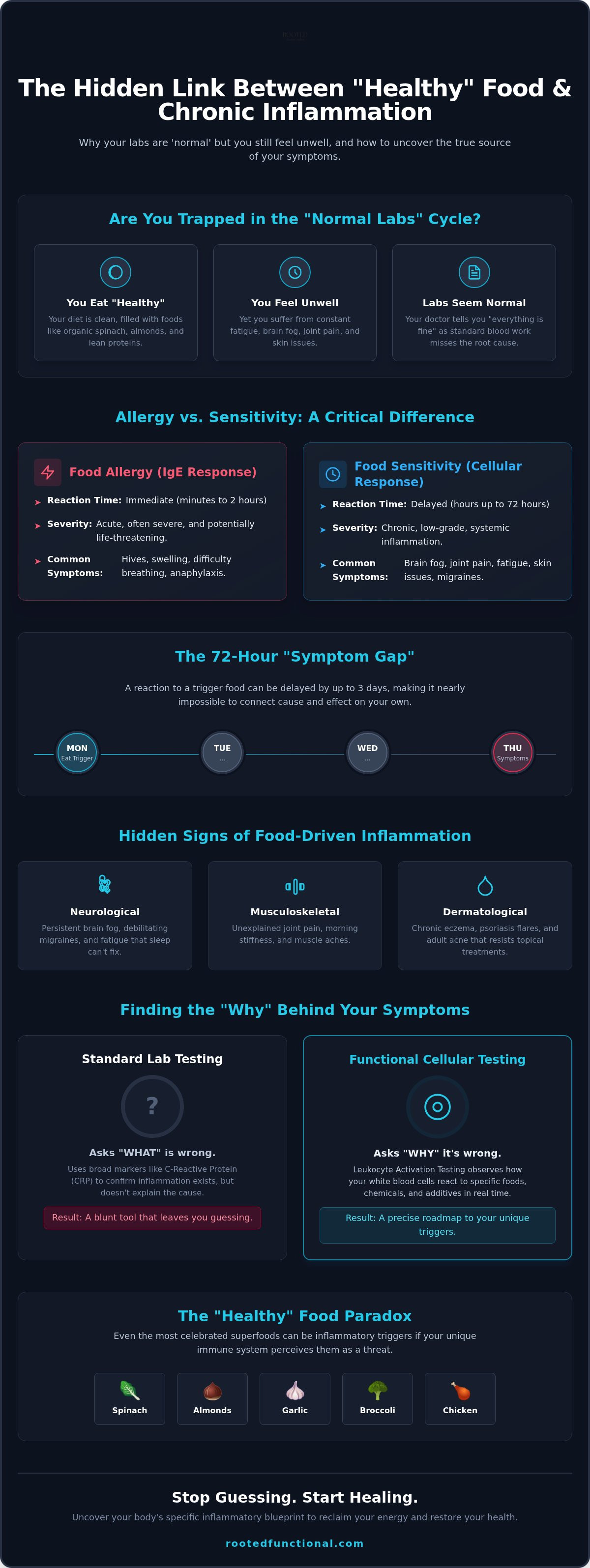
A true food allergy involves an IgE immune response. It is immediate and often life-threatening. Food sensitivities are different. They involve IgG or IgM antibodies and cellular reactions that don't show up for hours or even days. This is why food sensitivity testing for inflammation is essential for those stuck in a cycle of "unexplained" symptoms. When you eat a trigger food, your immune system creates a low-grade inflammatory response. Over time, this constant friction leads to intestinal permeability, or "leaky gut," where undigested particles enter the bloodstream and trigger systemic distress.
The "Symptom Gap" makes these triggers nearly impossible to track on your own. A reaction can take up to 72 hours to surface. If you ate a handful of almonds on Monday, your migraine on Thursday might seem random. It isn't. It is a delayed immune response. Without proper testing, you might keep eating the very foods that are breaking down your health.
Symptoms of Food-Induced Systemic Inflammation
Inflammation doesn't just stay in your gut. It travels. When your immune system is overactive, it can manifest in ways that seem entirely unrelated to your diet. We often see patients struggling with various "hidden" signs of food-driven inflammation:
Neurological signs: Persistent brain fog, debilitating migraines, and a level of fatigue that sleep cannot fix.
Musculoskeletal signs: Unexplained joint pain, morning stiffness, and muscle aches that mimic "old age" or overexertion.
Dermatological signs: Chronic eczema, psoriasis flares, and adult acne that doesn't respond to topical treatments.
While identifying food triggers is essential, supporting the body with specialized manual therapies can help manage the physical discomfort and stiffness that often accompany systemic inflammation; learn more about how these techniques can aid your recovery.
The Problem with "Normal" Lab Results
It is heartbreaking to be told "nothing is wrong" when you feel like your body is failing you. Standard medicine typically relies on markers like C-Reactive Protein (CRP). While CRP is a helpful indicator, it only tells us that inflammation exists. It doesn't tell us why. It is a broad, blunt tool.
Functional medicine asks a different question. We aren't just looking for the "what"; we are looking for the "why." Routine blood work often misses these cellular triggers because it isn't looking deep enough. By utilizing food sensitivity testing for inflammation, we stop guessing. We look at how your cells actually behave. This investigative approach validates your experience and provides a clear, clinical path toward feeling like yourself again. You aren't crazy. You're just waiting for the right data.
How Functional Food Sensitivity Testing Identifies Cellular Inflammation
Most food sensitivity tests stop at IgG antibodies. While these can provide clues, they don't always capture the full picture of how your body reacts in real time. How Functional Food Sensitivity Testing Identifies Cellular Inflammation involves looking at the actual behavior of your white blood cells. This is called leukocyte activation testing. Instead of just measuring a static level of antibodies, we observe whether your cells physically change or shrink when exposed to specific substances.
This approach is significantly more comprehensive because it accounts for various inflammatory pathways. It isn't limited to just whole foods like chicken or broccoli. We can also test your response to chemicals, food dyes, and environmental additives. This creates a personalized roadmap for your immune system. It shows us exactly what triggers a "red alert" at a cellular level, allowing us to move beyond broad guesses and into clinical precision.
The Role of White Blood Cells in Inflammation
Your white blood cells, specifically neutrophils and monocytes, are the first responders of your immune system. When they encounter a substance they perceive as a threat, they initiate an inflammatory cascade. They release toxic mediators that can damage your own tissues. If your immune system misidentifies a healthy food as a threat, this cascade happens every time you eat. It's like a fire that never quite goes out.
This constant state of cellular stress is a primary driver of chronic disease progression. It keeps your body in a defensive posture, which drains your energy and stalls your metabolism. By using food sensitivity testing for inflammation, we can identify these specific triggers and give your immune system a much-needed break. If you're ready to see what's happening beneath the surface, a Root Cause Consultation is the first step toward getting these answers.
Bio-Individuality: Your Body is Not a Textbook
We often see patients who have tried every generic anti-inflammatory diet without success. They eat plenty of kale, turmeric, and salmon because that's what the "textbooks" suggest. However, your neighbor’s superfood might be your poison. If your body is sensitive to the oxalates in spinach or the specific compounds in garlic, these "healthy" foods will only increase your inflammatory load.
Following generic health trends without personal data is a recipe for frustration. It often leads to more confusion and wasted effort. Testing removes the guesswork from your healing journey. It provides a definitive list of what your body loves and what it rejects. You don't have to guess why you feel inflamed anymore. You can have the data that finally validates your experience and points the way home.
Anti-Inflammatory Foods: Why "Healthy" Eating Might Be Triggering You
You have likely been told to load your plate with turmeric, wild-caught salmon, and dark leafy greens. These are the pillars of a standard anti-inflammatory diet. For many, they work wonders. However, if you are diligently eating these "superfoods" and still struggling with persistent bloating or joint stiffness, you are facing a biological paradox. What is healing for one person can be a hidden source of stress for another. This is the core reason why a generic approach often fails.
This is where food sensitivity testing for inflammation changes the narrative. It moves you away from "generally healthy" and toward "specifically healthy for you." When your immune system is in a state of hyper-vigilance, it can misidentify the proteins in kale or the compounds in garlic as invaders. This creates a cycle of low-grade, systemic inflammation. This constant internal friction is a major contributor to weight loss resistance. Your body cannot focus on metabolic efficiency when it is constantly trying to manage an immune threat.
Common "Healthy" Triggers to Watch For
Identifying your specific triggers requires looking beyond the labels of "good" and "bad" foods. Many staples of a clean diet are actually high in natural compounds that can irritate a sensitive system. We often see patients who are surprised to find that their daily spinach smoothie or almond snack is the root of their discomfort. Understanding the Signs You Need a Food Sensitivity Assessment for Inflammatory Relief is crucial because these reactions are often non-IgE mediated and delayed.
Nightshades: Tomatoes, white potatoes, and peppers contain solanine. For some, this compound directly contributes to joint inflammation and muscle aches.
Oxalates: Foods like spinach, beets, and almonds are high in oxalates. If your body cannot process them correctly, they can drive cellular stress and even contribute to physical discomfort.
Fermented foods: While kombucha and sauerkraut are great for gut health, they are high in histamines. If you have a histamine intolerance, these foods can trigger migraines, hives, or digestive distress.
Building Your Personalized Anti-Inflammatory Roundup
True healing begins when you stop guessing. Once we have your test results, we can build a customized eating plan that respects your bio-individuality. We use this data to select the specific fats, proteins, and carbohydrates that soothe your immune system rather than provoking it. This is not about restriction; it is about clinical precision. We want to give your body the space it needs to repair itself at a cellular level.
This foundational work is essential for anyone looking to change their body composition. Any effective Comprehensive Guide to Metabolic Weight Loss must start with inflammation control. You cannot out-exercise a diet that your immune system finds offensive. By removing your unique triggers, you clear the path for your metabolism to function exactly as it was designed to. You aren't just losing weight; you are restoring your vitality from the root up.
Signs You Need a Food Sensitivity Assessment for Inflammatory Relief
You know your body better than anyone else. When you feel "off," you shouldn't have to wait for a crisis to get help. Many of our patients arrive after years of being told their labs are perfect, yet they are exhausted, puffy, and stuck. This is the "Normal Lab" trap. Conventional panels often miss the low-grade, cellular-level friction identified through food sensitivity testing for inflammation. If you feel like something is wrong despite having no clinical "proof," it's time to look deeper at what you're putting on your plate.
Chronic fatigue that persists regardless of how much sleep you get or how much caffeine you drink is a major red flag. It's often a sign that your mitochondria, the power plants of your cells, are struggling under the weight of systemic inflammation. When your immune system is constantly fighting your food, it drains the energy you need for your daily life. You aren't lazy; you're likely inflamed.
Weight Loss Resistance and Inflammation
It's incredibly disheartening to eat a "clean" diet and exercise daily only to see the scale refuse to budge. This isn't a lack of willpower. It's a biological roadblock. When your immune system reacts to a specific food, it releases inflammatory cytokines. These molecules can block your hormone receptors, particularly for insulin and leptin. This tells your body to store fat rather than burn it for fuel.
If your cells are inflamed, the old advice of "eating less and moving more" simply won't work. Your body is in survival mode, not fat-burning mode. To break this cycle, we must identify the specific triggers that are keeping your system on high alert. You can learn more about this phenomenon from a Weight Loss Resistance Doctor: Why Your Labs Are Normal but the scale won't move.
Autoimmune Support and Food Triggers
For those living with autoimmune conditions, every meal is an opportunity to either soothe or stress the immune system. We look at this through the lens of "total toxic burden." Your body can only handle so much stress before it begins to overreact. Identifying your specific food triggers is a non-negotiable step in autoimmune recovery because it reduces the daily load on your immune system.
The goal is to move the body from a state of constant attack to a state of deep repair. By removing hidden inflammatory triggers, we give your tissues the space they need to heal. This investigative approach is about more than just avoiding symptoms; it's about restoring the balance your body deserves. If you're ready to stop the guesswork and start your healing journey, you can book your Root Cause Consultation here. We'll work together to find the answers that standard medicine has missed.
Moving Beyond Symptoms: Your Path to Lasting Health
Receiving your results from food sensitivity testing for inflammation is a powerful moment. It is often the first time a patient sees their internal struggle validated on paper. However, a test result by itself is just a list of data points. It does not fix the underlying damage or teach your immune system how to find its balance again. True healing requires a guided protocol that addresses the root cause of your distress rather than just removing a few ingredients from your pantry. We don't want you to just "deal" with your symptoms; we want to help you resolve them.
At Rooted Functional Medicine, we use these results as a foundation for your recovery. We focus on reversing the damage caused by years of chronic triggers through a purposeful, patient-led process. This often involves cellular detoxification and gut restoration. When your gut lining is compromised, your immune system stays in a state of high alert. We work to seal those barriers and clear out the cellular waste that keeps you feeling sluggish. Because we offer national telehealth services, this advanced investigative care is accessible to you regardless of your location. You can finally get the answers you need from the comfort of your own home.
What to Expect in Your Root Cause Consultation
Your journey starts with a deep-dive analysis of your history, your symptoms, and your unique labs. We don't just look at what foods to avoid; we look at why your body reacted to them in the first place. During this session, we build a personalized protocol designed to restore your cellular health. This is a far cry from the symptom-masking approach of conventional medicine. If you're new to this philosophy, it helps to understand What Is a Functional Medicine Doctor? and how our investigative approach differs from standard primary care.
Your Next Step Toward Relief
You have spent enough time guessing which "healthy" habit is actually hurting you. It is time to stop the cycle of trial and error and start a clinical investigation. Data is empowering. It gives you the control you need to make decisions that actually move the needle on your health. We're here to guide you through every step of that process with compassion and expertise. You don't have to navigate chronic illness alone anymore. There is a clear path back to vitality, and it begins with a single, decisive action. Book your Root Cause Consultation today and let's uncover the answers your body has been waiting for.
Your Roadmap to Lasting Vitality
You don't have to settle for "normal" lab results while your body tells you a different story. Chronic inflammation is not a life sentence. It is a signal that your immune system is struggling to find its balance. By moving beyond generic diet advice and embracing food sensitivity testing for inflammation, you uncover the specific cellular triggers that have been holding you back. This is the critical difference between simply surviving and truly thriving.
Under the guidance of Dr. Adrienne Guthrie, recognized as the Best Emerging Leader in Functional and Natural Medicine 2025, we offer a path toward deep, sustainable healing. Our personalized protocols are rooted in advanced cellular testing and are available to you through telehealth services nationwide. You deserve a guide who listens to your story and investigates the "why" behind your symptoms rather than just masking the "what."
The answers you've been searching for are within reach. Stop the guesswork and start the restoration your body deserves. Ready to find your root cause? Book your consultation here. Your journey to a life of energy and vitality starts today. We are certain that with the right data, you can finally feel like yourself again.
Frequently Asked Questions
Is food sensitivity testing for inflammation the same as an allergy test?
No, they are fundamentally different. Allergy tests measure IgE antibodies, which trigger immediate and sometimes life-threatening reactions like hives or anaphylaxis. In contrast, food sensitivity testing for inflammation looks at delayed cellular responses. These reactions can take up to 72 hours to appear and often involve IgG or IgM pathways. Identifying these subtle triggers is essential for resolving chronic, systemic issues that standard allergy panels miss.
How long does it take to see results after removing inflammatory foods?
Many patients notice a decrease in bloating and improved energy within the first two weeks of removing trigger foods. However, deeper systemic healing often takes longer. It usually takes about three to six months for the immune system to fully calm down and for the gut lining to begin its restoration process. Your individual timeline depends on your total toxic burden and how long you've been inflamed.
Can food sensitivities cause weight loss resistance?
Yes, they are a primary driver of metabolic stalls. When your immune system reacts to a food, it releases inflammatory cytokines that can block hormone receptors for insulin and leptin. This tells your body to store fat rather than burn it. By utilizing food sensitivity testing for inflammation, we can identify the specific roadblocks that make eating less and moving more ineffective for your unique biology.
What is the best food sensitivity test for chronic inflammation?
We believe the most accurate approach is a cellular response test, such as leukocyte activation testing. Unlike basic IgG tests that only measure antibody levels, cellular testing observes how your white blood cells actually behave when exposed to a substance. This provides a real-time look at your inflammatory blueprint. It includes testing for whole foods, chemicals, and additives to ensure no hidden trigger is left uncovered.
Why do my labs come back normal if I feel inflamed?
Conventional labs are designed to find acute disease, not low-grade dysfunction. Standard markers like C-Reactive Protein only signal that inflammation exists, but they don't explain why. You can feel terrible while your labs sit within the reference range because those ranges are based on a population that is largely unwell. Functional medicine looks for the root cause of your symptoms rather than just checking for a diagnosis.
Can I do food sensitivity testing via telehealth?
Absolutely. We offer our Food Sensitivity Testing and Consultation service via telehealth to patients nationwide. The process is simple and convenient. We send a kit directly to your home or a local lab for the blood draw. Once the results are in, we schedule a virtual Root Cause Consultation to walk you through your personalized protocol and answer your questions from the comfort of your home.
Is an elimination diet better than a food sensitivity test?
Elimination diets are often called the gold standard, but they are incredibly difficult to follow and prone to human error. It's hard to track a reaction that takes three days to surface. Testing provides a clear, data-driven starting point that removes the guesswork. It allows you to be much more targeted with your dietary changes, ensuring you aren't unnecessarily restricting foods that your body actually loves.
How often should I be tested for food sensitivities?
Most patients find that testing once a year is sufficient to monitor their progress. As your gut heals and your leaky gut resolves, you may find that you can tolerate foods that previously caused a reaction. Your immune system is dynamic, not static. We re-evaluate your triggers as your cellular health improves to ensure your eating plan remains as diverse and nourishing as possible.


