Functional Medicine for Hashimoto's: The Role of Gut Health
Hashimoto’s care involves more than a thyroid lab result. Functional medicine for Hashimoto's disease may consider gut health, food sensitivities, nutrition, nutrient status, and lifestyle factors that could relate to symptoms and thyroid function. The goal is to explore possible contributors, not to promise a cure or reversal of the autoimmune disease.
If you’re wondering why you still feel unwell, it can help to look beyond a single test or symptom. Hashimoto’s affects the immune system and thyroid, so considering the broader health picture may clarify what could be contributing to how you feel.
This article explains how gut health may relate to thyroid function, what food sensitivities and gluten may have to do with Hashimoto’s, and what a root-cause approach can explore. It also clarifies what “reversal” means, so you can distinguish supportive care from claims of a cure.
Table of Contents
How does gut health affect thyroid function?
The gut and thyroid are connected through digestion, immune activity, and hormone processing. Exploring these connections may help explain why symptoms persist even when one test result seems reassuring.
Thyroid Hormone Production and Conversion
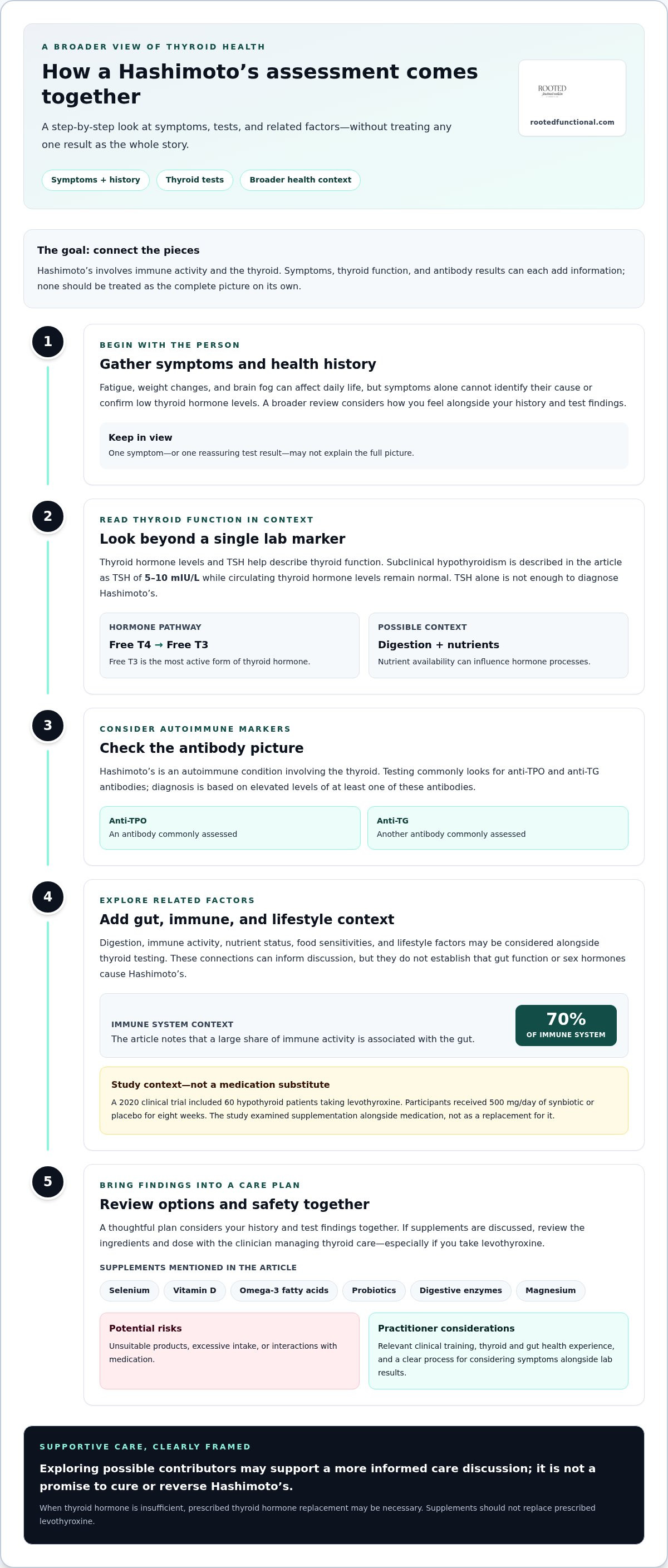
Thyroid hormone production begins in the thyroid, while hormone conversion helps make that hormone usable throughout the body. Free T4 converts into free T3, the most active form of thyroid hormone. Digestion and nutrient availability can influence the body’s hormone processes, so gut health may be one factor to consider alongside thyroid testing.
A 2020 clinical trial included 60 hypothyroid patients taking levothyroxine. Participants received 500 mg/day of synbiotic or placebo for eight weeks. That study examined supplementation alongside medication, not as a replacement for it. When the thyroid cannot produce enough hormones, thyroid hormone replacement may be necessary. Levothyroxine is a conventional treatment for a low-functioning thyroid.
Hormone Imbalance and Hashimoto’s Symptoms
In Hashimoto’s, the immune system can damage the thyroid and reduce its ability to produce hormones. This may lead to hypothyroidism, which can contribute to fatigue, weight changes, or brain fog. Symptoms alone can’t show which hormone is out of balance, and one test result may not explain the full picture. Considering symptoms alongside thyroid function can support a more informed discussion about care.
Functional medicine costs in the United States depend on the consultation, testing, and care plan, with the price given after a quote request. Insurance coverage varies by plan and by which services are covered.
Gut Microbiome, Sex Hormones, and Immunity
The gut contains trillions of friendly microorganisms, and 70% of the immune system resides in the gut. The microbiome and immune system interact, which makes gut function relevant to discussions of autoimmune diseases such as Hashimoto’s. Sex hormones also influence immune activity, so changes in hormone balance may be part of a broader health picture. These links don’t establish that gut or sex hormones cause Hashimoto’s.
Supplements considered for Hashimoto’s include selenium, vitamin D, omega-3 fatty acids, probiotics, digestive enzymes, and magnesium. Risks include taking an unsuitable product, excessive intake, or interactions with medication. Review the ingredients and dose with the clinician managing your thyroid care before starting supplements, and don’t replace prescribed levothyroxine with them.
When choosing a functional medicine practitioner for Hashimoto’s, look for relevant clinical training, experience reviewing thyroid and gut health, and a clear process for considering symptoms alongside lab results. If you take levothyroxine, ask how the practitioner will account for it in your care plan. A thorough assessment considers your history and test findings together rather than treating one result as the whole story.
What is Hashimoto’s Disease?
Hashimoto’s thyroiditis is an autoimmune condition involving the thyroid gland. Understanding the immune process, its effects on thyroid function, and possible contributing factors can make symptoms and test results easier to discuss.
Hashimoto’s as an Autoimmune Condition
In Hashimoto’s, the immune system mistakenly attacks thyroid tissue, which can impair the gland over time. Antibodies help identify this autoimmune activity. Testing commonly looks for anti-TPO and anti-TG antibodies, and diagnosis is based on elevated levels of at least one of these two antibodies. This matters because thyroid symptoms alone cannot establish the cause.
In the United States, women are 7 to 8 times more likely than men to develop Hashimoto’s. Immune dysregulation can also continue for years or decades before thyroid damage becomes severe enough for a formal diagnosis. That gap helps explain why a person’s symptoms and the timing of a diagnosis don’t always seem to match.
Hashimoto’s and Hypothyroidism
Hypothyroidism occurs when the thyroid doesn’t produce enough hormones for the body’s needs. Hashimoto’s can gradually damage thyroid tissue and reduce hormone production, making it a common autoimmune route to an underactive thyroid. The American Thyroid Association says Hashimoto disease may cause 30% to 90% of hypothyroidism cases in the United States.
Subclinical hypothyroidism describes TSH levels of 5-10 mIU/L while circulating thyroid hormone levels remain normal. This distinction matters: a TSH result needs context, and TSH alone isn’t enough to diagnose Hashimoto’s. Antibody results, symptoms, and thyroid hormone levels provide additional pieces of the assessment.
Symptoms and Thyroid Function
Hashimoto’s can affect thyroid function, but symptoms don’t identify their cause on their own. Fatigue, weight gain, and brain fog can disrupt daily life, yet they don’t confirm low thyroid hormone levels. Considering symptoms alongside thyroid tests and antibody results can help clarify whether Hashimoto’s is part of the picture.
Thyroid ultrasound isn’t a primary diagnostic tool for Hashimoto’s, but it can provide useful information about the gland. This may be relevant when test results and symptoms leave questions about thyroid health. A complete assessment avoids treating one symptom or lab marker as the whole explanation.
Stress and Inflammation
Stress can affect thyroid hormone processing: the body can convert T4 into reverse T3 instead of free T3. This is one reason stress belongs in a broader discussion of thyroid function, alongside symptoms and lab results. It doesn’t establish that stress caused Hashimoto’s, but it can be relevant when evaluating factors that influence how a person feels.
Environmental exposures may also be worth discussing. Chemicals in plastics, pesticides, and personal care products are potential endocrine disruptors, meaning they can interfere with hormone systems. Exposure doesn’t prove a cause of Hashimoto’s, but it may be one factor to consider when discussing thyroid health and inflammation with a clinician.
If these connections raise questions about your symptoms, you can book a conversation about thyroid health and discuss how your history and test results fit together.
Can Hashimoto’s be reversed with functional medicine?
Functional medicine may explore factors that relate to symptoms and thyroid function, but feeling better isn’t the same as reversing Hashimoto’s. Care can focus on measurable findings, changes over time, and your day-to-day experience.
Lab Testing and Symptom Tracking
Ongoing lab testing and symptom tracking compare thyroid markers with changes in daily health. A functional assessment may include TSH, free T3, free T4, reverse T3, TPO antibodies, and TgAb, alongside symptoms, nutrient status, diet, and lifestyle. Tracking fatigue, weight changes, and brain fog can reveal whether symptoms shift with lab results or other changes.
After medication or supplement changes, TSH is remeasured at least 6-8 weeks later. Changes in thyroid antibodies may take up to three months to show on lab tests. Once thyroid function reaches a balanced state, monitoring may shift to every 6-12 months.
Expected Timeframe for Improvement
Symptom changes can take weeks to months after starting functional medicine strategies. Some patients report improvement in energy, brain fog, and other symptoms within 4-8 weeks. These timeframes describe possible symptom changes, not a timeline for reversing Hashimoto’s or normalizing every lab marker.
If fatigue, weight gain, or brain fog are concerns, track each one separately. Note when fatigue affects your day, whether weight changes continue, and when brain fog is most disruptive. Comparing these patterns with thyroid tests can provide more context than relying on one symptom alone.
Functional and Standard Care
Endocrinology care assesses thyroid function and treats low hormone levels, commonly with levothyroxine. Functional care may add a broader review of symptoms, nutrition, nutrient status, lifestyle, and thyroid markers. The approaches can complement each other. Lifestyle or supplement strategies don’t replace prescribed thyroid hormone when the gland can’t produce enough.
For concerns such as fatigue or weight changes, care should consider both thyroid results and your experience. A broader review may identify factors worth addressing, while follow-up monitoring shows how symptoms and thyroid markers change over time.
Evidence for Functional Medicine Treatments
Monitoring thyroid function and antibodies over time can help track changes. Symptom improvement has been reported within weeks to months, but that doesn’t show that functional medicine reverses the autoimmune condition. Changes in energy or brain fog are worth noting, but they don’t prove Hashimoto’s has gone away.
The practical distinction is straightforward: assess thyroid function, track measurable changes, and address symptoms without treating improvement as a cure. Functional medicine can support a broader review, but current evidence doesn’t establish that its treatments reverse Hashimoto’s disease.
Food sensitivities, celiac disease, and gluten
Gluten-free or dairy-free eating may help some people with Hashimoto’s notice changes in symptoms, but it isn’t a universal treatment. A structured elimination followed by gradual reintroduction can help connect specific foods with changes in digestion, fatigue, or mental clarity.
Food Sensitivities and Dietary Changes
Food sensitivities are suspected reactions to particular foods, assessed through symptoms and, in some cases, testing. Possible assessments in Hashimoto’s care include stool analysis and food sensitivity testing. These can inform dietary questions, but they don’t mean every food is a problem or replace thyroid monitoring.
A practical dietary approach is to temporarily remove gluten, dairy, and soy, then reintroduce them gradually while tracking symptoms. Record what you ate and any changes in digestion, energy, or mental focus. Changing one factor at a time makes patterns easier to notice than removing several foods indefinitely.
Some people may benefit from limiting gluten, dairy, and processed foods while choosing whole, nutrient-dense options. An autoimmune Paleo diet may be used for 1-6 months to explore possible food allergens and sensitivities. Restriction also affects nutritional variety, so the food choices during an elimination period matter.
Food Sensitivity Testing can be one part of this evaluation. Consider results alongside symptoms and dietary patterns, rather than treating them as proof that a food causes every symptom. The practical question is whether a specific change and later reintroduction correspond with a repeatable difference.
Celiac Disease and Gluten
Celiac disease and suspected gluten sensitivity are different considerations when gluten seems connected with symptoms. A gluten-free diet may help some people with Hashimoto’s, but that response alone doesn’t establish celiac disease or explain every symptom. Keep the distinction in mind when considering dietary changes.
Environmental exposures, including chemicals in plastics, pesticides, and personal care products, may have endocrine-disrupting effects. They aren’t the same as a food sensitivity. Considering these factors separately can help avoid attributing changes in thyroid health or fatigue to gluten alone.
Stool analysis may also be considered to explore gut health. It can help a clinician investigate digestive concerns, including questions about infections, without assuming an infection explains food reactions. Diet, symptoms, and test findings each provide different information.
For a careful dietary trial, first note your usual meals and symptoms. Then choose a clear elimination period and reintroduce foods gradually. Consider gluten, dairy, or soy separately rather than changing all three at once. This makes patterns easier to identify and helps preserve nutritional variety while you assess symptoms.
Root-cause functional medicine approach
A root-cause approach looks beyond one thyroid marker to factors that may shape symptoms and health. For Hashimoto’s, this means considering lab findings alongside personal history, nutrition, gut concerns, stress, and daily habits. The goal is a fuller picture, not a promise to erase an autoimmune diagnosis. A useful plan addresses specific findings and tracks changes over time.
The assessment starts by organizing the available evidence. A thyroid panel can include TSH, Free T3, Free T4, Reverse T3, TPO, and TgAb. Symptoms, nutrient status, diet, and lifestyle add context to those results. For example, ongoing fatigue alongside thyroid markers and a history of restrictive eating raises different questions than fatigue alone. Stool analysis or food sensitivity testing can contribute information when gut symptoms or food reactions are part of the picture.
Care can then prioritize factors that match your individual findings instead of applying the same protocol to everyone. Personalized nutrition, targeted supplements, stress management, and other interventions may be considered as appropriate. A suspected gluten sensitivity, for example, raises different questions than chronic stress or a nutrient concern. Addressing priorities one at a time makes it easier to connect an intervention with changes in symptoms, nutrition, and lab results.
Daily habits also belong in the plan because they shape the conditions in which the body functions. Mindfulness practices and adequate sleep are stress-management strategies used in Hashimoto’s care. A practical sleep routine can include aiming for 7-8 hours and avoiding blue-light exposure for an hour before bedtime. These steps don’t replace thyroid monitoring; they create concrete lifestyle factors to review alongside laboratory findings.
Follow-up gives the process direction. Reassessing thyroid function, antibody levels, nutrient status, symptoms, diet, and lifestyle can show what is shifting and what needs attention. TSH is remeasured at least 6-8 weeks after medication or supplement changes, while antibody changes can take up to three months to appear on laboratory tests. This makes timing part of the plan, not an afterthought.
Functional medicine for Hashimoto's disease is most useful as a structured way to investigate contributing factors while keeping measurable thyroid changes in view. It doesn’t mean stopping prescribed medication or treating every sensitivity as a cause. If you want to connect your symptoms, history, and thyroid findings into a focused discussion, book an appointment to discuss your health concerns.
Rooted Functional Medicine: Healing Neuropathy Webinar
Specialized educational webinars are available for people seeking information about neuropathy. For Hashimoto’s, the Autoimmune Solutions Program and Root Cause Consultation are more directly relevant options for discussing autoimmune health and possible contributors to chronic symptoms.
A Root Cause Consultation may suit you if you want to discuss how your health history, symptoms, and existing test results fit together. The Autoimmune Solutions Program focuses on autoimmune support. Neither replaces prescribed thyroid medication or urgent medical care.
If you’re unsure where to begin, consider which concern you want to address first: neuropathy education, a root-cause discussion, or autoimmune support. Reach out to learn more about the option that fits your needs.
Choose a thoughtful next step for your care
Living with Hashimoto’s can leave you searching for an explanation for symptoms that affect everyday life. Functional medicine for Hashimoto's disease offers a framework for exploring personal health factors alongside thyroid monitoring, without treating symptom relief as proof of a cure. A focused conversation can help you identify what matters most and which questions remain.
Rooted Functional Medicine offers a Root Cause Consultation and the Autoimmune Solutions Program for people seeking support with root-cause and autoimmune concerns. The Healing Neuropathy Webinar is another educational option, though it addresses neuropathy rather than Hashimoto’s specifically. Start by identifying what you want help understanding, then choose the option that best fits that concern.
If you’d like to discuss your health concerns and possible next steps, contact Rooted Functional Medicine. You deserve care that takes your questions seriously and helps you move forward with clarity.
Frequently Asked Questions
Can functional medicine cure autoimmune diseases?
Functional medicine is an approach to care, not a cure for autoimmune disease. For Hashimoto’s, it can focus on symptoms and health factors alongside thyroid monitoring. The aim is to support health and explore what may contribute to your experience, not to claim the autoimmune condition has disappeared. Keep prescribed thyroid treatment and follow-up central to your care while considering additional strategies.
Does stress impact Hashimoto’s?
Stress can affect thyroid hormone processing. The body may convert T4 into reverse T3 instead of free T3, which is one factor to discuss when symptoms persist. Stress-management strategies such as mindfulness and adequate sleep can be part of a broader care plan. For practical tracking, note stressful periods alongside changes in sleep, energy, and symptoms, then discuss those patterns during a health visit.
How long does it take to see improvements?
Some patients report improvement in energy, brain fog, and other symptoms within 4-8 weeks of starting functional medicine strategies. Others may notice changes over weeks to months. Track a few specific measures, such as morning energy or concentration during work, so you can compare your experience over time. Symptom changes and thyroid lab results may follow different timelines.
I Have Been Diagnosed with Hashimoto’s, What Now?
Organize your diagnosis details, recent lab results, current medications, and the symptoms affecting daily life. Write down questions about thyroid function, treatment, and follow-up for your next medical visit. Don’t stop or change prescribed thyroid medication on your own. Keeping a record of symptoms, medication changes, and test dates can make ongoing care easier to follow.
What lab tests are important for Hashimoto’s?
Assessment may include TSH, free T4, free T3, and thyroid antibodies, including TPOAb and TgAb. Antibody results help identify autoimmune thyroid activity, while hormone tests show aspects of thyroid function. TSH alone isn’t enough to diagnose Hashimoto’s. Keep copies of results with their dates, since comparing changes over time can provide more context than looking at one result by itself.
What role does diet play in managing Hashimoto’s?
Diet can help you explore food-related symptoms and maintain nutritional variety, but one eating pattern doesn’t suit everyone. If you’re investigating a food sensitivity, record meals and symptoms, then make changes in a structured way. Avoid removing multiple food groups indefinitely without considering nutrition. The aim is to understand your own response, not assume gluten or dairy affects everyone with Hashimoto’s.
What is functional medicine for Hashimoto’s disease?
Functional medicine for Hashimoto's disease is a personalized approach that considers thyroid findings alongside symptoms, health history, nutrition, and lifestyle. It may explore factors that could contribute to your experience and use follow-up to assess changes. It complements thyroid care rather than proving Hashimoto’s can be cured. A useful plan connects each intervention to a clear health concern or measurable finding.
What tests do functional medicine doctors use to evaluate Hashimoto’s?
An evaluation may consider thyroid tests, antibody measurements, nutrient status, and symptom history. Depending on your concerns, stool analysis or Food Sensitivity Testing may also help explore gut health. These assessments address different questions: thyroid labs measure hormone markers, antibodies relate to autoimmune activity, and gut assessments explore digestive concerns. Results are most useful when considered alongside symptoms and medication history.