Heavy Metal Detox Test: How to Uncover the Root Cause of Chronic Symptoms
Updated: Sep 4
What if the "normal" blood work your doctor keeps ordering is actually missing the very thing making you sick? You've likely been told your labs look perfect, yet you're still struggling with chronic inflammation and fatigue that won't resolve. It's exhausting to feel dismissed by a medical system that only looks at the surface while you live with symptoms that feel anything but normal. If you suspect your environment is to blame, a functional heavy metal detox test is the essential first step to uncovering the hidden burden stored deep within your cells.
We understand the confusion that comes with trying to choose between hair, blood, or urine testing methods. You deserve a clear map of your toxic load instead of more guesswork or generic advice. In this guide, you'll learn how to identify the hidden drivers of your symptoms and how to select the most valid testing method for your unique situation. We'll walk through the process of moving from discovery to a professional protocol that safely restores your cellular health. It's time to find the answers you've been searching for and start a path toward real, lasting recovery.
Table of Contents
Beyond "Normal" Labs: Why You Need a Heavy Metal Detox Test
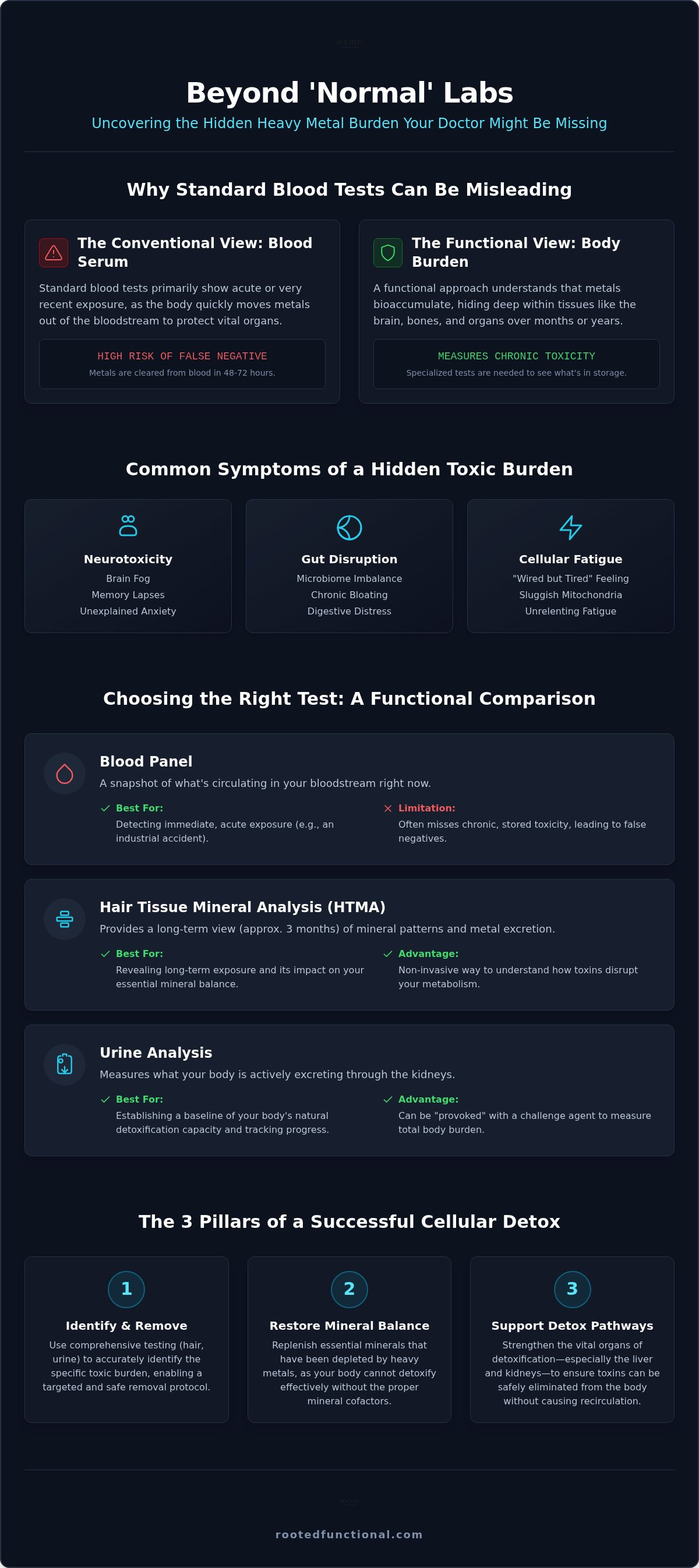
You've likely been told your labs are fine. Yet, you feel anything but fine. Standard testing often looks for acute poisoning, but it fails to see the slow, silent accumulation of toxins that drives chronic inflammation. Heavy metals like lead, mercury, and arsenic aren't just environmental hazards. They are cellular disruptors that interfere with your body's most basic functions. Bioaccumulation is the process where toxins build up in tissues faster than the body can eliminate them. Because these metals often move out of the bloodstream and hide in your organs or bones, a standard blood draw won't catch them. This is why a functional heavy metal detox test is necessary to see the full picture of your health. Integrating these findings with the natural principles used at a homeopathy clinic dubai can offer a more comprehensive path toward restoring cellular balance.
The Problem with Conventional Reference Ranges
Most lab reference ranges are designed to detect emergency situations. They tell you if you've been acutely poisoned, not if you're functioning at your best. There is a massive difference between being "not poisoned" and being "toxin-free." For many, sub-clinical levels of lead or mercury are enough to trigger an autoimmune flare or keep the body in a state of high alert. Conventional medicine often ignores these levels because they don't meet the threshold for high-level medical intervention, such as chelation therapy. In functional medicine, we know that even small amounts of these "silent" drivers can prevent you from truly healing. We look for optimal ranges, not just the absence of a crisis.
Common Symptoms of Hidden Toxic Burden
When metals build up in the brain and nervous system, they manifest as brain fog, memory lapses, or unexplained anxiety. These aren't just signs of aging or stress. They are often the result of neurotoxicity. In the gut, heavy metals can disrupt the microbiome and contribute to what causes bloating and chronic digestive distress. Finally, there is the physical toll on your energy. Many people feel "wired but tired," a state where their mitochondria are too sluggish to produce energy, yet their nervous system is too overstimulated to rest. If you've tried every supplement and diet without relief, the root cause might be a toxic burden that a standard heavy metal detox test can finally uncover. Finding the source is the only way to stop masking symptoms and start fixing them.
Blood, Hair, or Urine? Choosing the Right Testing Method
Choosing the right heavy metal detox test is the difference between finding the root cause and staying stuck in a cycle of symptoms. Most people start with their primary care doctor and ask for a Heavy Metal Blood Test. While this is a standard first step, it often fails to tell the whole story. To truly understand your toxic burden, you must look where the metals are actually hiding. We use a multi-modal approach because no single sample can capture every detail of your cellular health. You need a strategy that looks at recent exposure, long-term storage, and your body's current ability to eliminate waste.
The Limitations of Blood Panels
The body treats heavy metals like a fire in the living room. It wants them out of the main hallway, your blood, as fast as possible. To protect your vital organs, the body tucks these toxins away in "storage" areas like your liver, bones, and brain within 48 to 72 hours. This creates a high risk for a false negative. You might have a significant toxic burden, but if your exposure wasn't in the last few days, your blood work will look perfect. Blood tests are only the right choice for immediate, acute exposure, such as an industrial accident or a child swallowing a lead weight. For chronic symptoms, relying solely on blood is a missed opportunity for healing.
Hair and Urine: Windows into Cellular Health
Hair Tissue Mineral Analysis (HTMA) offers a unique perspective. It acts as a three-month screening of your mineral patterns and metal excretion. This non-invasive test doesn't just show the toxins. It reveals how those toxins are disrupting your metabolic typing and mineral balance. We also utilize unprovoked urine tests to measure what your kidneys are currently able to filter out on their own. This provides a baseline for your natural detoxification capacity. These tools are essential for tracking your progress during a cellular detox program. Testing your mineral levels is just as important as testing the metals themselves. When your minerals are depleted, your body often "grabs" heavy metals to fill the gaps in your cellular structure. If you are ready to stop guessing and start testing, a Root Cause Consultation can help you determine which method is best for your unique history.
The Functional Difference: Provoked vs. Unprovoked Testing
Standard testing often stops at a baseline level. If you're looking for answers to chronic illness, an unprovoked test might only show the tip of the iceberg. A functional heavy metal detox test often involves a choice between measuring what your body is naturally dumping and "challenging" the body to reveal what is hidden. Unprovoked testing is a baseline. It measures the metals your body is currently filtering out through urine or hair without any help. This is a safe, gentle starting point, especially if you have high sensitivity or significant gut issues. It tells us what your body is capable of doing on its own today.
Understanding the Provocation Process
A provoked test is different. It uses a "chelator" or a challenging agent like DMSA or EDTA. These substances act like a magnet. They travel through your system, grab metals from your tissues, and pull them into your urine for collection. This method provides a more accurate "total body burden" score. It shows us the fire that is actually burning, not just the smoke in the air. However, it isn't for everyone. Those with severe kidney dysfunction or extreme frailty should avoid this method. We always prioritize your safety over a data point. While a standard heavy metal blood test might miss these stored toxins, provocation brings them to light.
Why We Start with the Gut
We never jump straight into aggressive testing if your body isn't ready. The danger of pulling toxins is high if your "exit routes" are blocked. If your liver is sluggish or you are struggling with IBS symptoms, those mobilized metals have nowhere to go. They often end up recirculating and making you feel worse. This is why we ensure your cellular energy is sufficient first. We fix the drainage before we start the deep cleaning. Your body needs the strength to move these toxins all the way out of your system without causing a "healing crisis."
Deciding which approach fits your current health status requires a clinical eye. If you're highly reactive, we start unprovoked. If you've hit a plateau in your healing, a provoked heavy metal detox test can be the key that finally unlocks your recovery. It's about finding the balance between getting answers and respecting your body's current limits. We walk with you through this choice to ensure the process is as effective as it is safe.
How to Prepare for Your Heavy Metal Test and Cellular Detox
Preparing for your heavy metal detox test is a deliberate process of clearing the noise so we can see the signal. It requires more than just showing up at the lab. If your results are skewed by a recent sushi dinner or a high-dose mineral supplement, we lose the chance to uncover your true cellular burden. Accuracy is the foundation of your recovery. You've been through enough guesswork already. We want to see what is stored in your tissues, not just what you ate yesterday. Following a strict preparation protocol ensures your data is valid and your detox is safe.
Step 1: Dietary restrictions. Avoid high-metal fish like tuna, mackerel, and swordfish for at least 72 hours before your sample collection.
Step 2: Hydration and kidney support. Increase your water intake to ensure your kidneys can effectively process and move the sample.
Step 3: Supplement pause. Stop taking all mineral supplements and binders 3 to 5 days before the test to avoid masking your actual levels.
Step 4: Scheduling. Timing is vital. Most functional tests require a first-morning void or a specific 24-hour collection window to be accurate.
Dietary Dos and Don’ts
Shellfish are notorious for skewing results because they naturally concentrate organic arsenic from the ocean. While organic arsenic is less toxic than inorganic forms, it still creates a "noisy" lab report that can hide other priorities. Staying "clean" for three days prior is essential for baseline accuracy. This means no shrimp, scallops, or crab. Normal consumption of kelp or algae can artificially spike iodine and bromide levels. We want a clear window into your baseline health, not a reflection of your last few meals.
Supporting Your "Drainage Pathways"
We must ensure your exit routes are open before we even think about mobilization. Daily bowel movements are non-negotiable during the prep phase and the test itself. If you are constipated, the toxins your body tries to eliminate will simply recirculate and cause more inflammation. We often find that food sensitivity testing is a necessary first step to clear this path. By removing reactive foods, we lower the burden on your immune system and allow your liver and lymph to function properly. You can also support the lymph system with simple tools like dry brushing or gentle movement to help your body process the sample. If you are ready to stop the cycle of symptoms and get the right data, book a Root Cause Consultation to begin your guided journey.
From Results to Relief: Building Your Personalized Detox Protocol
Seeing a high score on your heavy metal detox test can feel overwhelming. For many of our patients, it is actually a moment of profound relief. Finally. You have a name for the weight you've been carrying. You have a target. This isn't just "all in your head" or "part of getting older." It is objective data. Data is the first step toward a personalized solution. It transforms a mystery into a mission. While a positive result confirms your toxic burden, it also confirms that your symptoms have a root cause that we can address together.
We strongly advise against "DIY" detox kits found online. These one-size-fits-all products can be dangerous for those with chronic illness. They often pull toxins out of storage without ensuring your body can actually eliminate them. This leads to recirculation. It leads to flares. It leads to unnecessary suffering. A professional protocol is built on three essential pillars: opening drainage pathways, binding toxins, and restoring minerals. We integrate your specific lab results into a comprehensive Root Cause Consultation to ensure your path to healing is both safe and effective.
The Role of Binders and Minerals
Binders are the safety net of any successful detox. Substances like zeolite or activated charcoal travel through your digestive tract to catch mobilized toxins. They prevent these metals from being reabsorbed into your system through the gut wall. This is only half of the story. We must also address "Mineral Displacement." This theory explains how heavy metals occupy the "parking spots" in your cells meant for essential minerals like zinc, magnesium, or selenium. As we remove the toxic metals, we must aggressively restore the minerals your body actually needs. This is a vital part of personalizing a protocol for your unique autoimmune profile.
Long-term Success and Retesting
True cellular healing is a marathon, not a sprint. You didn't accumulate these toxins overnight, and your body needs time to safely release them. A typical protocol lasts between three and six months. We move slowly to respect your body's limits and prevent a "healing crisis." Retesting is a non-negotiable step in our process. We need to see that the cellular burden is actually decreasing and that your mineral levels are stabilizing. It provides the validation you need to keep moving forward. Ready to stop guessing and start healing? Book your Root Cause Consultation today. Let's uncover the answers and build the map for your recovery.
Take the First Step Toward Cellular Clarity
You don't have to accept chronic symptoms as your forever reality. We've explored how standard blood work often misses the hidden toxins stored deep within your tissues. We've also looked at why choosing the right heavy metal detox test is the only way to uncover the true drivers of your inflammation. Healing is a purposeful journey of discovery, preparation, and restoration. It requires more than a generic kit. It requires a map tailored to your unique cellular needs. Real answers. Real relief.
Dr. Guthrie specializes in the expert interpretation of functional lab work to create personalized protocols for cellular detoxification. Through convenient nationwide telehealth appointments, we meet you where you are and lead you toward the recovery you deserve. It's time to stop masking symptoms and start addressing the root cause. Book Your Root Cause Consultation with Dr. Guthrie today to begin your path to healing. You've been overlooked for long enough. It's time to be heard, to be helped, and to finally be well.
Frequently Asked Questions
How long does a heavy metal detox take?
A successful cellular detoxification protocol typically takes between three and six months to complete safely. You didn't accumulate these toxins overnight, and your body needs time to release them without becoming overwhelmed. We move slowly to ensure your drainage pathways stay open and your minerals remain balanced. This marathon approach prevents the "healing crisis" often caused by aggressive, short-term detox kits. Retesting at the end helps confirm the cellular burden is truly decreasing.
Can heavy metals cause bloating and gut issues?
Yes, heavy metals are frequent drivers of chronic bloating and persistent gut dysfunction. Metals like mercury can disrupt your delicate microbiome balance and damage the intestinal lining. This leads to systemic inflammation that conventional tests often overlook. Identifying these toxins through a heavy metal detox test allows us to stop guessing about your digestive issues. Once we remove the toxic burden, your gut can finally begin the process of natural repair and restoration.
Is a hair mineral analysis accurate for heavy metals?
Hair Tissue Mineral Analysis (HTMA) is a highly reliable screening tool for assessing your mineral patterns and metal excretion over the last 90 days. While it isn't used to diagnose acute poisoning, it provides a unique window into how your metabolism is handling toxic stress. We look for specific "mineral ratios" that signal how metals are interfering with your cellular energy. It's a non-invasive way to begin uncovering your hidden toxic burden and metabolic typing.
What is the most reliable test for lead and mercury?
What is the most reliable test for lead and mercury?
The most reliable method depends on whether we are looking for recent exposure or a stored toxic burden. A standard blood test is excellent for detecting exposure from the last 48 hours. However, for chronic symptoms, a provoked urine test is often considered the gold standard. This method uses a challenging agent to draw metals out of your tissues and into your urine. It provides a much clearer picture of your total body burden than blood alone. For those concerned about mercury from dental sources, it's also helpful to check out Star Dental Care for information on comprehensive oral health and modern aesthetic tools.
You don't need a traditional primary care referral, but you do need a qualified functional practitioner to order and interpret these advanced labs. At Rooted Functional Medicine, we start every patient with a Root Cause Consultation. During this session, we determine which specific heavy metal detox test is right for your history and symptoms. This ensures you aren't wasting money on the wrong samples and that your results are interpreted with deep clinical expertise.
What are the most common symptoms of heavy metal toxicity?
Toxicity often manifests as a cluster of vague but debilitating symptoms that conventional medicine tends to dismiss. You might experience persistent brain fog, memory lapses, or unexplained anxiety. Physical signs include "wired but tired" fatigue, chronic joint pain, and stubborn digestive issues. Because these metals act as silent drivers of inflammation, they can also trigger or worsen autoimmune conditions. Uncovering this burden is often the missing piece in a complex health puzzle.
Can I do a heavy metal detox while pregnant or breastfeeding?
We do not recommend active heavy metal detoxification during pregnancy or while you are breastfeeding. The process of mobilizing stored metals can cause them to enter your bloodstream and potentially pass to your baby. Instead, we focus on gentle foundational support. This includes optimizing your nutrition, supporting your natural drainage pathways, and ensuring your mineral levels are sufficient. We can begin a formal cellular detox program once you have safely finished breastfeeding.
What is the difference between a standard lab and a functional lab test?
Standard lab tests are designed to identify medical emergencies and acute poisoning cases. They use broad reference ranges based on the average population, which includes many people who are already ill. Functional lab tests look for sub-clinical accumulation and optimal wellness ranges. We aren't just checking if you're "not poisoned." We are investigating how these toxins are impacting your cellular health, mineral balance, and long-term recovery. It's the difference between surviving and truly thriving.


