How to Test for SIBO at Home: A Clear Guide for 2026
What if a home breath test could offer a useful clue, but not the whole answer? If digestive symptoms keep disrupting your life, it’s understandable to want clarity. Learning how to test for SIBO at home can help you understand what a breath test measures and what its results can, and can’t, tell you.
At-home SIBO breath tests typically involve drinking a sugar solution and collecting breath samples at set times. A lab measures gases such as hydrogen and methane; some tests also measure hydrogen sulfide. The results can help guide a conversation, but they don’t diagnose the cause of symptoms on their own. Preparation and sample collection matter, too, and instructions vary by kit.
This guide explains what the test looks for, how to prepare and collect samples according to your kit’s directions, and why gas terminology can be confusing. You’ll also learn why a negative result may not settle the question, and when to discuss your results alongside your symptoms with a clinician. The goal is to identify a useful next step, not diagnose yourself from a test alone.
Table of Contents
At-Home SIBO Breath Tests: Capabilities and Limits
Ongoing bloating, changes in bowel habits, or abdominal discomfort can leave you searching for an explanation, especially if you haven’t felt heard. These symptoms deserve attention, but they don’t prove SIBO. Several digestive conditions can cause similar problems, so testing may be one part of an assessment, not a shortcut to certainty.
A breath test is an indirect measurement. After you drink a test solution, microbes in the digestive tract may produce gases as they process it. Some of those gases enter the bloodstream and are exhaled, where the test can measure them. The result offers information about gas patterns, not a direct view or sample of the small intestine. For a general overview of small intestinal bacterial overgrowth (SIBO) and its evaluation, see the linked reference.
A breath test can offer a clue, but it can’t confirm the full clinical explanation for your symptoms on its own. Collecting a sample at home changes where the collection happens, not what the result can establish. It isn’t a self-diagnosis or a basis for starting treatment on your own. A clinician can interpret the findings alongside your symptom history and other relevant health information.
What does an at-home SIBO breath test measure?
Breath tests commonly assess hydrogen and methane. Hydrogen can form when gut microbes ferment carbohydrates in the test solution. Other microbes can use hydrogen and produce methane. The test measures these gases in breath samples collected at set intervals, offering an indirect picture of activity as the solution moves through the digestive tract.
Not every kit measures the same gases or uses the same protocol. Some assess hydrogen and methane; others may also include hydrogen sulfide. Test solutions and collection schedules can differ, too. Read a result according to the specific kit’s method rather than casually comparing its numbers or instructions with those from another test.
Who might consider discussing SIBO testing?
If digestive symptoms persist, return frequently, or affect daily life, it’s reasonable to discuss possible causes with a clinician. That conversation may include whether SIBO testing makes sense, but symptoms alone can’t answer the question. Bloating, abdominal discomfort, diarrhea, and constipation can occur with several digestive conditions, so a test result needs broader context.
If you’re researching how to test for SIBO at home, treat the kit as one tool in an investigation, not a verdict. Before discussing testing, note when symptoms occur, how they change, and how they affect your routine. That record can help a clinician understand the pattern beyond a single day of sample collection.
Seek appropriate medical care for symptoms that are severe or rapidly worsening rather than relying on a home test to assess them. A breath test measures particular gases. It isn’t a general check of digestive health and shouldn’t delay care when symptoms need prompt attention.
How an At-Home SIBO Breath Test Works, From Kit to Breath Samples
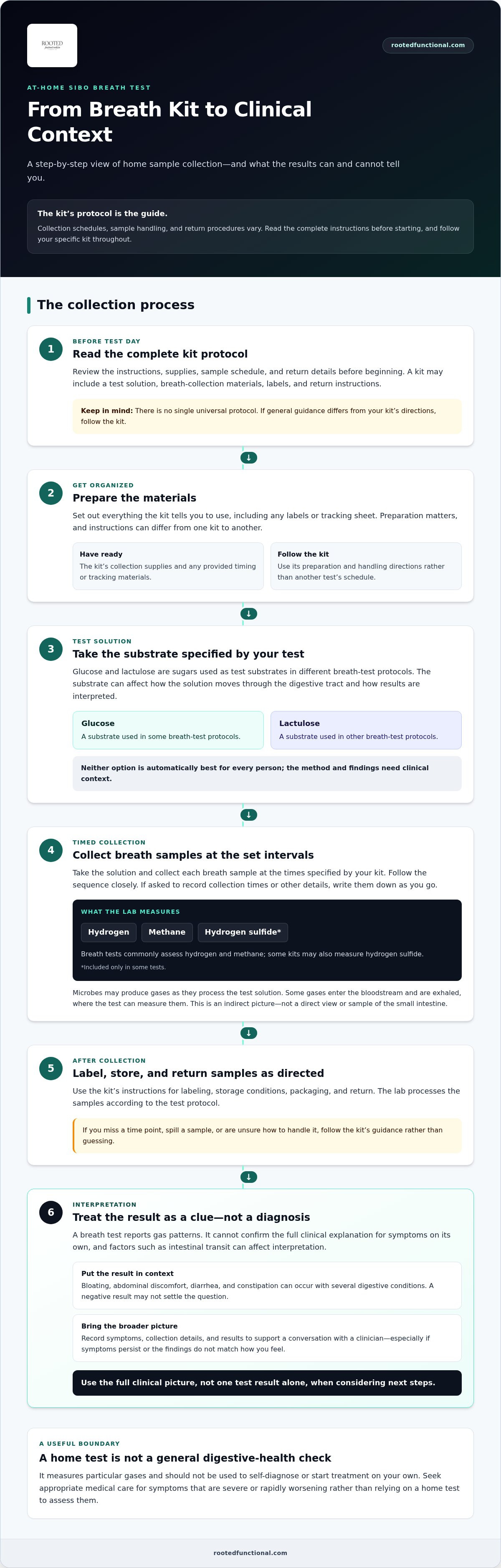
Home collection follows a planned sequence, but there isn’t one universal protocol for every SIBO breath test. A kit may contain a test solution, breath-collection materials, labels, and instructions for returning samples. Read the full guide before starting so you know what the kit requires and have the materials ready. If general guidance differs from your kit’s directions, follow the kit. While at-home kits are delivered directly to patients, clinics and screening facilities sourcing professional diagnostic testing supplies often partner with distributors like pointofcaremedical.com.
The steps below explain the process; your kit’s instructions determine exactly how to complete it. Collection times, sample handling, and return procedures can vary. Don’t substitute another kit’s directions or rely on a generic online schedule.
What usually happens during home collection?
In broad terms, you take the test solution and collect breath samples at intervals specified by the kit. Follow the sequence closely and use any provided timing or tracking materials. If the instructions ask you to record collection times or other details, write them down as you go instead of relying on memory.
Label and store each sample exactly as directed. Packaging, storage conditions, and return methods vary by kit, so review those instructions before collecting. The lab then processes the returned samples according to the test protocol. If you miss a time point, spill a sample, or aren’t sure how to handle it, follow the kit’s guidance rather than guessing.
What do glucose and lactulose mean in a breath test?
Glucose and lactulose are test substrates, or sugars used in different breath-test protocols. After a person takes the solution, the test measures gas levels in breath samples collected over time. The substrate can affect how the solution moves through the digestive tract and how results are interpreted. Neither option is automatically best for every person; the method and findings need to be considered in clinical context.
Use this checklist to keep the process organized:
Read the complete protocol. Review the instructions, supplies, sample schedule, and return details before test day.
Prepare the materials. Set out everything the kit tells you to use, including labels or a tracking sheet.
Follow the collection sequence. Take the solution and collect each sample at the times specified for your kit.
Check each sample. Label and store it as instructed, and note any collection issue the kit asks you to record.
Return the samples as directed. Follow the kit’s packaging and mailing instructions so the lab receives them according to its process.
If you’re learning how to test for SIBO at home, remember that careful collection supports a usable result, but doesn’t explain what that result means for your health. To discuss test details alongside persistent symptoms, you can book a consultation to discuss your symptoms and findings.
How Reliable Are Home SIBO Tests, and What Can Skew the Result?
A positive result can feel like an answer. A negative one can feel like a dead end. Neither should settle the question on its own. Breath tests measure gases in exhaled air after a test solution, so they provide an indirect signal rather than a direct sample of the small intestine. Both the way the test is performed and how the findings fit your symptoms matter.
Test reports may show hydrogen or methane levels over time, sometimes with another gas depending on the kit. A rise or level may meet a threshold used by a particular protocol, but a threshold isn’t a complete clinical assessment. For example, the North American Consensus describes a hydrogen rise of at least 20 parts per million above baseline within 90 minutes, or methane of at least 10 parts per million at any point, as criteria used in breath-test interpretation. A clinician still needs to consider the method, your history, and your symptoms.
Why can breath-test results be difficult to interpret?
Kits can differ in the gases they measure, the test solution they use, and the timing of samples. A report from a test measuring two gases may not answer the same questions as one measuring additional gases. Interpret results and cutoffs using the specific kit’s protocol rather than treating them as interchangeable.
Transit timing adds another layer. The test solution moves through the digestive tract, and the timing of that movement can influence when gases appear in breath. If it reaches the large intestine sooner than expected, for example, a rise in gas may be harder to attribute to one location based on the breath curve alone. Transit varies between people, so this is a consideration, not proof that a result is wrong.
A breath-test result is more meaningful when interpreted alongside your symptoms, health history, and the test protocol. A gas pattern can support a clinical discussion, but it can’t establish one cause for every digestive symptom.
What does a negative or unexpected result mean?
A negative result may be reassuring, but it doesn’t rule out every digestive condition or explain persistent symptoms by itself. The test measures specific gases under specific conditions. It may not capture every relevant factor, so consider the result alongside the collection process and your symptom pattern.
If the findings surprise you, bring the complete report and kit details to a qualified clinician. Note whether you followed the protocol and whether anything disrupted collection. This context can help clarify what the result may suggest and what remains uncertain. If the result and your symptoms don’t seem to match, that mismatch is useful information to discuss, not a reason to dismiss how you feel.
Learning how to test for SIBO at home can help you collect information, but a home result alone isn’t a reason to start treatment. Decisions should account for the whole clinical picture, including symptoms, history, and other possible explanations.
How to Prepare for a Home SIBO Test Without Compromising the Collection
Preparation can affect whether a breath-test sample is useful, but there isn’t one set of rules for every kit. Diet, fasting, medication, supplements, and timing instructions may vary. Use the directions supplied with your test, and resolve questions before collection day rather than filling gaps with advice meant for a different kit.
What should you check before test day?
Read the complete instructions, including preparation steps, sample timing, storage details, and return requirements. If the directions mention a prescribed medication, recent treatment, or supplement, ask the clinician who ordered the test how the instructions apply to you. Don’t stop or change a prescribed medication on your own. Note your current symptoms and any recent changes that may be useful to discuss when the results are reviewed.
This checklist can help you prepare without relying on memory:
Review the full protocol. Mark the required preparation, collection sequence, and sample return steps.
Gather the kit materials. Check that the test solution, collection supplies, labels, and instructions are ready.
Clarify personal questions. Ask the ordering clinician about medication changes or recent treatment that could affect your timing.
Keep brief notes. Record symptoms and relevant recent changes for your follow-up conversation.
On collection day, follow the kit’s sequence and timing closely. Keep the instructions and any required tracking materials nearby. Record details as directed, then label and store each sample exactly as specified. After collection, use the kit’s packaging and return instructions. Don’t assume another brand’s preparation schedule or sample-handling advice applies to your test.
What should you do if you miss a step?
Pause before improvising. If you miss a collection time, spill a sample, or realize you didn’t follow a preparation instruction, check the kit’s troubleshooting guidance. Record what happened accurately, including the step and approximate timing if you know it. Then follow the support route stated in the kit or ask the ordering clinician what to do next. Guessing or silently changing the sequence can make the collection harder to interpret.
That doesn’t mean every small deviation automatically makes a test unusable. The next step depends on the kit’s protocol and what happened. Be specific when you report it, and keep your notes with your test records so the clinician can consider them alongside the findings.
If you’re learning how to test for SIBO at home, preparation is part of collecting meaningful information, not a reason to adjust medication or follow a generic online protocol. For help discussing persistent symptoms and test-related questions in context, book a root-cause consultation.
Next Steps After an At-Home SIBO Test: Clinical Context
When your report arrives, don’t let one result make the whole decision. A breath test can add information, but it needs to be understood alongside your symptoms, health history, collection details, and other possible explanations. A positive result doesn’t automatically explain every symptom, and a negative one doesn’t make persistent discomfort less real.
Symptoms such as bloating can occur with different digestive concerns. If that’s part of your experience, What Causes Bloating? The Root Cause Guide to Lasting Relief offers another perspective on possible causes. Treat your test as one piece of the story, then bring the full picture into a clinical conversation.
What should you bring to a results discussion?
Having your records together can make the conversation more focused. Gather the lab report, kit protocol, and any notes about collection timing or issues. Add a simple symptom timeline, including when symptoms began, how often they occur, and any recent changes you’ve noticed.
Ask what the result can establish. How does the specific test protocol shape what the findings mean?
Ask what remains uncertain. Could the result account for your symptoms, or are other explanations worth considering?
Share the full context. Mention relevant health history, recent changes, and any collection problems or missed steps.
These questions can help you understand what the result does and doesn’t say in your situation. They also make room to discuss whether further evaluation is appropriate. Treatment decisions should reflect the whole clinical picture, not a home-test result in isolation.
When can a root-cause consultation help?
If symptoms continue or your report leaves you unsure what to do next, a consultation can provide space to review your concerns and relevant history. At Rooted Functional Medicine, Dr. Adrienne Guthrie provides personalized, lab-guided care focused on investigating root causes of chronic symptoms. Your evaluation is considered in individual context, without assuming that one test or explanation fits everyone.
Learning how to test for SIBO at home can help you collect useful information. The next step is making sense of it alongside how you feel and your broader health history. A Root Cause Consultation is one option for discussing persistent symptoms and placing findings in context.
Book a root-cause consultation to discuss your symptoms and test findings.
Choose a Clear Next Step
Living with unresolved digestive symptoms can leave you searching for certainty. Knowing how to test for SIBO at home may help you gather useful information, but you don’t have to turn a result into a conclusion on your own. Keep asking questions when your symptoms and test findings don’t seem to line up.
For your next conversation, focus on what you most want help understanding. That might be how symptoms affect your daily life, what a result means in your situation, or what other factors deserve attention. Personalized, lab-guided functional medicine care can help put health concerns into an individual context. Secure telehealth appointments are available nationwide.
You deserve to have your concerns taken seriously. Keep moving toward clarity one thoughtful step at a time.
Frequently Asked Questions
How long does an at-home SIBO breath test take?
The collection period depends on the kit, so check its schedule before setting aside time. Some protocols involve repeated samples over several hours, while others may be shorter. Allow time to follow preparation directions and complete labeling or return steps, too. The kit’s stated duration is the best guide for planning your day. Don’t rely on another test’s timeline, even if it uses a similar collection method.
Can insurance cover an at-home SIBO breath test?
At-home SIBO tests generally aren’t covered upfront, but coverage and reimbursement depend on your plan. Some people with PPO coverage may be able to submit a superbill for possible partial reimbursement. HSA or FSA funds may be accepted by some test providers. Before ordering, review your plan’s rules and the kit provider’s payment information so you understand what documentation may be needed and what costs you may be responsible for.
Can medications affect a SIBO breath test?
Some medications or recent treatments may affect test timing or interpretation. Which ones matter depends on the kit protocol and your health situation. Don’t stop, pause, or change prescribed medication without guidance from the clinician who prescribed or ordered it. Share a current medication and supplement list, including recent antibiotics or medicines that affect digestion, and ask whether any changes to test timing are appropriate for you.
Can I take a SIBO breath test if I am pregnant?
Ask your pregnancy care clinician and the test’s ordering clinician before taking a SIBO breath test while pregnant. They can consider your symptoms, the test solution, and whether testing is appropriate at this time. Don’t assume a home test is suitable just because it’s collected outside a clinic. If you’re pregnant and experiencing new or concerning digestive symptoms, discuss them with your care team rather than relying on a home result.
Does a SIBO breath test diagnose IBS?
No. A SIBO breath test measures gas patterns after a test solution; it doesn’t diagnose irritable bowel syndrome (IBS). Digestive symptoms can overlap across IBS and other conditions, so a breath-test result can’t determine the cause on its own. If you’ve been told you may have IBS or are exploring that possibility, discuss your symptoms and relevant history with a clinician. They can help clarify what evaluation may fit your situation.
Does a stool test show whether I have SIBO?
A stool test isn’t a direct substitute for a SIBO breath test. Stool testing examines a bowel movement sample, while a breath test measures gases in exhaled air after a test solution. They provide different kinds of information, and neither result should be treated as a complete explanation of symptoms by itself. If you already have stool-test findings, bring the report to a clinician and ask how it fits with your symptoms and other results.
What should I do if my home test result does not match my symptoms?
Bring the result to a qualified clinician and explain what feels inconsistent. For example, note if symptoms continue despite a negative report, or if a positive result doesn’t seem to fit your experience. If you’re learning how to test for SIBO at home, remember that the result is only one part of the picture. Share the report, collection notes, symptom timeline, and relevant health history, and ask what other explanations or evaluations may be worth considering.