Neuropathy Root Cause Testing: The Essential Guide to Functional Lab Work in 2026
- Aug 4
- 13 min read
What if your "normal" lab results are actually the reason you are still in pain? It is a heartbreaking reality for many of the 20 million Americans living with nerve damage. You know the burning and tingling in your feet are real. Yet, your doctor looks at a standard blood panel and tells you everything is fine. This gap in care is why neuropathy root cause testing is so critical. You are likely tired of being dismissed or told that a lifetime of symptom-masking drugs is your only option. It feels like you are just waiting for the damage to become permanent.
We understand this frustration deeply. You deserve answers that go beyond just dulling the pain with another prescription. This guide explores the advanced functional labs that traditional medicine often ignores, including tests for cellular health, hidden toxicities, and chronic inflammation. We will dive into why standard tests often miss the mark and provide a clear list of labs you can request. You will gain a better understanding of your body and a defined path toward real nerve regeneration.
Alongside these advanced diagnostics, maintaining the physical health of your feet with professional services like Footfall Podiatry is a vital part of a holistic recovery plan.
Table of Contents
Beyond the Diagnosis: Why Standard Neuropathy Testing Often Falls Short
You finally have a name for the burning, tingling, or numbness in your feet. Your doctor calls it peripheral neuropathy. For many, this feels like a relief at first. Finally, someone believes the pain is real. But a name is not a solution. It is just a description of your misery. For a comprehensive overview of peripheral neuropathy, you can see how it involves damage to the nerves outside the brain and spinal cord. Knowing your nerves are damaged is only the beginning. It doesn't tell you how to stop it.
Most patients start with an Electromyography (EMG) or a Nerve Conduction Study (NCS). These tests are useful for one thing. They measure how fast your nerves send signals and how your muscles respond. They confirm that damage exists. They do not, however, tell you why the damage started in the first place. This is the investigative gap. Conventional medicine focuses on the "what," but neuropathy root cause testing focuses on the "why." You cannot fix a problem you don't fully understand.
The Problem with Diagnostic-Only Testing
Confirming nerve damage does not stop the damage from progressing. It just documents the decline. If your doctor cannot find a clear reason like advanced diabetes, they often use the word "idiopathic." This is a fancy way of saying they don't know what's wrong. It is a label that feels like a dead end for your hope. Idiopathic neuropathy is a failure of investigation, not a lack of cause. You deserve more than a label that dismisses your suffering. You deserve a deep dive into your biology to find the actual triggers.
Why Your "Normal" Labs Might Be Lying to You
Have you been told your blood work is "perfect" while your feet feel like they are on fire? It is a common, heartbreaking experience. Most conventional doctors look at fasting glucose, A1c, and B12 levels. These are important, but they only catch the most obvious cases. Lab reference ranges are based on a bell curve of the average population. Unfortunately, the average person is not vibrant or healthy. There is a massive difference between being "not diseased" and being "functionally healthy."
The emotional toll of being told "everything is fine" when you are in pain is exhausting. It makes you feel like the problem is in your head. It isn't. Your body is sending a signal. We listen to that signal. We look for the subtle shifts in your cellular health before they turn into a crisis. We find the fires before they burn the whole house down.
Essential Functional Labs for Neuropathy Root Cause Testing
Standard blood work is just the surface. To find the "why" behind your pain, we need a deeper investigative protocol. While standard diagnostic tests for peripheral neuropathy focus on the severity of existing damage, functional labs look at the biological environment that allowed that damage to happen. This is the heart of neuropathy root cause testing. We search for the biological fires that are currently burning. We identify the triggers. We build a plan to put them out.
Metabolic Markers You Actually Need
Hemoglobin A1c is a lagging indicator. It tells us what happened to your blood sugar over the last three months. It is often too late by the time it looks "bad." Fasting Insulin and the HOMA-IR calculation tell us what is happening right now. Insulin resistance is a primary driver of nerve inflammation. Even if your blood sugar is in the "normal" range, high insulin levels can be toxic to delicate nerve endings. We also monitor Lactate Dehydrogenase (LDH). This marker signals tissue breakdown and cellular stress. If your LDH is elevated, your body is telling us that your cells are struggling to survive. We also look at your triglyceride to HDL ratio. This simple calculation is a powerful predictor of metabolic health and nerve vulnerability. It helps us see the risk before the damage becomes permanent.
Nutrient Deficiencies: Digging Deeper than B12
Serum B12 tests are notorious for being inaccurate. You can have plenty of B12 in your blood but almost none in your cells. Methylmalonic Acid (MMA) is the true gold standard. It only rises when your cells are actually starving for B12. We also investigate B1 (thiamine) and B6 levels. B1 is crucial for nerve energy production. Conversely, both too much and too little B6 can cause neuropathy symptoms. We must find the balance. Folate metabolism is another piece of the puzzle. If you have an MTHFR gene mutation, your body struggles to process folate. This directly affects the protective myelin sheath around your nerves. Without that protection, your nerves are exposed and vulnerable. Vitamin D3 is also essential for nerve repair and immune modulation. We don't guess. We test.
Inflammation is the final piece. We test for hs-CRP, Homocysteine, and Ferritin. High homocysteine is directly toxic to your nerves and blood vessels. Elevated Ferritin and hs-CRP signal that your immune system is in a state of high alert. This constant inflammation prevents your nerves from healing. Our Root Cause Consultation helps prioritize these specific markers based on your unique history. It is the first step in moving from confusion to a clear, clinical plan for restoration. You don't need every test. You need the right ones. Real answers are available. We are here to help you find them.
Advanced Testing: Toxicity, Cellular Health, and Autoimmune Triggers
You have checked your blood sugar. You have looked at your B vitamins. If you are still in pain, it's time to look at the environment your nerves live in. True neuropathy root cause testing requires us to investigate the toxins and triggers that hide deep within your tissues. Nerves are delicate. They are especially vulnerable to the "silent" stressors that conventional medicine rarely checks. We need to see if your body is carrying a burden it can no longer manage.
The Toxic Burden and Nerve Damage
Toxins have a preference for fatty tissues. Your nerves are wrapped in a protective layer of fat called the myelin sheath. This makes them a primary target for heavy metals like lead, mercury, and arsenic. These metals don't just sit there. They actively interfere with nerve signaling and cause physical decay. Most standard doctors only use blood tests for metals. This is a mistake. Blood tests only show recent exposure. To see what is actually stored in your tissues, we often recommend provoked testing. This gives us a much clearer picture of your lifetime toxic load. Environmental toxins like mold (mycotoxins) and pesticides also create a state of chronic nerve inflammation. If we find these triggers, our Cellular Detoxification Program becomes a vital part of your recovery. We help your body safely clear these poisons so your nerves can finally begin to heal.
Hidden Autoimmune and Gut Triggers
The health of your gut is inseparable from the health of your nerves. We frequently test for intestinal permeability, also known as leaky gut. When your gut lining is compromised, undigested food particles and toxins enter your bloodstream. This triggers a systemic immune response that can lead to the production of neuro-antibodies. These are immune cells that mistakenly attack your own nerve tissue. While the diagnosis and treatment of peripheral neuropathy often focuses on managing the resulting pain, we focus on stopping the attack at the source. Our Food Sensitivity Testing is a powerful tool here. Food sensitivities can trigger a systemic immune response that keeps your nervous system in a state of constant high alert. By identifying these triggers, we can calm the immune system and stop the cycle of damage. We also measure oxidative stress markers to see exactly how much damage is happening at the cellular level. This isn't just about finding a name for your pain. It is about uncovering the biological fires that are burning your nerves.
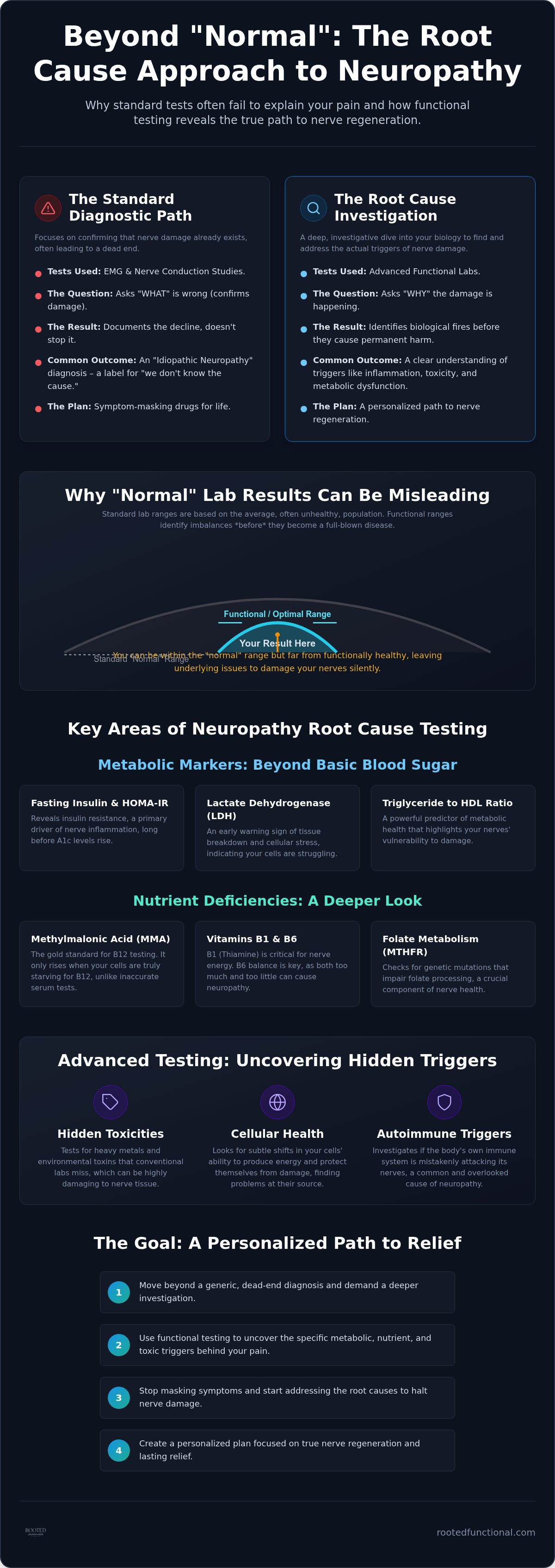
Interpreting Your Results: Why "Normal" Doesn't Mean "Healthy"
It's the most common story we hear. You feel the fire in your feet. You feel the numbness climbing your legs. Yet, your doctor says your labs are "fine." This happens because conventional labs use a bell curve. They compare your results to the average person walking into a hospital. In our country, the average person is not healthy. They are often struggling with chronic inflammation or metabolic dysfunction. If you are just like the average person, you are "normal" by their standards. But you don't want to be average. You want to be well. You want your life back.
This is why neuropathy root cause testing uses functional ranges. We don't wait for a disease to be fully formed before we act. We look for the subtle shifts that indicate your nerves are starving or under attack. For example, many labs say a B12 level of 300 is acceptable. In a functional model, we know that nerves start to suffer when B12 drops below 500 or 600. If your level is 300, your nerves are starving. Your labs aren't fine. They are a warning sign that your doctor is trained to ignore until it becomes a crisis.
Functional Ranges for Key Neuropathy Markers
We look for patterns. A single borderline result might not mean much on its own. But three or four borderline results tell a clear story of decline. We use tighter targets to identify issues before they become permanent damage.
Homocysteine: Conventional medicine often allows levels up to 15. We look for a target under 7 to ensure your blood vessels and nerves are protected from oxidative stress.
Vitamin D: For true nerve regeneration, we look for levels between 60 and 80 ng/mL. The standard range often starts as low as 30, which is barely enough to maintain bone health, let alone repair a nervous system.
Ferritin: We want to see this marker of iron storage and inflammation in a very specific window. Too high signals a biological fire. Too low signals that your nerves aren't getting the oxygen they need to survive.
Reading these reports doesn't have to be overwhelming. We help you see the forest through the trees.
The Importance of Lab-Based Protocols
Stop guessing. Many people start taking high doses of B6 or random supplements because they read a success story online. This can be dangerous. Excessive B6 can actually cause more nerve damage. You need a protocol based on your specific biology. This "test, don't guess" approach is the only way to ensure you are helping rather than hurting. Dr. Adrienne Guthrie specializes in interpreting these complex interactions. She sees the connections between your gut, your toxins, and your nervous system that others miss. You can start this investigative journey today by booking a Root Cause Consultation. Let's find the real answers together.
Taking the Next Step: Your Path to Nerve Regeneration and Relief
You have spent years managing symptoms. You have tried the drugs that only mask the pain. Now, you have the knowledge to look deeper. The journey from chronic pain to nerve regeneration begins with a single, investigative step. We don't just want to tell you what is wrong. We want to show you how to fix it. This is why we offer a Root Cause Consultation. It is a comprehensive deep dive into your unique biology. Unlike a standard 15 minute GP visit, we take the time to listen to your entire story. We look at the connections between your gut health, your toxic load, and your nervous system.
This level of detail is what makes neuropathy root cause testing so effective. We aren't just looking at your feet; we are looking at your life. We offer these evaluations through our nationwide telehealth options, so you can get expert care regardless of where you live. You deserve a partner who is as committed to your recovery as you are. We don't stop until we find the biological fires that are causing your nerves to suffer, and you can learn more about Family First Chiropractic and Acupuncture to see how integrative treatments support your path to wellness.
Preparing for Your Root Cause Consultation
Preparation is the key to a successful evaluation. Start by gathering your past lab results from the last two years. Even if they were called "normal," we want to see them. We look for the trends and patterns that others missed. You should also map out your symptom timeline. When did the tingling start? Was it after a period of high stress, a new medication, or an illness? Connecting these dots helps us identify the exact moment your body began to struggle. This investigative approach is the hallmark of functional medicine. It turns your history into a roadmap for your future.
Healing is Possible: The Rooted Approach
There is a common myth that nerve damage is always permanent. This is simply not true. Nerves have an incredible ability to heal when you remove the offending triggers. If we find heavy metals, we use our Cellular Detoxification Program. If we find nutrient gaps, we use targeted supplementation to flood your cells with what they need. We integrate clinical nutrition to calm systemic inflammation and support the myelin sheath. We move through this process step by step, ensuring your body has the resources it needs to repair itself naturally.
If you aren't ready for a full consultation yet, that is okay. You can still start your education today. Our Healing Neuropathy Webinar is a low-pressure way to learn more about our protocols. It explains the science of nerve repair in a way that makes sense. You don't have to live in fear of permanent damage. You don't have to rely on pills that only cloud your mind. There is a path forward. We are ready to walk it with you.
Your Journey Toward Real Healing
You have lived with the "idiopathic" label for long enough. You have been told to accept the burning and numbness as your new normal, but the clinical reality of 2026 tells a different story. True recovery isn't found in a pill bottle. It is found by digging into your unique biology through neuropathy root cause testing. By uncovering hidden toxicities, metabolic fires, and cellular starvation, we can finally stop the guesswork that has kept you in pain.
Dr. Adrienne Guthrie, recognized as the Best Emerging Leader in Functional & Natural Medicine 2025, has developed specialized autoimmune and neuropathy protocols to help you move beyond symptom management. Whether you are nearby or need our nationwide telehealth support, we are here to guide you. You don't have to walk this path alone anymore. It is time to stop masking symptoms and start restoring your health.
Your nerves have a remarkable capacity to repair themselves once the triggers are removed. Let's find those triggers together. You don't have to settle for "normal" results when you still feel unwell. You deserve to be heard, helped, and finally well.
Common Questions About Neuropathy Testing
Is neuropathy root cause testing covered by insurance?
Coverage for functional testing is often limited or unavailable through standard insurance plans. While Medicare Part B covers medically necessary standard tests like EMGs, specialized labs for heavy metals or gut health are typically out-of-pocket expenses. You should expect to pay for these advanced investigations yourself. This allows us to use the most precise tools without being restricted by insurance company mandates that only focus on symptom management.
Can I request these functional tests from my primary care doctor?
You can request these tests, but most primary care doctors are not trained to order or interpret functional labs. Conventional medicine focuses on managing symptoms rather than uncovering cellular triggers. A typical GP visit lasts about 15 minutes; this isn't enough time for the deep investigation required for neuropathy root cause testing. We recommend working with a practitioner who specializes in functional medicine to ensure your results are analyzed correctly.
How long does it take to get functional lab results back?
Most functional lab results take between two to three weeks to return from the laboratory. Some specialized panels, like those for environmental toxins or complex autoimmune markers, may take slightly longer. We use this time to begin reviewing your clinical history and symptom timeline. Once all data is in, we meet to discuss the findings and build your personalized restoration plan. Patience is a vital part of this investigative process.
What is the single most important test for neuropathy root causes?
There is no single "magic" test because neuropathy is a complex condition with many potential triggers. However, many practitioners consider a comprehensive metabolic assessment including fasting insulin and HOMA-IR to be foundational. These markers reveal early metabolic dysfunction that standard A1c tests often miss. We look at your body as a whole system. The most important test is the one that identifies your specific biological fire.
If my nerves are already damaged, will testing still help?
Yes, testing is essential even if you already have confirmed nerve damage. Identifying and removing the root cause is the only way to stop the damage from progressing further. Your nerves have a natural capacity to repair themselves once the toxic or inflammatory environment is cleared. Neuropathy root cause testing provides the roadmap for that healing. Without these answers, you are only treating the smoke while the fire continues to burn.
Can food sensitivity testing really help my nerve pain?
Food sensitivity testing is a powerful tool for reducing systemic inflammation that irritates the nervous system. When you eat foods that trigger an immune response, your body stays in a state of high alert. This constant inflammation prevents your nerves from repairing their protective myelin sheath. By removing these specific triggers, we calm the immune system and create an environment where nerve regeneration is actually possible. It is about removing the roadblocks to your recovery.
What happens if all my functional tests also come back normal?
It is very rare for every functional marker to be optimal when you are experiencing chronic pain. If your results appear "normal" at first glance, we dig deeper into the functional ranges rather than the broad hospital averages. We also look at the interaction between different markers. Pattern recognition is key. If a root cause remains hidden, we pivot our investigation to areas like oxidative stress or specific neuro-antibodies that require even more specialized testing.
How much does a typical functional neuropathy testing panel cost?
The cost of a testing panel varies depending on the complexity of your case. Individual tests can range from $80 for heavy metals to over $500 for a comprehensive gut health panel. Some advanced tickborne disease panels can cost nearly $2,000. We prioritize testing based on your specific history to ensure we are only ordering what is absolutely necessary. Investing in these answers now can save you years of expensive, ineffective treatments later.


Comments