Root Cause of Chronic Inflammation: What to Know in 2026
What if the root cause of chronic inflammation isn’t one hidden problem, but a combination of factors that needs to be understood in context? When fatigue, aches, digestive changes, or brain fog persist, it’s natural to look for one clear answer. These symptoms can have many explanations, though, and inflammation is a signal to investigate, not a diagnosis on its own.
It can be unsettling to read that inflammation is linked to serious disease, then wonder whether a blood test can reveal what’s happening in your body. Tests such as CRP and ESR can provide useful clues, but they don’t identify the cause by themselves. Your symptoms, health history, and other findings matter too.
This guide explains how acute and chronic inflammation differ, what conditions and health factors a clinician may consider, and what symptoms and tests can and can’t tell you. You’ll also learn how to prepare for a conversation about testing and next steps, so you can investigate persistent concerns without jumping to conclusions or overlooking the bigger picture.
Table of Contents
What Is Chronic Inflammation, and When Does It Become a Concern?
What Can Drive Chronic Inflammation? Conditions, Exposures, and Health Factors
Symptoms and Inflammation Tests: What They Can, and Cannot, Tell You
How to Investigate Possible Chronic Inflammation Without Guesswork
A Root-Cause Approach to Chronic Inflammation: Personalized Evaluation and Next Steps
What Is Chronic Inflammation, and When Does It Become a Concern?
Persistent fatigue, aches, or other changes can leave you searching for an explanation. They deserve attention, but they don’t automatically mean inflammation is present. These symptoms can have many causes, so avoid both extremes: assuming inflammation explains everything or dismissing your concerns because there’s no obvious swelling or redness.
Inflammation is part of the immune response to a threat, such as an infection or tissue injury. In the short term, it helps the body defend itself and begin repair. Concern may arise when the response continues longer than needed or becomes poorly regulated. Even then, inflammation is associated with some health conditions; it isn’t a universal explanation for disease. A clinician considers it alongside the whole picture.
How the immune response helps protect and repair the body
When immune cells detect a threat, they release signaling molecules that help coordinate the response. These signals can bring more immune cells to the affected area and support processes involved in containing infection or repairing damage. For example, skin around a small cut may become temporarily red, warm, or swollen as the body responds.
Acute inflammation is a short-term immune response to a threat; chronic inflammation is prolonged or dysregulated immune activity that may persist after the initial need for the response has passed. This distinction matters: signs around an injury can be part of normal healing, while an ongoing response may need clinical attention. Ideally, the immune response changes as the trigger resolves. For a broader overview of how this process can continue, see this explanation of chronic inflammation.
What makes inflammation chronic rather than temporary?
Inflammation may persist if the original trigger remains, the body continues to encounter a harmful stimulus, or the systems that regulate the response aren’t working as they should. The pattern depends on the underlying context. A clinician may investigate possible causes rather than treating “inflammation” as a single condition with one standard explanation.
Chronic inflammation doesn’t always produce the familiar signs of an acute injury. There may be no visible redness or clear point of pain. Some people notice general symptoms, while others have few obvious clues. Fatigue or aches alone can’t confirm that inflammation is present, show where it may be occurring, or identify its cause. They’re starting points for assessment, not proof.
Consider an evaluation when symptoms persist, worsen, recur, or interfere with daily life. That doesn’t mean inflammation is the problem. It means your experience deserves a careful review, including its timing, pattern, and other health factors. If inflammation is present, its root cause can’t be established from symptoms alone. Understanding that distinction helps you ask better questions without jumping to a diagnosis.
What Can Drive Chronic Inflammation? Conditions, Exposures, and Health Factors
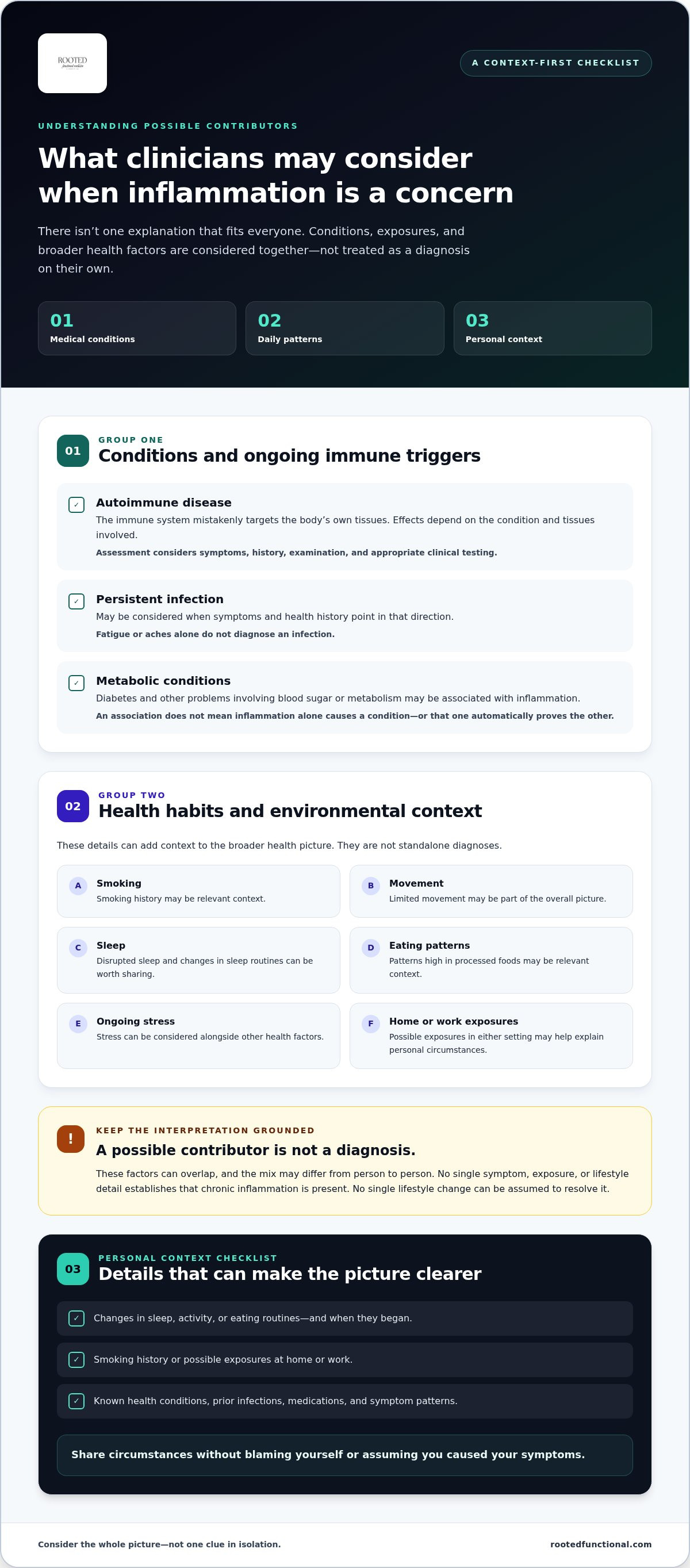
There isn’t one explanation that fits everyone. Clinicians may look at diagnosed conditions, ongoing exposures, and broader health factors to understand what could be contributing to inflammation. These categories can overlap: a medical condition may interact with sleep, activity, or other aspects of a person’s circumstances.
Chronic inflammation can have multiple contributing factors, and the mix may differ from person to person. A potential driver should be considered in context, not treated as a diagnosis based on a symptom or a single test result. Harvard Health on chronic inflammation also describes how health conditions and other influences may be relevant.
Medical conditions and persistent immune triggers
Some medical conditions can involve ongoing immune activity. With autoimmune disease, the immune system mistakenly targets the body’s own tissues. The effects depend on the condition and the tissues involved, so evaluation relies on the person’s symptoms, medical history, examination, and appropriate clinical testing.
A persistent infection may also be considered when symptoms and history point in that direction. It’s a possibility for a clinician to assess, not something to diagnose from fatigue or aches alone. Metabolic conditions, including diabetes and other problems involving blood sugar or metabolism, may also be associated with inflammation. That doesn’t mean inflammation alone causes these conditions, or that one automatically proves the other.
In practice, clinicians weigh clues together. A known autoimmune condition, recent or recurring infections, and metabolic health may each shape what questions or tests make sense. They don’t all apply to every person.
Health habits and environmental context
Daily patterns can add useful context, but they aren’t standalone diagnoses. Smoking, limited movement, disrupted sleep, and eating patterns high in processed foods may be relevant parts of a broader health picture. So may ongoing stress or exposures in a person’s home or workplace. These factors don’t establish that chronic inflammation is present, and no single lifestyle change can be assumed to resolve it.
Share details that help explain your circumstances, without blaming yourself or assuming you’ve caused your symptoms. For example, mention:
Changes in sleep, activity, or eating routines, and when they began.
Smoking history or possible exposures at home or work.
Known health conditions, prior infections, medications, and symptom patterns.
These details can help a clinician decide what deserves closer investigation and what may be unrelated. The goal isn’t to chase every possible factor. It’s to build a grounded picture of your health and choose next steps based on your individual needs. For an individualized review, a Root Cause Consultation can include a review of health history alongside interpreted lab findings, without assuming there is one guaranteed explanation.
Symptoms and Inflammation Tests: What They Can, and Cannot, Tell You
Inflammation doesn’t always announce itself in the same way. A cut may cause localized redness, warmth, swelling, or tenderness. These signs can reflect a short-term response in a specific place. By contrast, symptoms sometimes associated with longer-lasting inflammation can be broad, such as fatigue, low energy, or aches. They’re also common in many other situations, including sleep disruption, infection, medication effects, and other health conditions.
A symptom can occur alongside inflammation without proving inflammation caused it. Even when inflammation is found, an association doesn’t establish whether it contributed to a condition, resulted from it, or appeared at the same time. The goal is to connect the clues carefully, not make a diagnosis from a symptom list.
Can chronic inflammation exist without obvious symptoms?
Sometimes there are no clear outward signs, or symptoms are subtle and nonspecific. In other cases, a person may have signs related to a particular underlying condition. Neither pattern can confirm chronic inflammation by itself. Fatigue, pain, and low energy deserve to be taken seriously, but they can’t identify inflammation or reveal its source on their own.
Arrange a clinical assessment if symptoms persist, worsen, or remain unexplained. Bring details about their onset, frequency, and effect on daily activities. That history helps a clinician decide whether inflammation should be investigated and what other explanations need consideration.
What common blood markers show, and what they miss
Two commonly used blood tests are C-reactive protein (CRP) and the erythrocyte sedimentation rate (ESR). CRP measures a protein that can rise in response to inflammation. ESR measures how quickly red blood cells settle in a tube over a set period; inflammation can affect this rate. Both are broad indicators, not tests that point to one specific condition or location in the body.
An inflammatory marker is evidence to interpret, not a standalone diagnosis. An elevated result can have different explanations, including a recent infection or another inflammatory process. A result within the reference range may be reassuring in context, but it doesn’t answer every clinical question or rule out every condition. Its meaning depends on the person, the test, and the reason it was ordered.
Clinicians choose tests based on your health history, examination, symptoms, and specific concerns. They may consider whether a marker fits the overall picture, whether other findings point in another direction, and whether follow-up is appropriate. A number outside a reference range isn’t automatically proof of disease, just as a normal number isn’t a complete account of your health.
If results leave you unsure, ask what question the test was meant to answer, what other explanations could affect the finding, and how it fits with your symptoms. Finding the root cause of chronic inflammation, when inflammation is present, takes more than identifying a marker. It calls for interpreting results alongside your clinical history and the rest of the evidence.
How to Investigate Possible Chronic Inflammation Without Guesswork
Uncertainty can make it tempting to order a wide range of tests or try several changes at once. A steadier approach is more useful: record what’s happening, review relevant health context, seek an appropriate clinical assessment, then interpret any findings with a clinician. This helps connect symptoms to the right questions instead of treating a result as an answer by itself.
Prepare a useful symptom and health-history record
Before an appointment, note when symptoms began, how long they last, how often they occur, and what seems to ease or worsen them. Include how they affect sleep, work, movement, or other daily activities. A simple dated log is enough. It doesn’t need to prove a pattern; it gives you and your clinician something specific to review.
Bring a current list of medications and supplements, diagnosed conditions, relevant family history, and any recent infections or possible exposures. Include routine changes that seem important. These details may help guide the discussion, but don’t assume one event or exposure explains your symptoms.
Build a clinician-led evaluation plan
A clinician can review your history, examine you, and decide whether testing is appropriate. Tests are most useful when they address a specific clinical question. Broad testing without a clear reason can produce findings that are hard to interpret or unrelated to your concerns. Ask what each proposed test is intended to clarify, how its result might affect next steps, and whether follow-up will depend on the findings.
Your evaluation may unfold over time. The next step can depend on your symptoms, examination, medical history, and initial test results. For more background on what a functional medicine doctor does, see What Is a Functional Medicine Doctor? The Root Cause Guide to Healing. A personalized approach can help organize relevant clues, but it can’t promise one explanation for every symptom.
Document: Record symptom timing, duration, patterns, and effects on daily life.
Review: Gather medications, supplements, diagnoses, family history, and relevant exposures.
Assess: Discuss the full picture with a qualified clinician before deciding on tests.
Interpret: Review results in context and agree on reasonable follow-up.
Don’t stop or replace prescribed treatment based on information you find online. Discuss concerns or potential changes with the clinician responsible for your care. Seek prompt medical attention for severe, alarming, or rapidly worsening symptoms rather than waiting for a routine appointment.
If you’d like help reviewing your health history and considering individualized next steps, you can book a Root Cause Consultation.
A Root-Cause Approach to Chronic Inflammation: Personalized Evaluation and Next Steps
After learning about possible contributors, you may still be asking what applies to you. A root-cause evaluation is a way to examine that question systematically. It can bring symptoms, health history, and relevant clinical findings into one conversation. It doesn’t assume there’s one hidden cause, promise a diagnosis, or guarantee symptom relief.
At Rooted Functional Medicine, Dr. Adrienne Guthrie’s Root Cause Consultation includes a review of your health history and advanced functional lab work that is ordered and interpreted as part of an individualized approach. The aim is to consider findings in context, not treat a lab result as a complete explanation. Secure telehealth is available nationwide.
What individualized root-cause evaluation can involve
An evaluation may begin with the concerns that led you to seek support: what symptoms you’ve noticed, when they began, how they’ve changed, and how they affect daily life. Your health history, existing diagnoses, medications, prior test results, and other relevant clinical information can add important context. These details help shape the questions worth exploring.
Lab work is not a universal panel applied to everyone. When advanced functional lab work is ordered, its purpose and interpretation should relate to the individual’s history and concerns. Results can contribute information for discussion and help inform care planning. They may also be inconclusive or point toward questions that require further clinical assessment. No single finding guarantees that the root cause of chronic inflammation has been identified.
Personalization matters because similar symptoms can have different explanations, and the same health factor may affect people differently. A careful review can help organize what is known, identify what remains uncertain, and consider reasonable next steps. It’s an investigation, not a promise of one definitive answer.
When to consider a Root Cause Consultation
If ongoing health concerns have left you wanting a more individualized review, a consultation can bring your history and relevant findings into one discussion. This approach should complement appropriate conventional evaluation, not replace it. Continue care for diagnosed conditions, and seek urgent medical attention for severe or rapidly worsening symptoms rather than waiting for a functional medicine appointment.
You can prepare by bringing a concise symptom timeline, a list of current medications and supplements, and copies of relevant health information. That gives the conversation a practical starting point. From there, Dr. Guthrie can consider your circumstances and discuss an individualized approach without assuming inflammation is the cause of every concern.
If you’re ready to explore whether this kind of personalized review fits your needs, Book a Root Cause Consultation.
Take the Next Step With Clarity
You don’t have to arrive with a diagnosis or a complete explanation. A useful next step can be bringing your questions and concerns into a conversation grounded in your individual health history. The root cause of chronic inflammation, if inflammation is part of your picture, is something to investigate thoughtfully rather than assume.
A Root Cause Consultation offers an opportunity to review your health history alongside advanced functional lab work that’s ordered and interpreted in context. Secure telehealth appointments are available nationwide. The goal is a clearer discussion of what may be relevant and what questions deserve attention, not a promised answer or outcome.
If you’re ready to explore a personalized clinical review, book a Root Cause Consultation. Your concerns deserve to be heard, and a careful next step can help you move forward with greater clarity.
Frequently Asked Questions
Is chronic inflammation always painful?
No. Chronic inflammation doesn’t always cause pain, and pain alone doesn’t show that inflammation is present. Some people notice symptoms tied to a specific condition, while others may not recognize a clear pattern. For example, joint discomfort can have several explanations, including injury or an existing joint condition. If pain is new, persistent, or changing, note where it occurs and what affects it, then discuss those details with a clinician.
Can you have chronic inflammation without knowing it?
Yes, it may not cause obvious or distinctive symptoms. A person might feel generally tired or notice changes that are easy to attribute to a busy schedule, but those experiences don’t confirm inflammation. Nor does feeling well prove that no health issue is present. Routine screening isn’t a substitute for a personal assessment. If you’re concerned because of a diagnosed condition or ongoing changes, ask a clinician whether evaluation makes sense for you.
What blood test checks for chronic inflammation?
There isn’t one blood test that confirms chronic inflammation and identifies its source. Clinicians may use C-reactive protein (CRP), high-sensitivity CRP (hs-CRP), or erythrocyte sedimentation rate (ESR), depending on the clinical question. These tests offer different kinds of information and aren’t interchangeable in every situation. If a result is flagged, ask what it means for your specific concern and whether it needs follow-up rather than interpreting the number alone.
Can chronic inflammation be cured?
There’s no single cure that applies to every case, because inflammation can be related to different conditions and circumstances. The appropriate goal depends on what evaluation shows and whether a specific underlying condition can be treated or managed. The phrase root cause of chronic inflammation doesn’t guarantee that one cause will be found or that addressing it will resolve every symptom. Work with a clinician on a plan suited to your diagnosis, health needs, and response over time.
Do anti-inflammatory foods reduce chronic inflammation?
Eating patterns rich in whole foods, such as Mediterranean- or DASH-style approaches, are associated with lower inflammatory markers, but food alone isn’t a cure or a way to diagnose inflammation. A practical start is to build meals around vegetables, fruit, beans, whole grains, nuts, and other foods you tolerate, while limiting heavily processed choices when possible. Keep medical care and any prescribed treatment in place, and discuss dietary changes if you have a health condition or specific nutritional needs.
When should I seek medical care for possible inflammation?
Arrange an assessment for symptoms that persist, worsen, return repeatedly, or interfere with daily life. Seek urgent medical care for severe or rapidly worsening symptoms, such as trouble breathing, severe chest pain, fainting, or new confusion. Don’t wait for an inflammation test to explain an emergency. For a non-urgent visit, bring a short timeline of symptoms and a list of medicines or supplements so the clinician can understand the change and advise on next steps.