Signs of an Unhealthy Gut: 10 Symptoms to Notice in 2026
Could recurring bloating, constipation, or fatigue point to a gut issue, or could something else be going on? The signs of an unhealthy gut can include changes in digestion and symptoms elsewhere in the body, but no single symptom can confirm what is causing them.
If digestive problems keep disrupting your day, it makes sense to look for a pattern. When skin changes, low energy, or mood shifts enter the picture, it can be hard to know whether they’re connected or happening at the same time. Your symptoms are real, but they can have more than one possible cause.
This guide covers 10 changes to notice, what they can and can’t tell you, and when to seek medical care. You’ll also learn how to track symptoms and prepare for an evaluation that considers your health history and, when appropriate, lab findings. Clues are a starting point, not a diagnosis. Context matters.
Table of Contents
What Are the Signs of an Unhealthy Gut? Common Symptoms to Notice
Recurring digestive symptoms can wear you down, especially when they have no clear explanation or keep returning after you’ve tried to manage them. You may also notice changes outside digestion and wonder whether they’re connected. The signs of an unhealthy gut are worth noticing, but symptoms alone can’t confirm a gut problem or identify its cause.
Digestive changes that may signal a problem
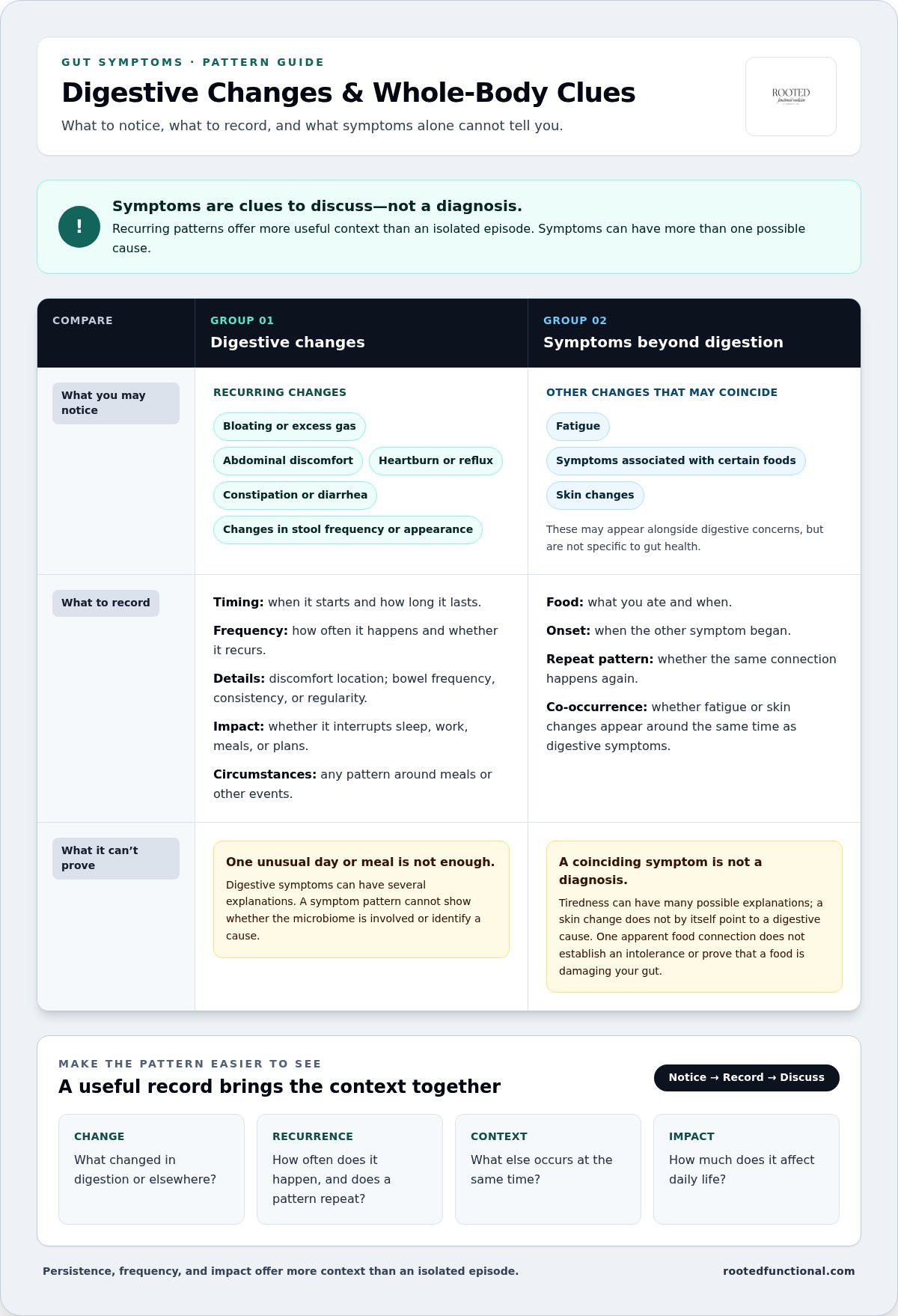
Notice recurring bloating, abdominal discomfort, excess gas, heartburn or reflux, constipation, diarrhea, and changes in stool frequency or appearance. These symptoms can have several explanations. A change after one meal, for example, doesn’t necessarily mean your gut or microbiome is unhealthy.
Bloating or gas: Note how often it happens, when it starts, and whether it follows a recurring pattern.
Abdominal discomfort: Record where and when you feel it, how long it lasts, and whether it affects daily activities.
Heartburn or reflux: Track how often it happens and whether you notice a pattern around meals or other circumstances.
Bowel changes: Keep track of shifts in frequency, consistency, or regularity rather than drawing conclusions from one unusual day.
Persistence, frequency, and impact offer more useful context than an isolated episode. A symptom that repeatedly interrupts sleep, work, meals, or plans deserves attention, even if it comes and goes. A brief record of what you experience and when can help distinguish a recurring pattern from a one-off change.
Whole-body symptoms that can accompany gut concerns
Some people also notice fatigue, symptoms they associate with certain foods, or skin changes. Record these alongside digestive symptoms, particularly if they appear around the same time. None is specific to gut health: tiredness can have many possible explanations, and a skin change doesn’t by itself point to a digestive cause.
Food-related reactions can be difficult to interpret, too. If discomfort or another symptom seems to follow a particular food, note what you ate, when the symptom began, and whether the pattern happens again. One apparent connection doesn’t establish an intolerance or prove that a food is damaging your gut. Avoid drawing firm conclusions from a single experience.
The digestive tract contains a community of microorganisms often called gut flora. Learning about it can provide useful background, but a symptom list cannot reveal what is happening in that community or whether it explains your experience.
Symptoms are clues to discuss, not a diagnosis. Consider the full pattern: what changed, how often it happens, what else occurs at the same time, and how much it affects your life. That context is more informative than labeling one symptom as proof of an unhealthy gut.
How Gut Health Connects With Digestion, Immunity, and the Brain
The gut does more than move food through the body. It contains a community of microorganisms, interacts with immune activity, and communicates with the nervous system. These connections help explain why gut health comes up in discussions of digestion and whole-body well-being—a relationship long recognized in holistic traditions and centers like Pranah Ayurvedic Medical Center. They don’t mean every symptom outside the digestive tract starts in the gut.
The gut microbiome is the community of microorganisms living in the digestive tract. It’s part of a larger system that includes organs, tissues, nerves, and other processes involved in digestion. Gut health isn’t simply a matter of having more “good” bacteria than “bad” bacteria. Microbes interact with food and the conditions in the intestines, and their effects depend on a person’s wider health and circumstances.
What the gut microbiome does
As food moves through the digestive tract, gut microbes interact with components of the diet and the intestinal environment. The digestive system breaks down food, absorbs nutrients, and moves waste. The microbiome contributes to this environment, but it doesn’t act alone or explain every variation in digestion.
That distinction matters when you’re trying to interpret the signs of an unhealthy gut. Bloating or a change in bowel habits can prompt questions about digestion, but symptoms can’t show whether the microbiome is involved, what is happening within it, or what should be done next. A symptom pattern is one piece of context, not a direct measurement of microbial activity.
The gut-brain and immune connections
Communication between the digestive system and the nervous system works in both directions. Signals can travel from the gut to the brain and from the brain back to the gut, influencing digestive activity and how sensations are experienced. This connection is one reason stress and digestive symptoms may coincide for some people. It doesn’t mean symptoms are “just stress,” or that a gut issue necessarily explains mood changes.
The gut also has immune activity. Immune cells and other processes help the body respond to what it encounters, while inflammation is shaped by a complex mix of influences. A change in gut microbes may be studied in relation to immune or inflammatory conditions, but a possible association isn’t proof that an imbalance caused a particular disease.
Gut microbes interact with food and the intestinal environment, and the gut communicates with the nervous and immune systems. Links between these functions and symptoms such as fatigue, mood changes, or skin concerns are complex and don’t establish a diagnosis.
If fatigue, mood changes, or skin symptoms appear alongside digestive concerns, record them as part of the overall picture, not as evidence of a specific gut problem. Persistent symptoms are best explored in context. A Root Cause Consultation can consider your health history, symptom patterns, and appropriate lab findings as part of an individualized evaluation.
When Gut Symptoms Need Attention: Red Flags and Other Possible Causes
Digestive symptoms can be uncomfortable without pointing to one clear cause. Some changes, however, deserve prompt attention. Knowing when to seek help is more useful than trying to match yourself to a list of signs of an unhealthy gut. A warning sign doesn’t prove you have a particular gut disorder, but it shouldn’t be ignored.
Symptoms that should not be ignored
Contact a healthcare professional promptly if you notice blood in your stool, severe or worsening abdominal pain, persistent vomiting, or unexplained weight loss. These symptoms can have different causes, and an individualized assessment is needed to understand what’s happening. Don’t assume they’re simply signs of an unhealthy gut.
Blood in stool: Seek medical advice rather than trying to explain it away based on other symptoms.
Severe or worsening pain: Arrange prompt evaluation, especially if the pain is intense or changing quickly.
Persistent vomiting: Get medical advice, particularly if you can’t keep fluids down.
Unexplained weight loss: Discuss it with a healthcare professional, especially if it continues without an intentional change in eating or activity.
Sudden, intense abdominal pain or signs of severe dehydration call for urgent medical care. If you’re unsure how serious a symptom is, seek professional guidance instead of waiting for a checklist to provide an answer. The goal is not to panic, but to respond to significant changes in a timely way.
Why similar symptoms can have different causes
Bloating, abdominal discomfort, diarrhea, constipation, and reflux can occur with more than one condition. Irritable bowel syndrome (IBS), gastroesophageal reflux disease (GERD), infections, medication effects, and other health concerns can have overlapping symptoms. Similar experiences don’t necessarily share the same cause, and a symptom checklist can’t reliably sort them out.
Context helps a clinician assess the pattern. Symptoms that begin after a recent illness may need to be considered differently from changes that develop after starting or changing a medication. Timing around meals, how often symptoms occur, whether they’re getting worse, and their effect on daily life can also provide useful information. Note relevant medication use and recent illness, but don’t stop a prescribed medication or make treatment changes without medical guidance.
Patterns are worth recording, not using to self-diagnose. Write down what changed and when, then share that history with a healthcare professional. Symptoms can be meaningful even if their cause isn’t obvious, and you deserve an evaluation that takes them seriously.
This article is for general education. It can’t diagnose a condition or replace individualized medical evaluation. If symptoms persist, worsen, or concern you, discuss them with an appropriate healthcare professional. Seek urgent care for emergency symptoms rather than relying on an online article or a routine appointment.
What to Do About Possible Signs of an Unhealthy Gut
Noticing possible signs of an unhealthy gut doesn’t mean you need to overhaul your diet or try supplements on your own. Start by gathering useful information: record what’s happening, add relevant context, look for patterns, and bring your concerns to a healthcare professional. These steps can make a conversation more focused without turning your notes into a self-diagnosis.
Track symptoms in a useful, low-pressure way
Keep a simple note on paper or on your phone. Record when a symptom starts, how often it occurs, how long it lasts, and how severe it feels. Include bowel changes and meals that seem relevant. Also note sleep, stress, medications, recent illness, or other changes that may help explain the timing.
Look for patterns over time, not certainty from one entry. A food and symptom record can help you describe what you’ve noticed, but it can’t prove that a food, the microbiome, or another factor caused a symptom. You don’t need to track every detail perfectly. A few clear observations are more useful than a complicated log that becomes stressful to maintain.
If bloating is your main concern, you can also explore this guide to what causes bloating for more context about that specific symptom.
Prepare for a productive healthcare conversation
Before an appointment, turn your notes into a short timeline. Include when the symptoms began, how they’ve changed, medications you take, and any prior evaluations or relevant recent illness. Focus on the details that seem most important. You don’t have to arrive with a theory about the cause.
Summarize the symptoms that affect you most and how they affect daily life.
Bring a current medication list and relevant records from prior evaluations.
Write down questions, such as how your symptoms will be assessed and what findings would guide next steps.
Steady, balanced habits can support general well-being while you seek answers. Aim for regular meals, adequate fluids, sleep, and movement that feels appropriate for you. Incorporating stress-reduction routines and supportive bodywork, such as remedial massage and family care from providers like bellafamilychiro.com, can also promote comfort while addressing broader wellness goals. Avoid starting a restrictive diet or supplement regimen based only on a symptom checklist, especially if it could complicate your health needs. A healthcare professional can help put possible changes in context.
Rooted Functional Medicine’s personalized approach considers your health history, symptom patterns, and appropriate lab findings as part of an evaluation. If you’d like to explore persistent concerns in context, book a personalized Root Cause Consultation.
How Rooted Functional Medicine Approaches Persistent Gut Symptoms
Recurring digestive symptoms can leave you wondering whether you’re missing an important clue. You don’t need to arrive with a diagnosis or a perfect explanation. At Rooted Functional Medicine, a Root Cause Consultation offers an individualized way to explore ongoing concerns by considering your health history, symptom patterns, and appropriate lab findings together.
What a root-cause evaluation can explore
Symptoms are considered in the context of the person experiencing them. When did they begin? How have they changed? What else was happening around the same time? This broader view can help guide questions about possible contributing factors without assuming that a symptom automatically points to one cause.
When appropriate, advanced functional lab work is ordered and interpreted alongside your history and symptoms. Testing is part of an evaluation, not a guarantee of a specific explanation or outcome. Learn more about the functional medicine root-cause approach and how it considers health concerns in context.
A clear next step when symptoms keep returning
Bring the notes you have, describe what has been difficult, and ask what information may help guide the evaluation. You don’t need to identify the cause yourself. The signs of an unhealthy gut can overlap with symptoms of other conditions, so a thoughtful assessment considers possibilities rather than treating a checklist as a diagnosis.
Dr. Adrienne Guthrie leads care at Rooted Functional Medicine. Secure telehealth appointments are available nationwide. A consultation is an evaluation process, not a promise that testing will find a particular cause or that symptoms will improve. It also does not replace urgent or emergency care, or primary care. Seek appropriate medical care for urgent symptoms or needs outside the scope of this consultation.
If symptoms keep returning and you’re ready to discuss them in context, book a Root Cause Consultation. Bring your questions and whatever notes you’ve gathered. The next step is a conversation about your individual history and possible paths for further evaluation.
Take the Next Step Toward Clarity
Uncertainty can make recurring symptoms feel even heavier. But you don’t have to decide for yourself what the signs of an unhealthy gut mean. A symptom is a reason to ask questions, not a verdict about your health. Your next step can be a conversation focused on your individual experience and the possibilities worth exploring.
You don’t need to have every detail figured out before seeking support. It’s enough to explain what’s concerning you and what you hope to understand. An individualized evaluation can help shape questions and guide thoughtful next steps, without assuming that one explanation fits everyone.
If you’re ready to explore persistent concerns with a root-cause perspective, book a personalized Root Cause Consultation. Dr. Adrienne Guthrie leads care, with secure nationwide telehealth and advanced functional lab work considered when appropriate. The process explores your situation without promising a diagnosis or outcome.
Your symptoms deserve attention, and seeking clarity is a meaningful step forward. Keep asking questions and advocating for care that considers the whole picture.
Frequently Asked Questions
Is one symptom enough to mean you have an unhealthy gut?
No. A single episode of bloating or an unusual bowel movement doesn’t establish that you have an unhealthy gut. Symptoms can follow an ordinary change in routine, a particular meal, or many other circumstances. Pay attention to whether the issue recurs, changes, or interferes with daily life. If it concerns you, describe what happened and when to a healthcare professional rather than trying to diagnose yourself from one symptom.
Can you have gut health problems without digestive symptoms?
It’s possible for a health concern involving the digestive system to be present without obvious digestive discomfort, and some people notice changes elsewhere instead. But fatigue, skin changes, or mood shifts don’t confirm a gut problem. They can have many explanations. If you have a concern despite having regular digestion, discuss the full picture with a healthcare professional rather than relying on nonspecific symptoms to identify a cause.
Can stress affect gut symptoms?
Yes, stress can coincide with changes in digestive symptoms because the gut and nervous system communicate in both directions. For example, you might notice symptoms change during a demanding week, but that timing alone doesn’t prove stress is the cause. You can note stressful periods alongside symptoms in your record. This information may help a clinician understand the pattern without dismissing your experience as “just stress.”
How long should I track gut symptoms before discussing them with a healthcare professional?
There’s no fixed tracking period you need to complete before asking for help. You can bring whatever notes you already have, even if they cover only a few days. A brief record of timing, frequency, and changes can be useful, but don’t delay seeking advice if symptoms are severe, worsening, or worrying. Tracking is a tool for the conversation, not a requirement or a test you have to pass.
Can gut symptoms be caused by medications or a recent illness?
They can be related to medication effects or changes after an illness, among other possibilities. Note when symptoms began and whether that timing followed a new medicine, a dose change, or getting sick. Share those details with a healthcare professional, including nonprescription medicines and supplements. Don’t stop or change a prescribed medication on your own; ask the prescriber how to handle symptoms and whether the medication could be relevant.
Are at-home gut microbiome tests enough to diagnose a digestive condition?
No. An at-home microbiome test can report information about a stool sample, but that result alone can’t diagnose a digestive condition or establish why you have symptoms. Results need careful interpretation, and a test may not answer the question you’re trying to resolve. Before changing your diet or taking supplements based on a report, discuss your symptoms and the test’s limits with a qualified healthcare professional.
What stool changes should prompt a call to a healthcare professional?
Contact a healthcare professional about blood in your stool, black or tarry stool, or a persistent change in your usual bowel pattern, especially if it comes with pain or other new symptoms. A single change can have different explanations, so stool appearance alone can’t identify a diagnosis. If bleeding occurs or symptoms are severe, seek prompt medical advice; sudden intense pain or signs of severe dehydration call for urgent care.