What Causes Blood Sugar Spikes? The Root Cause Guide to Metabolic Health
What if the "healthy" choices you make every day are actually the hidden drivers behind your afternoon energy crashes? It is deeply frustrating to feel like you are doing everything right only to be met with heavy brain fog and exhaustion. You deserve to know exactly what causes blood sugar spikes beyond just the food on your plate. Conventional medicine often fails here. It offers generic advice that leaves you feeling overlooked and unheard. I understand that struggle because I have been there too.
You want stable energy and a body that works with you. In this guide, we will uncover the hidden physiological drivers of your fluctuations. We will look past the surface to find the root causes living in your gut, your hormones, and your environment. You are going to learn how to restore metabolic balance through functional medicine. We are providing a clear roadmap to help you identify your unique triggers and finally reverse metabolic dysfunction for good. It is time to find real answers and reclaim your vitality.
Table of Contents
Understanding Blood Sugar Spikes: More Than Just a Number
A blood sugar spike is a rapid, sharp rise in glucose levels following a trigger. While most people associate these spikes with eating a candy bar, the reality is often much more complex. It is not just about the food. It is about how your body handles that food. Understanding what causes blood sugar spikes requires us to look deeper than your dinner plate. We have to look at your cellular machinery.
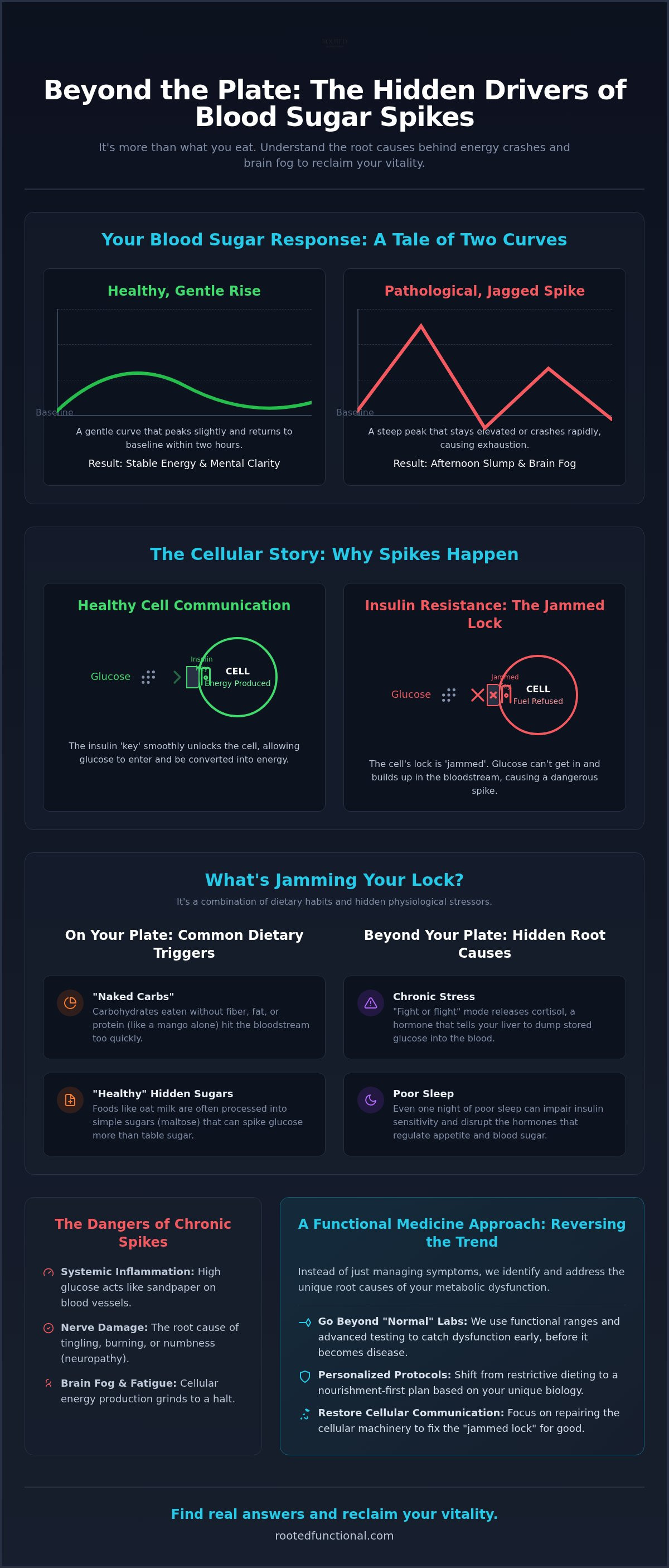
Think of insulin as a key. Its primary job is to unlock your cells so glucose can enter and be used for energy. In a healthy system, this process is smooth and efficient. When the lock is jammed, glucose cannot enter the cell. It stays trapped in your bloodstream instead. This state of elevated glucose is known as Hyperglycemia. It is a sign that the communication between your hormones and your cells has broken down.
Many of my patients feel deep frustration because they see spikes even on a "clean" diet. You might eat a salad and still feel that familiar post-meal brain fog. This happens because your metabolic health is not just about what you eat today. It is about how your body has been programmed to respond over time. There is a significant difference between a healthy rise and a pathological spike:
Healthy Rise: A gentle curve that peaks slightly and returns to your baseline within two hours.
Pathological Spike: A steep, jagged mountain peak that stays elevated or crashes rapidly, leaving you exhausted.
How Spikes Happen at the Cellular Level
Mitochondria are the power plants of your cells. They are responsible for turning glucose into usable energy. When these engines become overwhelmed by too much fuel, they send signals to stop the intake. This creates a state of cellular congestion. Your cells essentially refuse more glucose to protect themselves from internal damage. Insulin resistance is a protective cellular response to over-nutrition where cells shut down to prevent metabolic overload. Your body is trying to save itself, but the result is unstable blood sugar.
The Dangers of Chronic Hyperglycemia
Frequent spikes do more than just ruin your energy for the afternoon. They trigger a cascade of systemic inflammation that affects every organ. High glucose volatility acts like sandpaper on your delicate blood vessels and nerves. This is a primary driver of long-term complications. Frequent spikes are directly linked to the development of nerve damage. If you are struggling with tingling, burning, or numbness, your blood sugar patterns are likely the root cause. You can find a deeper path to recovery in our guide on Healing Neuropathy: The Root Cause Approach to Lasting Nerve Relief.
I know you have likely been told your labs are "normal" even while you feel terrible. We don't settle for "normal" ranges that miss early dysfunction. We look for the root cause. By identifying why your cellular locks are jammed, we can begin the work of restoring your metabolic balance naturally.
The Common Culprits: Why Your Sugar Rises After Meals
It is deeply discouraging to wake up with high numbers after a day of "perfect" eating. You might feel like your body is betraying you. But often, the reasons for these fluctuations are hidden in plain sight. Understanding what causes blood sugar spikes requires us to look at the intersection of your plate and your lifestyle. It is not just about the obvious sugars; it is about how your body responds to the world around it.
Dietary Triggers and the Glycemic Index
Most people know to avoid white bread and soda. However, many "healthy" alternatives are just as problematic. Oat milk, for instance, is often processed in a way that creates high levels of maltose. This can drive your glucose higher than dairy milk. Even tropical fruits like mangoes can cause issues if eaten alone. We call this a "naked carb." When you eat a carbohydrate without fiber, fat, or protein, it hits your bloodstream like a freight train.
It is also vital to distinguish between the glycemic index and the glycemic load. The index tells you how fast a food raises sugar. The load tells you how much sugar is actually in a serving. A food might have a high index but a low load, making it safer in small amounts. If you are tired of guessing which foods are safe, a Root Cause Consultation can help you map out a personalized nutrition plan that works for your unique biology.
Lifestyle Factors: Stress, Sleep, and Activity
Your blood sugar is not just a reflection of your last meal. It is a reflection of your internal environment. When you are in "fight or flight" mode, your body releases cortisol. This hormone tells your liver to dump stored glucose into the blood for quick energy. This is one of the primary ways stress causes hyperglycemia even when you haven't eaten a single gram of sugar.
Sleep is another non-negotiable pillar of metabolic health. Just one night of poor sleep creates a "second-day effect" where your cells become significantly less sensitive to insulin. You might also experience the Dawn Phenomenon. This is a natural surge of growth hormone and cortisol in the early morning that can cause high fasting numbers. It is your body's way of preparing you for the day, but in a compromised system, it leads to a morning spike that is hard to bring down.
Finally, consider your movement. Your muscles act as a "glucose sink." They are the primary place where your body stores and burns sugar. Even ten minutes of walking after a meal can mop up excess glucose before it has a chance to spike. Sedentary behavior leaves that sugar sitting in your blood, where it causes inflammation and cellular distress.
The Hidden Root Causes Conventional Medicine Often Misses
Conventional doctors usually look at your fasting glucose and A1c. If these fall within the "normal" range, they often tell you everything is fine. But you know something is wrong. You feel the energy crashes. You see the numbers climb on your monitor. To truly understand what causes blood sugar spikes, we have to look past the surface symptoms. We view the body as an interconnected web where one system constantly speaks to another. This is the core of what a functional medicine doctor does. We dig for the "why" instead of just masking the "what."
Gut Health and the Microbiome Connection
Your gut is the gateway to your metabolic health. When your intestinal lining is compromised, small particles called lipopolysaccharides (LPS) leak into your bloodstream. This triggers systemic inflammation. This inflammation acts like physical interference, jamming your insulin receptors and making it much harder for your cells to hear the signal to let glucose in. Specific beneficial bacteria, such as Akkermansia, are essential for keeping this gut barrier strong and maintaining healthy glucose levels. If these bacteria are missing, your metabolism suffers regardless of how many carbs you cut. If you also struggle with digestive discomfort, you might want to explore what causes bloating to see how these issues are linked.
Environmental Toxins and Cellular Inflammation
We live in a world filled with "obesogens." These are endocrine disruptors found in plastics, pesticides, and common personal care products. They don't just affect your weight; they interfere with insulin signaling at a cellular level. Heavy metals like arsenic or lead can also accumulate in your tissues and damage the delicate cells in your pancreas. This directly impacts how much insulin you can produce and how well your body utilizes it. Conventional medicine rarely tests for these environmental burdens. We use targeted cellular detoxification protocols to help clear these metabolic blocks and restore your natural pathways.
Mineral Deficiencies and Insulin Sensitivity
Your cellular machinery needs specific tools to function. Magnesium and Chromium act as essential cofactors for glucose transport. Without them, your body cannot move sugar from your blood into your cells efficiently. Modern soil depletion means even a healthy diet might leave you deficient in these critical minerals. Many people are running on empty without ever knowing it. Advanced lab testing helps us identify these invisible gaps so we can fix them with precision. Understanding what causes blood sugar spikes often leads us back to these fundamental building blocks that your body is missing.
How to Stabilize Your Blood Sugar Naturally
Stabilizing your glucose shouldn't feel like a life sentence of deprivation. Most conventional advice focuses entirely on what you must remove from your life. I prefer to focus on what we can add to protect your system. For instance, the Houston Medical Wellness Clinic offers comprehensive wellness and weight loss programs that help individuals build a resilient metabolic foundation. By changing how you approach your meals and movement, you can reclaim control over your energy. Understanding what causes blood sugar spikes is the first step; taking tactical action is the second. You have the power to influence your metabolic health every single day.
The order in which you eat your food changes everything. Start with fiber, such as a green salad or steamed vegetables. Follow with protein and healthy fats. Save your starches and sugars for the very end of the meal. This simple sequence slows down gastric emptying. It creates a gentle wave of glucose rather than a crashing spike. We also use time-restricted feeding to improve metabolic flexibility. Metabolic flexibility is your body's ability to switch fuels efficiently between glucose and stored fat. When your body can switch fuels easily, you don't experience the same level of hunger or fatigue.
The Power of Post-Meal Movement
You don't need a heavy workout to see results. A simple 15 minute walk after your largest meal is often more effective than an hour at the gym for managing what causes blood sugar spikes. When your muscles contract, they can pull sugar directly from your blood without needing a signal from insulin. This is a non-insulin dependent pathway that bypasses the "jammed locks" of insulin resistance. Try this movement checklist to keep your levels steady:
Take a brisk 10 to 15 minute walk after your heaviest meal.
Perform 20 air squats or calf raises if you cannot leave the house.
Spend 5 minutes doing light household chores immediately after eating.
Tracking for Discovery: Beyond the Finger Prick
In 2026, Continuous Glucose Monitors (CGMs) are available over the counter without a prescription. This is a game changer for personalized health. These devices provide real-time biofeedback and show you exactly how your body responds to specific triggers. You might discover that a "healthy" oat milk latte causes a massive spike for you, while a different choice keeps you stable. Look for patterns over several days rather than obsessing over a single number. If you are ready to stop guessing and start healing with a personalized plan, Book your Root Cause Consultation today. We will help you translate your data into a roadmap for lasting wellness.
Reversing the Trend: A Functional Medicine Approach to Diabetes
You have likely been told that Type 2 Diabetes is a one way street. Conventional medicine calls it a chronic and progressive disease. They focus on managing symptoms with more prescriptions. With 40.1 million Americans now living with this condition, the standard approach clearly isn't working. I am here to tell you that this narrative is incomplete. When we address the physiological drivers and what causes blood sugar spikes at the cellular level, we can often reverse the trend. This is about finding the path back to health. It is not just about managing a slow decline.
Why 'Normal' Labs Aren't Enough
Standard lab ranges are based on the average of a sick population; being "within range" doesn't mean you are healthy. We look for optimal functional ranges that signal true vitality. For example, your fasting glucose might look fine while your fasting insulin is sky high. This shows your body is working overtime to maintain balance. We test for markers like C-peptide to see how much insulin your pancreas is actually making. We also look at inflammatory cytokines. These markers tell us if your system is on fire. Feeling "fine" is not the goal. We want you to be truly well. If your blood sugar has already caused complications, you can find hope in our guide on Reversing Diabetic Neuropathy: The 2026 Guide to Restoring Nerve Health Naturally.
Our Type 2 Diabetes Reversal Program
At Rooted Functional Medicine, we don't use a cookie cutter approach. Our Type 2 Diabetes Reversal Program is a lab based, integrative protocol. We target your cellular health and gut microbiome. We address the environmental toxins and mineral gaps we discussed earlier. This is a partnership. We provide the expertise and the roadmap; you provide the commitment to your own healing. Our nationwide telehealth model makes this expert care accessible across the United States. We use the latest 2026 technology, including over the counter continuous glucose monitors, to provide real time feedback. This data helps us uncover what causes blood sugar spikes in your specific body. Stop managing symptoms and start finding answers. Apply for our Type 2 Diabetes Reversal Program today and let us help you reclaim your future.
Take the Next Step Toward Lasting Balance
Don't settle for "normal" labs while feeling exhausted. We have uncovered how cellular congestion, gut health, and environmental toxins drive your metabolic distress. You now understand that what causes blood sugar spikes is often much deeper than your last meal. It is about a system that needs restoration; it is about finding the "why" behind the numbers. You deserve a partner who looks where others have stopped searching.
Led by Dr. Adrienne Guthrie, named Best Emerging Leader in Functional Medicine 2025, our practice provides specialized Type 2 Diabetes Reversal Protocols. Our nationwide telehealth support ensures you have expert guidance no matter where you live. It is time to stop masking symptoms. It is time to start uncovering the root causes of your fatigue and brain fog. You have the power to change your health trajectory. We are ready to help you walk that path with confidence and clarity. Book Your Root Cause Consultation today and begin your journey toward stable energy and true wellness. Your body is capable of healing. Let's find the answers together.
Frequently Asked Questions
Can stress alone cause a blood sugar spike even if I haven’t eaten?
Yes, stress triggers the release of cortisol and adrenaline. These hormones signal your liver to release stored glucose into the bloodstream for immediate energy. This "fight or flight" response happens regardless of your last meal. If you have chronic stress, your body remains in a state of high alert. This leads to persistent elevations that can be hard to manage without addressing the emotional and physiological root cause.
Why does my blood sugar spike after a workout?
High intensity exercise can cause a temporary rise in glucose because your body demands quick fuel. Your liver overcompensates by dumping sugar into the blood to power your muscles. While this might look concerning on a monitor, it is often a natural part of the stress response during heavy lifting or sprinting. For most people, these levels settle quickly as the muscles "mop up" the excess glucose once the session ends.
Is it possible to have blood sugar spikes if I am not diabetic?
Absolutely. Many people experience significant fluctuations even with "normal" A1c levels. Factors like poor gut health, mineral deficiencies, and environmental toxins influence what causes blood sugar spikes in non-diabetics. These early signs often indicate metabolic dysfunction that hasn't yet progressed to a clinical diagnosis. Identifying these patterns early is the best way to prevent long term damage and restore your cellular health before a crisis occurs.
What are the most common "hidden" sugars to look out for in healthy foods?
Condiments like balsamic glaze, flavored yogurts, and "refined sugar free" protein bars are common culprits. Many products use concentrated fruit juices or syrups like agave and brown rice syrup. These still hit your bloodstream rapidly. Even savory items like store bought tomato sauce or salad dressings often contain added sugars to improve flavor. Always check labels for names like maltodextrin or barley malt, which can drive your numbers higher than expected.
How long does it take for blood sugar to return to normal after a spike?
In a healthy person, glucose levels should typically return to their baseline within two hours of eating. If your levels remain elevated for three or four hours, it is a sign that your insulin response is sluggish or your cells are resistant. The duration of the spike depends on the meal's glycemic load and your current level of metabolic flexibility. Tracking these recovery times provides vital clues about your underlying cellular health.
Can a lack of sleep really make my blood sugar harder to control?
Yes, sleep deprivation is a major driver of metabolic instability. Just one night of poor rest can reduce your insulin sensitivity by up to 25 percent the following day. This happens because lack of sleep disrupts your hunger hormones and raises cortisol levels. When you don't sleep well, your body struggles to process glucose efficiently. This creates a cycle of cravings and energy crashes that makes management feel nearly impossible.
What is the best drink to lower blood sugar quickly?
Water is the most effective tool for flushing excess glucose through your kidneys. Staying hydrated helps dilute the sugar in your bloodstream and supports natural detoxification. Some people find that a tablespoon of apple cider vinegar in a large glass of water helps improve insulin sensitivity when taken before a meal. However, no drink is a magic fix for a major spike. Consistent hydration and movement remain the most reliable natural strategies for regulation.
Are there specific supplements that help prevent blood sugar spikes?
Supplements like Magnesium, Chromium, and Berberine are often used to support glucose transport and insulin signaling. These nutrients act as cofactors that help your cellular machinery function properly. While these can be helpful, they work best when tailored to your specific deficiencies. Understanding what causes blood sugar spikes for your unique biology allows us to use targeted supplementation rather than a "one size fits all" approach. Always consult with a practitioner to ensure safety.


