Anti-Inflammatory Foods: How to Build a Balanced Plate
What if the most helpful anti-inflammatory food choice isn’t a single “superfood,” but the pattern on your plate? Conflicting lists can make it hard to know which anti inflammatory foods are worth adding, especially when broad advice doesn’t fit your routine or health needs. You don’t need a perfect menu to get started.
This guide explains the food groups commonly included in an anti-inflammatory eating pattern, from colorful produce and whole grains to fish, nuts, and healthy fats. You’ll also find practical ways to bring them into everyday meals, without turning dinner into another complicated health project.
Food can be one part of supporting your health, but no ingredient or eating pattern can guarantee relief from chronic symptoms. Your history, symptoms, and nutritional needs matter. We’ll look at where general guidance can help, where it has limits, and when personalized evaluation may be useful alongside care from your healthcare professional.
Table of Contents
What Are Anti-Inflammatory Foods, and What Can They Realistically Do?
Nutrition advice can feel contradictory. One list warns against foods another calls healthy, while headlines make individual ingredients sound like solutions to complex health concerns. A useful starting point is a measured definition: anti-inflammatory foods are foods commonly included in eating patterns associated with healthier inflammatory markers, not treatments that cure disease.
The phrase describes a broad way of eating, not an official food category or a guaranteed result. It refers to the overall pattern on your plate and the evidence connected with that pattern. An overview of the anti-inflammatory diet can offer background, but claims about a specific food should be considered separately from research on whole dietary patterns.
Inflammation is not always the enemy
Inflammation is part of the body’s normal response to injury or infection. A sore, warm area around a cut, for example, can be part of the short-term process that helps protect and repair tissue. That response differs from persistent inflammation, which can have different implications for health.
Persistent inflammation has been associated with various chronic diseases, but an association doesn’t prove that inflammation alone caused a condition or that eating a particular food will prevent it. The relationship between health and diet is complex. A food list can’t diagnose the cause of symptoms or predict what will happen for one person.
Why the overall eating pattern matters
Research and nutrition guidance often consider combinations of foods eaten over time, rather than treating one ingredient as a cure. That distinction matters when evaluating claims about anti inflammatory foods. A headline about a spice or fruit may sound definitive, but evidence about a single food doesn’t automatically show that adding it will meaningfully change inflammation or symptoms.
When you encounter a food claim, ask what it actually describes. Is it about a whole eating pattern, a measured health marker, or a specific symptom? Does it suggest a possible association, or promise to treat a disease? The narrower and more dramatic the promise, the more carefully it deserves to be read. Health claims are not a substitute for evidence about outcomes that matter to you.
This article offers general nutrition education, not an individualized treatment plan. Your health history, symptoms, medications, and food tolerance can shape what’s appropriate. Food choices may support health, but outcomes vary, and no eating pattern guarantees symptom relief or replaces medical care. Use the ideas that follow as a flexible starting point, not a test you have to pass.
Anti-Inflammatory Foods to Add to Your Grocery List
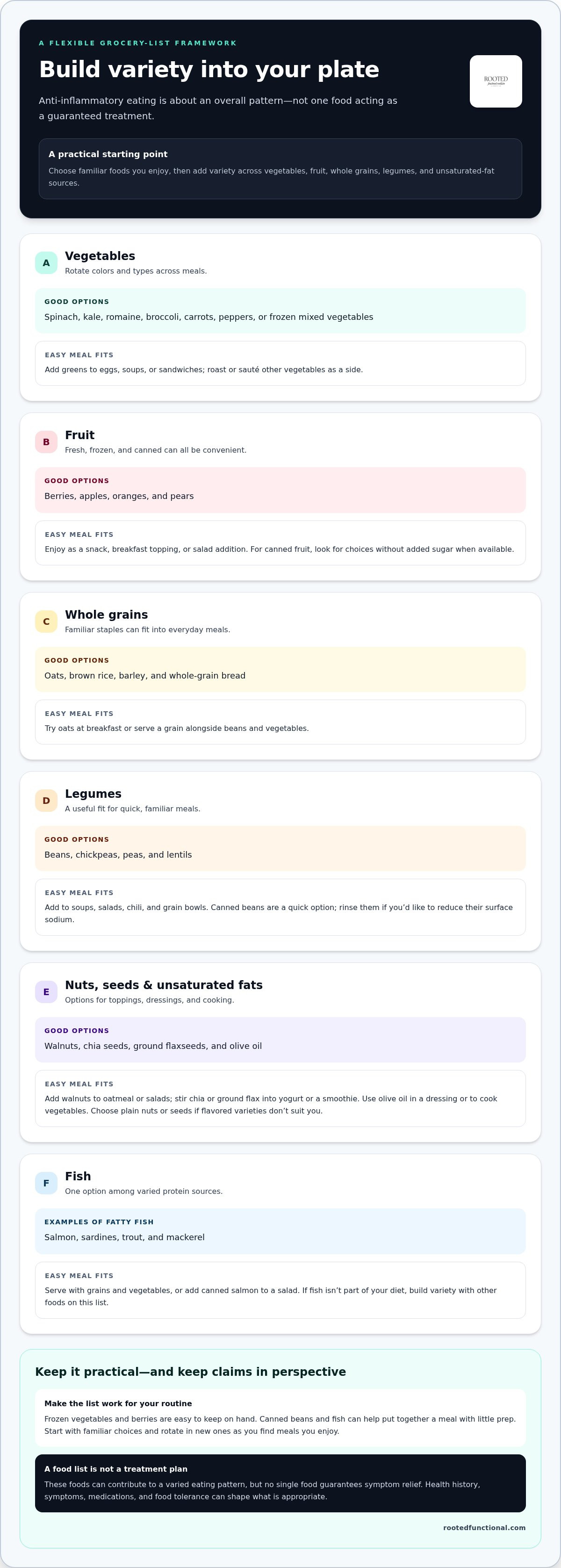
A useful grocery list doesn’t need rare ingredients or a complete pantry makeover. Start with foods you already enjoy, then add variety across plants, whole grains, legumes, and unsaturated fats. Harvard T.H. Chan School of Public Health’s Healthy Eating Plate offers a practical framework for thinking about balance. “A varied plate built around vegetables, fruits, whole grains, and healthy protein sources offers a flexible foundation for everyday meals.”
Produce, whole grains, and legumes
Choose foods you’ll actually use. These options can contribute to a varied eating pattern, but none is a guaranteed anti-inflammatory treatment. Rotate colors, textures, and types across the week instead of expecting one vegetable or fruit to do all the work. If you’re deciding what to buy, consider how each item will fit into meals you already make.
Vegetables: Try leafy greens such as spinach, kale, or romaine, along with broccoli, carrots, peppers, or frozen mixed vegetables. Add greens to eggs, soups, or sandwiches; roast or sauté other vegetables as a side.
Fruit: Berries, apples, oranges, and pears work as snacks, breakfast toppings, or additions to a salad. Fresh, frozen, and canned fruit can all be convenient options. For canned varieties, look for choices without added sugar when available.
Whole grains: Oats, brown rice, barley, and whole-grain bread can make familiar meals more filling. Try oats at breakfast or serve a grain alongside beans and vegetables.
Legumes: Beans, chickpeas, peas, and lentils fit easily into soups, salads, chili, and grain bowls. Canned beans are a quick option; rinse them if you’d like to reduce their surface sodium.
Healthy fats, nuts, seeds, and fish
Unsaturated-fat sources add more options for cooking and assembling meals. Use olive oil in a dressing or to cook vegetables, and keep nuts or seeds handy for a topping. Fatty fish is another option in a varied eating pattern. If you don’t eat fish, you can still build variety with plant foods from the list.
Nuts and seeds: Add walnuts to oatmeal or salads, or stir chia seeds or ground flaxseeds into yogurt or a smoothie. Choose plain options if flavored varieties don’t suit your preferences.
Fish: Salmon, sardines, trout, and mackerel are examples of fatty fish. Serve one with grains and vegetables, or add canned salmon to a salad. If fish isn’t part of your diet, choose other foods from the list that work for you.
Make the list fit your routine. Frozen vegetables and berries are easy to keep on hand, while canned beans and fish can help put together a meal with little prep. Start with a few familiar choices, then rotate in new ones as you find meals you enjoy. If weight-management goals are part of your broader health picture, consider nutrition in context rather than sorting foods into “good” and “bad” categories.
If you’re looking for food guidance that accounts for your health history and symptoms, a Root Cause Consultation is one way to explore individualized evaluation. A food list can offer ideas, but it can’t determine which choices are right for every person.
How to Compare Anti-Inflammatory Food Claims and Make Sensible Choices
Food claims can sound certain even when the evidence is still developing. To assess them, ask what was studied, what outcome was measured, and whether the claim matches the strength of the evidence. Evidence about an overall eating pattern doesn’t automatically prove that one ingredient will change inflammation or improve a health condition.
Food patterns versus miracle-food headlines
Early research may examine a particular compound, a small group, or a measured marker rather than whether a food improves a person’s health over time. Headlines can blur those distinctions. Careful wording such as “associated with” describes a relationship without claiming that one food caused an outcome. Before trusting a claim about anti inflammatory foods, look at current human research and reputable clinical sources, and consider whether the evidence supports the headline’s promise.
Ask whether the research looked at a single food, a whole dietary pattern, or a health outcome that matters to you. A finding about one marker is not the same as proof of disease prevention or symptom relief. No single ingredient should be presented as a guaranteed treatment.
Foods to limit without creating a forbidden-food list
Harvard T.H. Chan School of Public Health names fried foods, soda, refined carbohydrates, and red meat among foods to limit in an anti-inflammatory eating pattern. That’s a prompt to consider frequency and the overall mix of foods, not a reason to shame yourself or treat every serving as harmful. An occasional choice doesn’t define your entire way of eating.
Categories also need nuance. Refined grains and whole grains aren’t interchangeable, and carbohydrates include foods with different nutritional profiles. “Processed” is not a useful synonym for “unhealthy” by itself; canned beans and plain frozen vegetables, for example, can be practical choices. Rather than sorting every food into universally good or bad, notice which options appear most often in your routine and where a realistic swap might add variety.
How to Add Anti-Inflammatory Foods to Everyday Meals
Knowing which foods to choose is one thing. Making them work with your schedule, budget, culture, and cooking capacity is another. You don’t need a strict meal plan to include anti inflammatory foods in regular meals. Start with a flexible structure, then adjust it to fit your appetite and preferences.
Build a balanced plate without rigid rules
Think in combinations, not perfect portions: add vegetables or fruit, a protein source, and a whole-grain option when they suit the meal. Beans, lentils, eggs, fish, tofu, or poultry can provide protein. The examples below are adaptable ideas, not a prescribed clinical diet.
Breakfast: Top oatmeal with berries and walnuts, or add fruit and chia seeds to yogurt.
Lunch: Combine leafy greens, chickpeas, brown rice, and olive-oil dressing in a bowl.
Dinner: Pair salmon or beans with roasted vegetables and barley or another whole grain.
Use this meal-building sequence as a starting point:
Choose a familiar base. Try oats, brown rice, whole-grain bread, or vegetables you already like.
Add a protein and produce. Mix in beans, lentils, fish, eggs, or another preferred protein, plus a fruit or vegetable.
Finish with flavor and flexibility. Use herbs, spices, seeds, nuts, or olive oil if they fit the dish and your taste.
Make changes that are realistic to maintain
Choose one or two foods you enjoy before attempting sweeping restrictions. Add frozen spinach to soup, keep canned beans ready for a quick lunch, or cook extra grains to use in another meal. Batch preparation can save effort, but convenience counts too. Fresh, frozen, and canned ingredients can all help make a meal more manageable.
Let enjoyment, access, and routine guide your choices. A food that fits your family’s cooking traditions or is easy to find may be more useful than an unfamiliar ingredient you feel pressured to buy. If a food seems to bother you, note what you ate and how you felt, but don’t use that observation alone to diagnose a sensitivity or remove whole food groups. Digestive symptoms can have different causes; a guide to what causes bloating may help put that concern in context.
There’s no single plate that works for everyone. If ongoing symptoms or health concerns make meal choices difficult, individualized evaluation may help clarify what belongs in your plan. A Root Cause Consultation includes advanced functional lab work to investigate potential drivers of chronic symptoms. Food choices can support health, but they aren’t a substitute for personalized medical care.
When Anti-Inflammatory Food Guidance Needs a Personal Approach
General food lists can offer ideas, but they can’t account for your full health picture. Symptoms, medical history, medications, food tolerance, and nutritional needs may all affect which choices make sense for you. If a food seems to trigger discomfort, that experience deserves attention, but it doesn’t by itself identify the cause or confirm a sensitivity.
When general food lists are not enough
Persistent or concerning symptoms call for clinical guidance, not guesswork or self-treatment with a restrictive diet. Cutting out several foods or entire food groups without professional support may make eating harder and limit your choices unnecessarily. If you’re exploring nutrition alongside autoimmune care, resources on natural treatments for autoimmune diseases should be considered in the context of individualized guidance, not as a replacement for medical care.
A food list cannot uncover why symptoms are happening, determine whether a medication affects your dietary needs, or replace care from a qualified healthcare professional. Be cautious about advice that promises anti inflammatory foods will treat a diagnosis or tells everyone with a condition to avoid the same ingredients. Your needs may differ, even if someone else found a particular approach helpful.
How personalized functional care can add context
At Rooted Functional Medicine, a Root Cause Consultation is an option for people seeking a closer look at ongoing symptoms. The consultation includes advanced functional lab work that is ordered and interpreted to investigate potential drivers. This is an evaluation, not a promise that a specific food or eating pattern will resolve a condition. Nutrition can be considered alongside your history and broader health context.
Personalized care is available in person and through secure telehealth nationwide. If autoimmune concerns are part of your picture, support should account for your individual circumstances rather than rely on a universal food rule. The aim is to add context to general nutrition guidance and consider appropriate next steps with care.
You don’t have to overhaul your diet before seeking clarity. If persistent symptoms are making food choices difficult, a Root Cause Consultation can provide individualized evaluation. Bring your questions, current concerns, and the changes you’ve already tried. The consultation can help investigate potential contributors, while treatment decisions remain tailored to your needs.
Take the Next Step at Your Own Pace
Your next move doesn’t have to be a complete reset. Choose one change that feels manageable, then give yourself room to learn what fits your routine, preferences, and needs. A flexible approach to anti inflammatory foods makes room for everyday life, not just ideal plans. Progress can start with a thoughtful question, not a perfect plate.
If persistent symptoms are shaping what you eat, you deserve more than a generic list or a promise that one food will fix everything. Rooted Functional Medicine offers personalized root-cause care, with secure telehealth appointments available nationwide. A consultation can help investigate potential drivers of chronic symptoms and consider individualized next steps. It doesn’t guarantee a particular outcome, but it can bring more context to the questions you’re carrying.
Book a Root Cause Consultation to explore care tailored to your health picture. You can move forward one informed step at a time.
Frequently Asked Questions
Which foods are considered anti-inflammatory?
Common choices include vegetables, berries and other fruits, whole grains, legumes, nuts, seeds, olive oil, and fatty fish. These anti inflammatory foods are usually discussed as parts of an overall eating pattern, not stand-alone treatments. For a practical starting point, pick one option you already enjoy, such as adding beans to a familiar soup or fruit to breakfast. Your needs, food access, and healthcare guidance can shape what works for you.
Can food reduce inflammation in the body?
Some dietary patterns are associated with changes in inflammatory markers, but that doesn’t establish that a particular food will reliably reduce inflammation or treat an illness. A marker measured in research also isn’t necessarily the same as how you feel day to day. Inflammation can have different roles and causes. If symptoms continue or you have a diagnosed condition, talk with a qualified healthcare professional before making major nutrition changes.
Are eggs considered inflammatory foods?
Eggs aren’t universally inflammatory for everyone. Whether they suit you can depend on factors such as allergy, individual tolerance, and your overall health needs. If you suspect eggs are connected to symptoms, note the amount, preparation, timing, and other foods eaten rather than drawing a conclusion from one meal. Ongoing or concerning reactions deserve clinical attention. Avoid cutting out several foods at once without professional guidance, since that can make patterns harder to interpret.
What foods should I limit on an anti-inflammatory eating plan?
Some guidance suggests limiting frequent soda, fried foods, and refined carbohydrates, but that doesn’t make every food in these broad categories identical or require total avoidance. Consider how often these choices appear in your routine and whether a manageable substitution feels right. For instance, you might choose water more often than soda or include a whole-grain option when it suits the meal. Strict elimination isn’t necessary for everyone and may need professional guidance.
How long does it take for anti-inflammatory foods to work?
There’s no dependable timeline for everyone, and food isn’t a quick treatment for inflammation or chronic illness. Studies may examine dietary patterns or particular health measures, which don’t guarantee immediate changes in symptoms. If you’re adjusting your meals, make changes you can sustain and consider tracking patterns over time rather than judging each meal in isolation. Keep a healthcare professional involved if symptoms persist, worsen, or affect your daily life.
Do I need supplements as well as anti-inflammatory foods?
No, supplements aren’t automatically necessary, and a food list can’t tell you whether you need one. Supplements can carry risks and may interact with medications, so don’t start one to treat inflammation without professional advice. A clinician can consider your health history, usual diet, and whether testing or a tailored plan is appropriate. Bring the names of any supplements you already take to a care appointment so they can be considered alongside your medications.