Cellular Detoxification Program: A Personalized, Lab-Guided Approach
A “detox” label isn’t proof that a product removes toxins or improves cellular health. If you’ve found conflicting claims online, it makes sense to ask what a cellular detoxification program actually involves and whether it fits your goals. The body already has natural processes for handling waste, so a guided program should be understood in context, not as a promise to cleanse or cure.
Before trying a mineral-based protocol, it’s reasonable to want a clear explanation of what functional lab interpretation means and how a new approach could fit with your current care. Rooted Functional Medicine’s Cellular Detoxification Program uses a mineral-based protocol guided by functional lab interpretation, rather than a one-size-fits-all recipe.
This article explains what “cellular detoxification” can mean in biology, what this guided program involves, and what to discuss with a qualified practitioner before starting. It also covers safety considerations, including how to bring up supplements, medications, and existing treatment. The goal is to help you take a grounded next step, not to make another blanket detox promise.
Table of Contents
What Does a Cellular Detoxification Program Mean?
The same word can describe ordinary processes inside the body, a restrictive cleanse, or a practitioner-guided wellness service. Those approaches aren’t interchangeable. To assess a cellular detoxification program, first separate what the body does naturally from what a particular program intends to support.
Definition: Cellular detoxification is a broad wellness term for approaches intended to support health at the cellular level. It is not the name of one standardized medical procedure, and the term alone does not establish that a program removes toxins or treats disease.
In scientific contexts, detoxification can refer to how the body processes certain compounds through metabolic pathways. The term is also used in alternative health settings with different meanings and claims. This overview of detoxification illustrates how the word spans medical and alternative medicine perspectives. To evaluate a cellular detoxification program, look at its specific methods and evidence rather than assuming the label tells you what it does.
How the body normally processes and eliminates waste
The body handles waste through several connected systems. The liver transforms and processes many substances, while the kidneys filter blood and remove some waste in urine. The lungs release carbon dioxide produced during metabolism, and the digestive system moves undigested material and other waste out in stool. These are ordinary physiological functions, not evidence that a person needs a cleanse.
Cellular metabolism and waste elimination are related, but they aren’t the same process. Cells use nutrients to carry out their work and produce byproducts along the way. The body then processes and removes various waste products through its organs and systems. Calling a wellness service “cellular” doesn’t mean it has been shown to speed up these natural processes or remove a particular substance.
What the word cellular adds, and what it does not prove
“Cellular” may signal that a program aims to address health goals associated with cells, such as normal energy production or cellular function. It doesn’t identify a diagnosis, confirm that a person has impaired cellular processes, or show that a particular protocol will change them. Tiredness, for example, can have many possible explanations, so the label cannot establish its cause.
Separate a program’s stated intention from a demonstrated clinical outcome. Ask what the approach involves, what evidence supports its specific claims, and how its risks are considered in light of your health history and current care. A clear explanation should make limitations clear rather than rely on dramatic promises or suggest that everyone needs detoxification support.
This distinction matters whether you’re reading about a cleanse or considering a guided service. A mineral-based protocol interpreted in clinical context differs in format from a standalone cleanse, but the description alone still doesn’t prove a health outcome. Understanding the language is a first step toward judging an approach by its methods, evidence, and fit for your goals.
How Minerals, Cellular Energy, and Lab Context Fit Together
“Cellular health” can sound like a precise finding, but a label or symptom isn’t enough to determine what’s happening in the body. Mitochondria, minerals, and laboratory results each offer part of the picture. None alone confirms that someone needs detoxification support or predicts how they’ll respond to a protocol.
Mitochondria and cellular energy
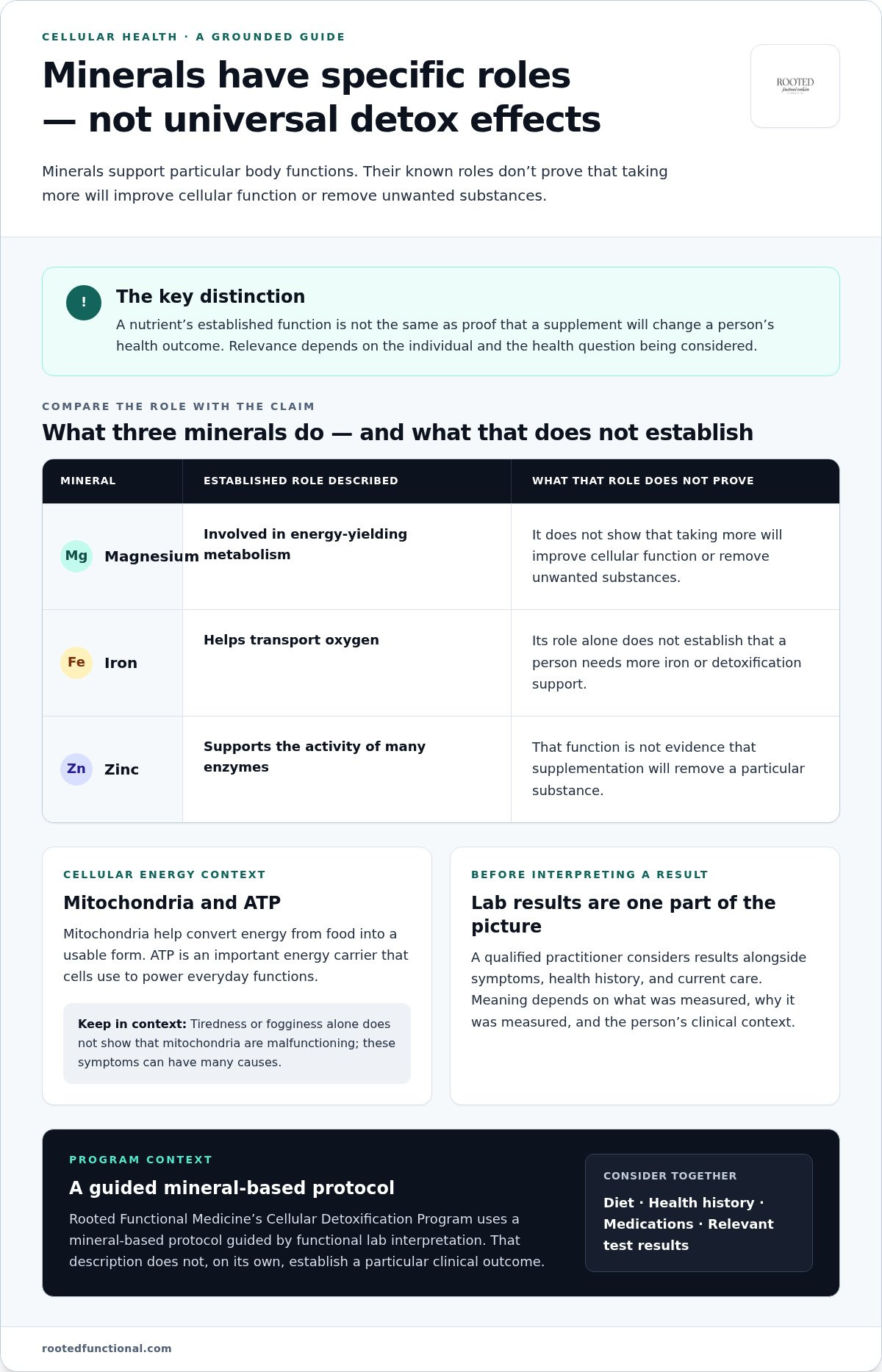
Mitochondria are structures inside cells that help convert energy from food into a usable form. One important energy carrier is ATP, which cells use to power many everyday functions. This process depends on multiple factors, including the body’s overall health and access to nutrients. Feeling tired or foggy doesn’t, by itself, show that mitochondria are malfunctioning. Those symptoms can have many causes and need to be considered alongside a person’s broader health picture.
Why minerals are discussed in cellular health
Minerals are nutrients with specific roles, not universal detox agents. For example, magnesium is involved in energy-yielding metabolism, iron helps transport oxygen, and zinc supports the activity of many enzymes. These established roles don’t mean that taking more of a mineral will improve cellular function or remove unwanted substances. Whether a nutrient is relevant depends on the individual and the health question being considered.
Supplement decisions call for care. Diet, health history, medications, and relevant test results can all affect whether a change makes sense. A mineral-based approach should therefore be understood in context, not as a blanket recommendation or a substitute for prescribed care. Rooted Functional Medicine’s cellular detoxification program uses a mineral-based protocol guided by functional lab interpretation. The program’s approach does not, on its own, establish a particular clinical outcome.
What functional lab interpretation can, and cannot, tell you
Laboratory results can add information, but they’re only one part of an assessment. A qualified practitioner considers them alongside symptoms, health history, and current care. The meaning of a result depends on what was measured, why it was measured, and the person’s clinical context. Without details about a specific test, it isn’t possible to conclude that it identifies a toxin, nutrient deficiency, or root cause. Nor does an individual finding guarantee that a particular intervention will help.
A measured biomarker is evidence about the value of that marker in the sample; by itself, it is not proof that a detox protocol is effective or will produce a health benefit. A result may inform a discussion or a next step, but it shouldn’t be treated as a standalone diagnosis or a promise of response.
If you want to understand how your health history and lab findings may inform a discussion of program fit, you can book a Root Cause Consultation.
Cellular Detoxification Program vs. Cleanse: How to Evaluate the Difference
The word “detox” gets used for very different things. It may describe the body’s normal processes, a restrictive cleanse, or a practitioner-guided wellness program. The label doesn’t tell you what an approach does, how it’s evaluated, or whether its claims are supported. Compare the details, not just the name.
A cleanse often refers to a set of dietary rules or products marketed to “flush” the body. A guided service may instead use clinical context and interpreted findings to inform an individualized approach. Neither label proves effectiveness. A responsible program shouldn’t promise to remove unspecified toxins or cure chronic conditions.
Questions that separate a guided program from a generic cleanse
Ask whether decisions reflect your health history and clinician-interpreted findings, and whether the purpose and limits of the approach are explained in plain language. A clear explanation distinguishes what is known from what remains uncertain and addresses possible risks rather than treating “natural” as synonymous with safe. Be cautious of dramatic guarantees, vague claims about unnamed toxins, or pressure to stop standard care.
Rooted Functional Medicine’s cellular detoxification program is a guided clinical service built around a mineral-based protocol and functional lab interpretation. That describes the approach, not a guaranteed result. An individualized discussion can help you understand how the approach relates to your circumstances and what questions remain before you decide.
What a program should not replace
A detox program isn’t a substitute for medical diagnosis or urgent medical care. If you have a new, severe, or rapidly worsening health concern, seek appropriate medical attention rather than relying on a cleanse or wellness protocol. Don’t stop or change prescribed medication without first speaking with the clinician who prescribed it.
Functional care and conventional treatment don’t have to be opposing choices. A practitioner-guided wellness approach should be considered alongside your existing care, with relevant clinicians informed about changes that could affect your treatment. To discuss how a guided program may fit your goals and current care, you can book a Root Cause Consultation.
How to Decide Whether a Cellular Detoxification Program Fits You
It’s understandable to look for answers when you’re not feeling well. Fatigue or brain fog alone, however, can’t show that you need detoxification support. A more useful decision starts with your goals, health history, and a clear discussion of what a program can and cannot address. Use this framework to prepare.
Clarify your goals. Write down what you hope to understand or improve. Be specific: are you looking for guidance on a lab finding, or trying to make sense of a change in how you feel? A clear goal keeps the conversation focused without assuming the cause in advance.
Gather your health history. Note existing diagnoses, significant health changes, allergies, and relevant records. Add a short timeline of symptoms, including when they began and what has changed. Symptoms are important context, but they don’t diagnose a need for a detox program.
Review your current care. Prepare a current list of prescription and over-the-counter medications, vitamins, and other supplements. Include the clinicians involved in your care and any ongoing treatment. These details matter when considering safety and how a new approach may fit alongside existing care.
Discuss the findings and next steps. Ask how your history and any relevant lab results inform the recommendation, what remains uncertain, and what alternatives may be reasonable. A result can inform a discussion, but it doesn’t guarantee that a specific protocol will be appropriate or produce a particular response.
What to bring to a program discussion
Bring your medication and supplement list, relevant health records, and a concise symptom timeline. Share existing diagnoses and the names or roles of other clinicians involved in your care. State what you want to understand, even if your goal is simply to get a clearer picture. This context supports a more grounded conversation than a symptom list alone.
Functional medicine considers health in a broader context, bringing together personal history, symptoms, and relevant findings rather than relying on one detail in isolation. You can explore this broader functional medicine approach as you consider what kind of discussion may be useful for you.
How to weigh safety, uncertainty, and expectations
Before starting, discuss possible risks, limitations, monitoring, and alternatives. Be open about medications, supplements, and health conditions, since these can affect safety considerations. Ask what would prompt a change in the plan and how progress would be reviewed. Individual findings and responses differ, so a responsible conversation should set expectations without promising a specific outcome.
If symptoms are urgent or rapidly worsening, seek immediate medical attention rather than waiting for a wellness appointment. Don’t stop prescribed medication without consulting the clinician who prescribed it. If you’re ready to talk through your goals and health context, book a Root Cause Consultation.
What to Expect from Rooted Functional Medicine's Cellular Detoxification Program
Rooted Functional Medicine’s Cellular Detoxification Program is a guided clinical service, not a standalone cleanse or a universal supplement recipe. It uses a mineral-based protocol guided by functional lab interpretation. The service is available in person or through remote appointments, so you can discuss the approach in either format.
This describes the program’s structure at a high level. It doesn’t mean a lab result alone diagnoses a problem, that every person follows the same approach, or that participation guarantees a particular health outcome. A discussion of fit can help you understand how the approach relates to your context, what is known, and what questions still need thoughtful consideration.
How a personalized, lab-guided approach is framed
Health history and laboratory interpretation offer context for considering an individualized approach. A lab finding is information to interpret, not a guaranteed roadmap for care. Its relevance depends on the person and the clinical picture, so it shouldn’t be treated as proof that a protocol will produce a specific result.
In a discussion about the program, ask how functional lab interpretation informs the mineral-based approach and how your personal health context is considered. You can also ask about the program’s intended scope and limitations. Clear answers help distinguish a guided service from a broad promise to “detox” without explaining what that means.
What to clarify before you begin
Bring forward the questions that matter most to you. Ask what lab interpretation can and cannot indicate, how the approach relates to your current care, and what limitations or uncertainties should shape your expectations. If you’re taking medications or supplements, or managing a health condition, include that context in the discussion. Don’t change prescribed treatment based on a wellness program without speaking with the clinician responsible for that care.
Rooted Functional Medicine is led by Dr. Adrienne Guthrie, PhD, DNM. Whether you meet in person or remotely, the aim is a clear conversation about the program’s approach and your goals, not a promise that every concern has one explanation or one solution. That discussion can help you decide whether this cellular detoxification program is relevant to what you’re seeking.
Take a considered next step
You don’t need to arrive with certainty. If you’re curious about the mineral-based, lab-guided approach or want to clarify how it may fit with your health goals and current care, you can discuss your next step with Rooted Functional Medicine.
Choose Your Next Step with Clarity
You don’t have to accept every claim about detox or dismiss every question you have about cellular health. A thoughtful next step is to focus on what you want to understand, what evidence would matter to you, and how any new approach could fit alongside your current care.
Rooted Functional Medicine offers a mineral-based cellular detoxification program guided by functional lab interpretation and led by Dr. Adrienne Guthrie, PhD, DNM. You can discuss your goals through an in-person or remote appointment and explore whether the approach feels relevant to your needs. You don’t need to arrive with every answer. Start with your questions.
Book a conversation about your health goals and take a clear, considered step toward understanding your options. Your health decisions can begin with curiosity, careful context, and a plan that respects the care you already receive.
Frequently Asked Questions
What is a cellular detoxification program?
A cellular detoxification program is a wellness service whose meaning depends on the specific approach. Rooted Functional Medicine’s program uses a mineral-based protocol guided by functional lab interpretation, but that description doesn’t establish a diagnosis or guarantee an outcome. Before considering a program, ask what it involves, why it may relate to your goals, what evidence supports its approach, and what uncertainties or safety considerations apply to your health history.
Is cellular detoxification scientifically proven?
Some biological processes involved in metabolism and waste handling are well established, but that doesn’t prove every program marketed as cellular detoxification works. Evidence needs to be considered for the specific intervention and outcome, not inferred from the name. For example, a claim about improving a symptom requires different evidence from a claim about changing a measured lab value. Be cautious of broad promises to remove toxins or treat several diseases.
Can a mineral-based detox program remove toxins from the body?
Don’t assume a mineral-based program removes a particular toxin. That claim depends on the substance, the intervention, and reliable evidence for that specific effect. Minerals have recognized roles in normal body functions, but those roles alone don’t show that a protocol removes toxins or improves health. Ask what the program is intended to address, what evidence supports that purpose, and whether any proposed testing is relevant to your circumstances.
How do functional lab tests guide a cellular detoxification program?
Functional lab results can contribute information to a practitioner’s assessment, but they don’t automatically reveal a root cause or predict that a protocol will help. The test, the measured marker, and the person’s clinical context all matter. A result should be explained in relation to why it was measured and what decisions it could reasonably inform. Ask what a finding means, what it cannot show, and how it would affect your care.
Is a cellular detoxification program safe if I take medication?
Safety depends on your medications, health conditions, supplements, and the specific components of the approach. Share a complete, current list with the clinician guiding your care before making changes, including nonprescription products. Ask whether there may be interactions, what monitoring is appropriate, and whether your prescribing clinician should be involved. Don’t stop or adjust prescribed medication on your own. Severe or rapidly worsening symptoms call for urgent medical care, not a detox program.
Can I take part in a cellular detoxification program remotely?
Yes. Rooted Functional Medicine offers its Cellular Detoxification Program remotely as well as in person. Before a remote discussion, gather your health history, current medication and supplement list, and questions so you can make good use of the conversation. The right approach depends on your circumstances. Remote care doesn’t remove the need to discuss safety, interpret findings carefully, and consider how any wellness plan relates to your existing care.
What should I ask before starting a cellular detoxification program?
Ask what the program involves, how it connects to your goals, what evidence supports its approach, and what remains uncertain. Clarify how any test result would influence decisions, what safety considerations apply to your medications or health conditions, and how the approach fits with existing treatment. You can also ask what alternatives might be reasonable. A useful conversation should leave you with clear information and room to decide, not pressure or a promise of guaranteed results.