Hormonal Weight Gain: Why the Scale Won’t Budge and How to Fix It
Updated: Sep 6
What if your stubborn midsection weight isn't about a lack of willpower, but a chemical instruction your body can't stop following? You've cut the calories. You've increased the cardio. Yet, the scale refuses to budge. It's exhausting to live with constant fatigue and brain fog while feeling ignored by a medical system that tells you everything is fine. You aren't failing your diet; your hormones are simply out of balance.
We understand the frustration of doing everything right and seeing zero results. This struggle is biological, not a character flaw. In this guide, we'll dive into the hidden drivers of hormonal weight gain and explain how a root-cause approach can finally restart your metabolism. You'll learn exactly which hormones are stalling your progress. We'll also provide a roadmap for functional testing that goes far beyond the standard labs you've seen before. It's time to stop the guessing game and start healing from the inside out.
Table of Contents
Understanding Hormonal Weight Gain: When Willpower Isn’t the Problem
The Key Players: How Insulin, Cortisol, and Female Hormones Drive Weight
Why Conventional 'Eat Less, Move More' Advice Fails Hormonal Bodies
Beyond Standard Blood Work: The Functional Approach to Identifying Root Causes
Reclaiming Your Metabolism: Next Steps for Lasting Weight Loss
Understanding Hormonal Weight Gain: When Willpower Isn’t the Problem
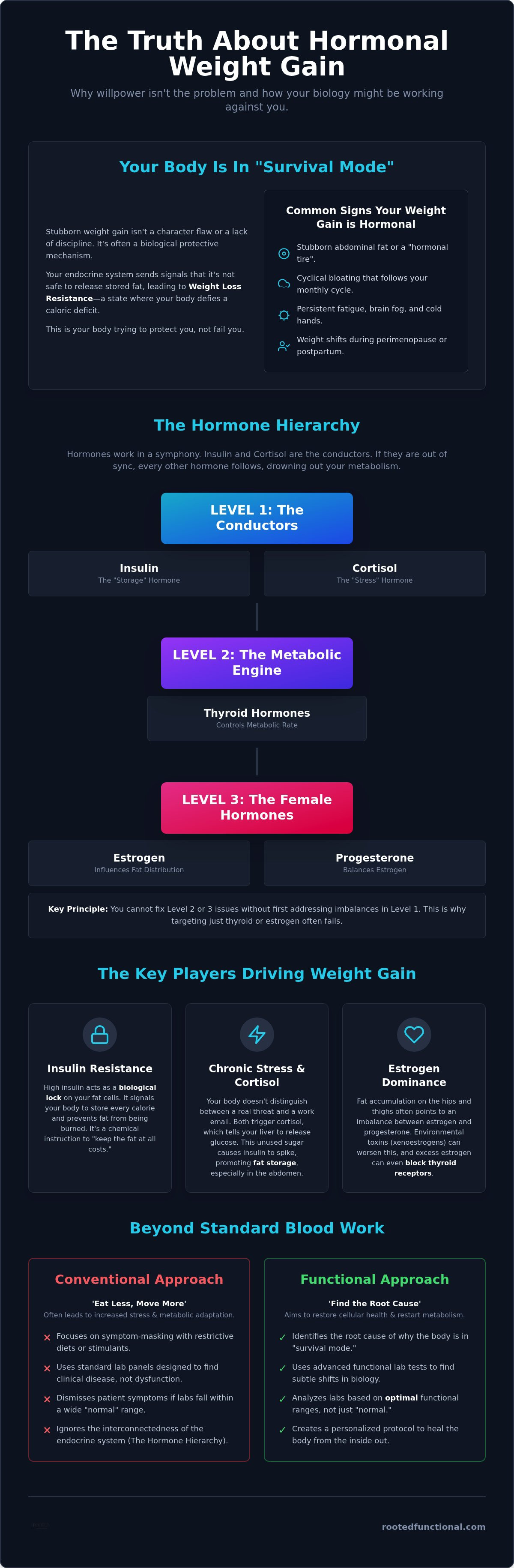
You wake up, step on the scale, and feel that familiar sinking sensation. You’ve been diligent with your meals. You’ve pushed yourself at the gym. Yet, the number doesn't move. Conventional medicine often dismisses this as a simple math problem: eat less, move more. This advice is more than unhelpful; it’s damaging. It ignores the emotional toll of trying your hardest and seeing no results. For many, the struggle with hormonal weight gain is actually a biological protective mechanism. Your body has entered "survival mode." It's holding onto fat because your endocrine system is sending a signal that it isn't safe to let it go.
This is weight loss resistance. It’s the physiological state where your body refuses to release fat despite a caloric deficit. While many clinics offer symptom-masking solutions like stimulants or restrictive diets, we focus on a root-cause approach. Understanding the Hormonal factors in weight gain is the first step toward reclaiming your health. We aren't interested in temporary fixes. We want to know why the communication between your brain and your fat cells has broken down.
The Signs Your Weight Gain Is Hormonal
How do you know if your biology is working against you? Look for specific physical clues. A "hormonal tire" or stubborn abdominal fat that won't budge is a classic sign. You might also notice hair loss, cold hands, or cyclical bloating that follows your monthly cycle. Pay attention to timing. If your weight shifted dramatically during postpartum or perimenopause, your hormones are likely the driver. These aren't just cosmetic issues. They are loud signals from your cells. Your body is trying to tell you that something is out of balance.
The 'Normal' Lab Trap
Many patients visit a doctor only to be told their labs are "normal." This is the most frustrating part of the journey. Standard blood panels are designed to find clinical disease. They don't look for functional, optimal ranges. You can feel terrible while sitting right in the middle of a clinical range. We look deeper. We want to know why you feel "off" even when the paperwork says you're fine. Functional medicine bridges this gap. We look for the subtle shifts in your biology that occur long before a disease diagnosis. If you're tired of the guessing game, a Root Cause Consultation can help identify what standard labs miss. We believe your experience matters more than a "normal" lab result.
The Key Players: How Insulin, Cortisol, and Female Hormones Drive Weight
Hormones are not a collection of independent players. They function like a complex symphony. In this orchestra, insulin and cortisol are the lead conductors. If they are out of sync, every other hormone follows suit. This "Hormone Hierarchy" explains why you can't simply fix your thyroid or estrogen levels without addressing the big bosses first. Understanding how key hormones drive weight is essential for anyone stuck in a plateau. When these conductors are loud and frantic, the subtle notes of your metabolism get drowned out.
Insulin resistance acts as a biological locking mechanism for your fat cells. When your cells stop responding to insulin effectively, your body pumps out more to compensate. High insulin levels signal your body to store every calorie and, more importantly, prevent fat from being burned. This is why hormonal weight gain often feels like an impossible uphill battle. You're fighting a chemical instruction that says "keep the fat at all costs." It is not about your lack of self-control. It's about a cellular door that won't open.
Estrogen Dominance and Weight Loss Resistance
Fat accumulation specifically in the hips and thighs often points toward estrogen dominance. This isn't always about having too much estrogen in a total sense. It's often about the ratio between estrogen and progesterone. When progesterone is low, estrogen goes unchecked. Environmental toxins, known as xenoestrogens, mimic our natural hormones and further complicate this balance. They are found in plastics, pesticides, and personal care products. For those looking to minimize their exposure to these substances, TheEDCDoc provides educational resources on how they impact biological health. This excess estrogen can even block thyroid receptors. Your thyroid might be producing enough hormone, but the message never reaches your cells. You feel the symptoms of a slow metabolism even with "normal" thyroid labs.
The Cortisol-Insulin Connection
Chronic stress is a metabolic disaster. Your body doesn't distinguish between a physical threat and a late-night work email. Both trigger cortisol. This "stress hormone" tells your liver to release glucose for quick energy. If you aren't actually running from a predator, that sugar has nowhere to go. Insulin then rises to clear it, leading to visceral fat storage around your midsection. This is the weight that wraps around your organs. It's why you feel "wired but tired" yet still gain weight. It's a cycle that traditional dieting can't break. For a deeper look at this, read our Root Cause Weight Loss Pillar. If you're ready to stop the cycle, you can schedule a Root Cause Consultation to find your specific blockers.
Why Conventional 'Eat Less, Move More' Advice Fails Hormonal Bodies
You've been told that losing weight is simple math. Just eat less and exercise more. If that were true, you wouldn't be reading this. You've tried the math, and it failed you. When your body is trapped in a cycle of hormonal weight gain, conventional advice can actually make the problem worse. Most people don't realize that their body isn't a calculator; it's a chemistry lab. If the chemistry is off, the math won't work.
When you slash calories drastically, your body doesn't just burn fat. It adapts. It perceives a famine. To protect you, it slows down your basal metabolic rate. This is the "Starvation Response." Your thyroid, which acts as the master of your metabolism, dials back its activity to conserve energy. Adding hours of high-intensity cardio to a calorie deficit creates a massive stress load. For a body already struggling with hormonal weight gain, this is like pouring gasoline on a fire. It spikes cortisol. We've already discussed how cortisol acts as a fat-storage signal. You're working harder, but your body is digging its heels in deeper.
We must shift the focus from "calories" to "hormonal signaling." Your body doesn't count calories; it reads signals. If the signal is "danger" or "starvation," your body will hold onto every ounce of fat it can.
The Problem with Chronic Dieting
Years of "yo-yo" dieting can break the communication between your brain and your metabolic system. Your hypothalamus stops trusting the signals of hunger and fullness. Constant deprivation also leads to nutrient deficiencies. You can't build hormones like progesterone or thyroid hormone without the right raw materials. A successful approach must prioritize nourishment over deprivation. You have to convince your body that it's safe to let go of the weight. If you're ready to stop the deprivation cycle, you can schedule a Root Cause Consultation to see what your body actually needs.
Metabolic Flexibility vs. Calorie Counting
The goal isn't just a lower number on the scale. The goal is metabolic flexibility. This is your body's ability to switch between burning carbohydrates and burning stored fat. When your hormones are imbalanced, you lose this ability. You become a "sugar burner," trapped in a cycle of energy crashes and cravings. You can find more details in our Metabolic Weight Loss Guide. Shifting the focus to cellular health allows your body to regain its natural rhythm. It's about fixing the signal, not just cutting the fuel.
Beyond Standard Blood Work: The Functional Approach to Identifying Root Causes
If you’ve been told your labs are normal but you still can't lose weight, you aren't imagining things. Conventional blood work is a snapshot. It’s a single moment in time. To solve the mystery of hormonal weight gain, we need a movie, not a photograph. We use functional lab testing as our primary investigative tool. This approach allows us to see how your body is actually processing hormones at a cellular level. We don't just look for disease; we look for optimal function.
A full thyroid panel is non-negotiable for anyone struggling with weight loss resistance. Most doctors only test TSH. This is a pituitary signal. It tells us what your brain wants, but it doesn't tell us what your cells are getting. We look at the full story. This includes:
Free T3: The active hormone that actually drives your metabolism.
Free T4: The storage hormone that your body must successfully convert.
Thyroid Antibodies: Markers that help us rule out underlying autoimmune issues like Hashimoto's.
If your body isn't converting T4 to T3, your metabolism will stay stuck. You’ll feel cold, tired, and heavy regardless of what the TSH says.
What We Look For in Functional Testing
We often utilize the DUTCH test to get a comprehensive view of your biology. This provides a 24-hour map of your hormone metabolites and cortisol patterns. It shows us how you break down estrogen and how your adrenals respond to stress throughout the day. We also dig into metabolic markers that go beyond basic glucose. Fasting insulin and HbA1c tell us if your body is efficiently using fuel or stubbornly storing it as fat. If you're tired of being told you're fine when you feel anything but, you may need a Weight Loss Resistance Doctor who looks at the functional story behind the numbers.
The Link Between Inflammation and Hormones
Inflammation is the silent enemy of your metabolism. When you have undiagnosed food sensitivities, your immune system stays on high alert. This systemic inflammation can actually "clog" your hormone receptors. Your hormones might be present, but they can't get into the cells to do their job. Environmental toxins from plastics and fragrances also play a role. They act as endocrine disruptors, mimicking hormones and confusing your body’s natural signaling. Cellular health is the foundation of a healthy weight. Our process is clear. We identify the trigger, remove the metabolic obstacle, and repair the system from the inside out.
If you’re ready to stop guessing and start testing for real answers, book your Root Cause Consultation today. We are here to help you uncover what has been missed.
Reclaiming Your Metabolism: Next Steps for Lasting Weight Loss
You’ve spent years fighting your body. You’ve treated it like an enemy to be conquered through restriction and exhaustion. It’s time to stop the battle. Healing from hormonal weight gain is possible, but it requires a shift in perspective. You cannot starve a stressed body into submission. You must nourish it back to health. When we fix the underlying biology, the weight follows naturally. This isn't a theory; it is the predictable result of restoring cellular function and hormonal balance.
Our Functional Weight Loss Program is built on this foundation. Unlike standard diets that focus on a number, we focus on the system. We use your unique lab data to create a structured, integrative protocol. This isn't a "quick fix" that leaves you depleted. It is a long-term wellness strategy designed to restart your metabolism for good. We look at the gaps in your nutrition, the state of your gut, and the rhythm of your hormones. We provide a roadmap that replaces the guessing game with clinical certainty.
Starting Your Journey with a Root Cause Consultation
The first step toward transformation is being heard. In a conventional setting, you often get seven minutes with a practitioner who looks only at your TSH. A Root Cause Consultation is fundamentally different. It is a comprehensive functional medicine evaluation where we dig into your history, your symptoms, and your goals. We want to know when the fatigue started. We want to understand the timeline of your weight changes. This deep dive allows us to see the patterns that standard medicine overlooks. Because we offer telehealth care, this expert level of functional medicine is accessible to you nationwide. You can find answers from the comfort of your own home.
Take the First Step Toward Healing
Your body isn’t broken. It isn’t trying to make your life difficult. It is simply out of balance and stuck in a protective state. You don't need more willpower; you need a better strategy. You deserve a practitioner who views you as a whole person and treats the root cause of your struggle. The cycle of hormonal weight gain can end here. It starts with one decision to look deeper and choose a path focused on restoration rather than deprivation. We are ready to help you uncover the "why" behind your weight loss resistance and guide you toward the "how" of lasting health.
Ready to find your root cause? Book your consultation here.
Start Your Path to Metabolic Healing
You've spent long enough feeling dismissed by a system that only looks at "normal" labs. Your struggle with hormonal weight gain is a biological signal, not a lack of willpower. True healing happens when we stop guessing and start digging into the root causes of why your body is stuck in survival mode. Dr. Adrienne Guthrie, named Best Emerging Leader in Functional and Natural Medicine 2025, leads our team in providing lab-based, personalized protocols that go beyond standard results. We offer nationwide telehealth support to ensure you have access to the investigative care you deserve. It's time to stop the cycle of deprivation and start the process of restoration. Your body isn't broken; it's simply waiting for the right signals to find its way back to balance.
Book Your Root Cause Weight Loss Consultation
Frequently Asked Questions
Is hormonal weight gain real, or am I just getting older?
Hormonal weight gain is a real biological phenomenon and is not a mandatory part of getting older. While your body changes during perimenopause, the stubborn weight is a signal of metabolic distress. It is not a failure of willpower. Your chemistry has simply changed how it processes energy. This is a physiological response to shifting internal signals that we can correct with a root-cause approach.
Can an endocrinologist help with weight loss if my labs are normal?
Most conventional endocrinologists focus on clinical disease, so they may not offer help if your labs fall within standard ranges. If you don't have a diagnosed condition like Type 1 diabetes, they might tell you that everything is fine. We look at functional ranges instead. We identify the subtle imbalances that conventional medicine often ignores. Our goal is to find why you feel terrible regardless of the paperwork.
What are the main female hormones that cause weight gain?
Estrogen, progesterone, and thyroid hormones are the primary female hormones involved in weight regulation. When estrogen is high relative to progesterone, your body tends to store fat in the hips and thighs. Your thyroid acts as the master controller of your metabolism. If it is sluggish, your body cannot burn fuel efficiently. Balancing these three is essential for anyone struggling with weight loss resistance.
How do I know if my weight gain is caused by cortisol or insulin?
You can often distinguish between the two by looking at your energy patterns and where you carry your weight. Cortisol and insulin issues typically cause weight gain around the midsection. If you feel "wired but tired" and stressed, cortisol is likely the driver. If you have constant cravings and afternoon energy crashes, insulin resistance might be locking your fat cells. Functional testing can confirm your primary blocker.
What is the best diet for hormonal weight gain?
The most effective diet for this condition focuses on blood sugar stability and reducing systemic inflammation. We focus on whole foods that lower stress on the body and support your endocrine system. There is no one-size-fits-all meal plan because your root causes are unique. The goal is to stop the starvation response and convince your body it is safe to release stored fat through proper nourishment.
How long does it take to lose hormonal weight once you start a protocol?
Most patients begin to feel better within weeks, but lasting weight loss typically takes a few months of consistent protocol. Healing takes time because we are fixing biology, not just chasing a number. Significant weight loss usually begins once your cellular health is restored and inflammation is down. This is about long-term wellness. We want to build a metabolism that works for you for the rest of your life.
Can food sensitivities cause hormonal imbalances and weight gain?
Yes, undiagnosed food sensitivities are a frequent root cause of systemic inflammation and hormonal weight gain. When you eat foods that trigger an immune response, your body stays in a state of high stress. This spikes cortisol and blocks your hormone receptors. Your cells cannot receive metabolic signals when they are inflamed. Identifying these triggers is essential for restarting a stalled metabolism and restoring your health.
Does functional medicine use hormone replacement therapy for weight loss?
Our primary focus is on restoring your body's natural hormone production rather than relying solely on replacement therapy. While bioidentical hormones can be a helpful tool in specific cases, they are not a standalone solution for weight loss. We prioritize fixing the gut, adrenals, and liver first. We want to uncover why your levels were off. We aim to restore your cellular health for long-term results.


