Autoimmune Solutions Program: A Root-Cause Path to Lasting Relief
What if “normal” lab results don’t explain your fatigue, pain, or autoimmune flares? If you’ve left appointments without answers, feel concerned about relying on immunosuppressants long term, or feel overwhelmed by conflicting diet advice, your frustration makes sense. The autoimmune solutions program takes a personalized, lab-guided approach to investigating possible contributors to immune dysfunction, rather than focusing only on symptoms.
At Rooted Functional Medicine, Dr. Adrienne Guthrie understands the strain of chronic illness through her clinical work and lived experience. The goal isn’t to promise a cure or tell you to stop prescribed treatment. It’s to explore the “why” behind your symptoms and build a clearer plan with appropriate practitioner support.
This article explains how the program begins with a Root Cause Consultation, how lab findings may inform a personalized protocol, and how food and lifestyle guidance can fit into the process. You’ll also learn how a step-by-step approach can help clarify possible next steps, without treating one diet or test as the answer for everyone.
Table of Contents
Why Your 'Normal' Labs Aren't the Whole Story
Being told your results are “normal” can feel like being told your symptoms aren’t real. Persistent fatigue, pain, or recurring flares still deserve attention when initial tests don’t reveal a clear explanation. A result within a laboratory’s reference range is one piece of information, not a complete picture of how you feel or what may contribute to immune dysfunction.
“Biologically optimal” isn’t a universal set of numbers that applies to everyone. It means asking whether your results, symptoms, history, and overall health fit together. Standard blood work can be valuable for diagnosis and monitoring, but each test answers specific questions. Depending on what’s measured and when, it may not explore every possible factor related to inflammation or immune balance. A functional medicine approach considers the broader pattern and whether further evaluation is appropriate. For an overview of the conditions involved, see this introduction to autoimmune diseases.
You know what has changed in your body. When a result doesn’t explain it, uncertainty can be exhausting. You may wonder whether to keep asking for answers or learn to live with your symptoms. Your concerns deserve to be heard and discussed. One normal test doesn’t settle every question.
The Problem with Symptom-Masking Medicine
Immunosuppressive medications can be an important part of care for some autoimmune conditions. They aim to reduce harmful immune activity and manage disease. Whether other factors could also be affecting your health is a separate question to explore with qualified practitioners.
Symptoms may continue to affect daily life even while treatment addresses disease activity. A diagnosis gives a name to a pattern and can guide care, but it doesn’t mean you should stop asking informed questions. Never change or stop prescribed medication without guidance from the clinician who manages it.
What Your Body Is Actually Trying to Tell You
A flare can feel random, but tracking when symptoms change may help you and your healthcare team notice patterns. Sleep, stress, illness, food, or other exposures may be relevant for some people. A pattern is a clue to discuss, not proof of a cause. Cellular health matters because cells rely on nutrients and coordinated processes to carry out their functions, including those involved in immune regulation.
A root cause is a foundational biological trigger that may contribute to a symptom or pattern of symptoms. The autoimmune solutions program uses a personalized, lab-guided approach to investigate potential contributors rather than assume everyone has the same explanation. It starts with a Root Cause Consultation, where your health history and concerns can help shape what to explore next.
The Science of Discovery: Our Investigative Protocol
Investigating possible contributors to autoimmune symptoms takes more than ordering a test and looking for a single out-of-range result. In a personalized, lab-guided approach, results are considered alongside your symptoms, health history, and existing care. A lab result may offer a clue, but it doesn’t diagnose a root cause on its own.
The Autoimmune Solutions Program explores patterns that standard testing may not fully address. Rather than assume everyone needs the same tests or protocol, the process may consider areas such as gut health, nutrient status, and possible environmental exposures. The National Institute of Environmental Health Sciences discusses how environmental triggers may relate to autoimmune disease. A potential exposure alone, however, doesn’t prove it is driving an individual’s symptoms.
The aim is to make the information useful. A practitioner can review what was tested, explain what results mean in context, and discuss whether further evaluation may be appropriate. That’s different from treating every flagged result as a problem or promising that one test will explain everything.
The Gut-Immune Connection
The gut and immune system interact through the intestinal lining and the community of microbes in the digestive tract. This relationship makes digestive history and gut symptoms relevant to discuss, but it doesn’t mean gut dysfunction causes every autoimmune condition. Bloating, for example, can have different explanations. A careful review looks for patterns before drawing conclusions or recommending changes.
Personalized guidance matters. Restrictive diets aren’t automatically right for everyone, and testing or food changes should be considered in light of your health needs.
Advanced Lab Markers We Monitor
There isn’t one universal panel that can reveal every contributor to immune symptoms. Depending on your history and clinical context, a practitioner may discuss whether further assessment of inflammation, food sensitivities, nutrient status, or other factors is warranted. The specific markers used in the Autoimmune Solutions Program shouldn’t be assumed in advance. Testing decisions are individualized.
Nutrients and minerals support many normal cellular processes, including functions involved in nerve and immune health. If a deficiency is suspected, appropriate assessment can help inform next steps. The same care applies to detoxification: the goal is to understand relevant exposures and support health safely, not to promise that a “detox” will remove a specific toxin or cure autoimmunity.
Dr. Adrienne Guthrie’s Root Cause Consultation is the starting point for reviewing your health history and discussing what information may help guide a personalized plan.
Comparing the Autoimmune Solutions Program to Conventional Care
Conventional care and functional medicine can serve different purposes, and one doesn’t have to replace the other. A conventional clinician may diagnose an autoimmune condition, monitor disease activity, and recommend evidence-based treatment. That care can be essential. The Autoimmune Solutions Program adds a root-cause-focused perspective, exploring whether your health history and lab findings point to factors that may also affect your symptoms and cellular health.
Appointments and care plans vary. Rooted Functional Medicine’s approach begins with a Root Cause Consultation, followed by a personalized, lab-guided protocol. Instead of assuming everyone needs the same intervention, the aim is to make decisions with your history and findings in view.
Conventional care: Diagnosis, disease monitoring, and treatment recommendations based on your condition and clinical needs.
Rooted’s approach: A broader investigation of possible contributors, with a focus on restoration and cellular health.
Your role: Share your experience, ask questions, and take part in decisions alongside your healthcare providers.
These approaches aren’t mutually exclusive. Don’t stop or change prescribed medication based on a functional medicine plan without discussing it with the clinician managing your treatment.
A Partnership for Your Health
Dr. Adrienne Guthrie approaches each case by looking for connections between symptoms, history, and available lab data. Her lived experience with chronic illness can also help her understand how difficult it is to keep searching after feeling unheard. The aim is partnership, not a one-size-fits-all answer. For a broader discussion, see Natural Treatments for Autoimmune Diseases: Root Cause Guide.
Why a Structured Program Beats Supplement Guesswork
Trying supplements one at a time without a clear reason can make it difficult to tell what’s helping, what isn’t, or whether something is appropriate for you. More isn’t always better. A structured protocol offers a more considered path: use your consultation and relevant lab information to identify what may warrant attention, then discuss suitable next steps with a practitioner.
Testing can’t explain every symptom, and no particular sequence guarantees results. Instead, decisions can be guided by your individual context rather than online trends or someone else’s supplement routine. A Root Cause Consultation can help frame the questions to explore.
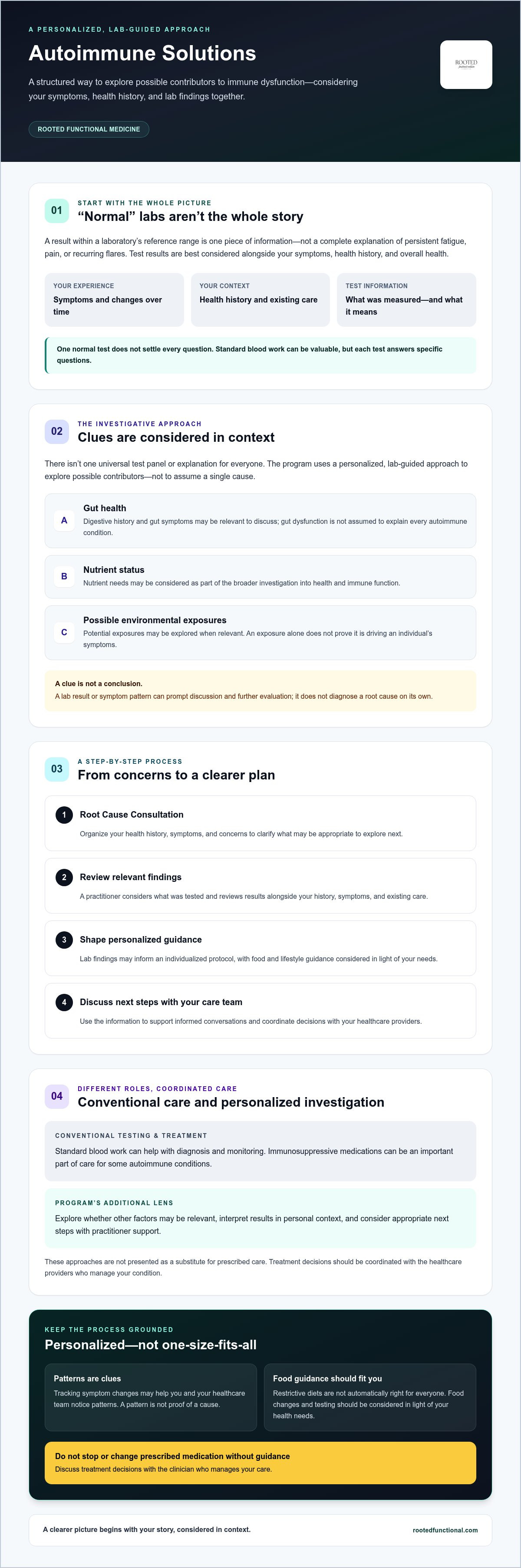
How the Program Works: Your Roadmap to Cellular Restoration
A clear process can make the search for answers feel less overwhelming. Rooted Functional Medicine’s Autoimmune Solutions Program is personalized and lab-guided, with the Root Cause Consultation as the starting point. Testing and next steps depend on your health history and clinical context, rather than a preset checklist applied to everyone.
Step 1: Root Cause Consultation. Discuss your symptoms, health history, concerns, and previous results with Dr. Adrienne Guthrie. The conversation helps identify questions that may need further investigation.
Step 2: Functional testing. If appropriate, lab testing can provide information to consider alongside your history and current care. Your practitioner can explain what a test may and may not reveal.
Step 3: Personalized protocol. Recommendations are shaped by the information available, with a focus on potential contributors to immune imbalance and cellular health. No single food plan or intervention is assumed to suit everyone.
Step 4: Review and adjustment. As you discuss your response and any new information with your practitioner, the plan can be reconsidered in light of your needs and results.
The Z-to-A approach starts with the goal of better health, then works backward to explore factors that may be getting in the way.
The Telehealth Experience: Expert Care Nationwide
Rooted Functional Medicine serves patients nationwide through telehealth, so geography doesn’t have to prevent you from exploring this approach. You can meet with your practitioner remotely, review your health history, and discuss lab findings without traveling to a clinic. Ask how testing is arranged and how results and recommendations are shared, since those details can depend on your plan.
Remote care can still feel personal. The consultation gives you a chance to ask questions, explain how symptoms affect daily life, and understand the reasoning behind proposed next steps.
What Your Personalized Protocol May Address
Your recommendations should reflect your history and findings. Depending on what’s relevant, you may discuss food sensitivities, nutrient status, or lifestyle factors. These aren’t automatic prescriptions, and the information provided doesn’t establish that every protocol includes a particular diet, supplement, or stress-management tool.
A lab result is one part of a larger picture. Any dietary changes or nutrient support should be considered with appropriate practitioner guidance. If you’re ready to discuss your health history and possible next steps, book a Root Cause Consultation.
Taking the First Step Toward Lasting Autoimmune Relief
Waiting and hoping symptoms will disappear can leave you without a clearer picture of what’s happening. Autoimmune conditions need thoughtful, ongoing care, and no single path guarantees lasting relief. You can take an active role by raising questions, understanding your results, and exploring whether other factors may contribute to how you feel.
The autoimmune solutions program offers a structured, lab-guided way to investigate possible root causes alongside your existing care. Dr. Adrienne Guthrie brings professional insight and lived experience with chronic illness to this work. You don’t have to figure out the next question alone.
A little preparation can make your Root Cause Consultation more useful. Gather relevant test results and a list of medications and supplements. Note when symptoms began, what tends to make them better or worse, and which questions you most want answered. You don’t need to have everything figured out before the conversation begins.
Is the Autoimmune Solutions Program Right for You?
You may be ready to explore a root-cause approach if symptoms continue to affect daily life, previous results haven’t answered your questions, or you want to understand how your health history and lab findings fit together. The program is for people seeking investigation and a personalized plan, not a promise to replace conventional treatment. Keep working with your medical team, and don’t change prescribed care without their guidance. To discuss your health history, book your Root Cause Consultation today.
Reclaiming Your Energy and Vitality
Progress may mean gaining clarity about your health, identifying practical next steps, or noticing changes worth discussing with your care team. No responsible approach can guarantee a specific outcome, but understanding your individual needs can help you make more informed choices about cellular health over time. You deserve support that takes your concerns seriously and treats your questions as part of the process. Learn more about the Autoimmune Solutions Program.
Take the Next Step Toward Answers
Your symptoms deserve to be taken seriously, even when earlier tests haven’t explained them. A root-cause perspective brings your health history and lab findings into a fuller conversation, helping you consider informed next steps rather than rely on guesswork. It can complement your existing medical care, not replace it.
The autoimmune solutions program offers a personalized, lab-guided path focused on investigating potential contributors and supporting cellular health. Dr. Adrienne Guthrie’s investigative approach and lived experience bring clinical perspective and empathy to the process. She was named Best Emerging Leader in Functional & Natural Medicine in 2025, and Rooted Functional Medicine provides telehealth support nationwide.
You don’t need every answer before you begin. A Root Cause Consultation is an opportunity to share what you’ve been experiencing, ask questions, and discuss whether this approach fits your needs. Book your Root Cause Consultation with Dr. Guthrie to take a thoughtful first step toward greater clarity. Your experience matters, and support is available as you explore what comes next.
Frequently Asked Questions
What specific autoimmune conditions does the program support?
The Autoimmune Solutions Program is designed for people seeking a personalized, root-cause-focused approach to autoimmune concerns, but Rooted Functional Medicine doesn’t provide a confirmed list of supported diagnoses. The protocol is guided by your health history, symptoms, and relevant lab findings. If you have a specific diagnosis, ask whether the program may suit your situation during a Root Cause Consultation, and continue working with the clinician managing your condition.
How is the Autoimmune Solutions Program different from seeing a rheumatologist?
A rheumatologist specializes in diagnosing and treating diseases that affect the joints, muscles, and immune system. The Autoimmune Solutions Program takes a functional medicine approach, exploring potential contributors to symptoms through a health-history review and personalized, lab-guided protocol. It isn’t a substitute for specialist diagnosis or treatment. These approaches may serve different roles, so discuss how they can fit together with your healthcare providers.
Can I do this program if I am already taking immunosuppressant medications?
Taking immunosuppressant medication doesn’t automatically determine whether the program is appropriate for you. Share your diagnosis, medications, and current treatment plan during the Root Cause Consultation so the practitioner can discuss your situation. The program shouldn’t be a reason to stop, reduce, or change prescribed medication. Make medication decisions with the clinician who manages your treatment, and keep them informed about other care you’re considering.
How long does it typically take to see results in the program?
There’s no stated standard timeline for results, and individual experiences can vary. The process may involve reviewing your health history, deciding whether functional lab testing is appropriate, and considering recommendations in light of your findings. Symptom changes aren’t guaranteed, and the program shouldn’t be viewed as a cure for autoimmune disease. Ask how progress will be reviewed and what changes you should track so you can discuss them with your practitioner.
Is the program available to patients nationwide?
Yes. Rooted Functional Medicine serves patients nationwide through telehealth. Remote appointments let you discuss your health history and care plan without traveling to a physical office. Ask how any recommended lab testing is arranged and how results are reviewed, since those details may depend on your individual plan. Telehealth support complements, but doesn’t replace, any in-person or specialist care you may need.
What kind of lab tests are involved in the autoimmune protocol?
Testing is personalized, and Rooted Functional Medicine hasn’t provided a fixed list of markers used for every patient. The practitioner considers your symptoms and health history when discussing whether functional lab work may be useful. Nutrient status, inflammation, gut health, or food sensitivities may be relevant areas to explore, but no specific panel should be assumed. Ask what a proposed test can and can’t tell you before proceeding.
Do I need a referral from my primary care doctor to get started?
Rooted Functional Medicine’s available information doesn’t state whether a referral is required. Contact the practice or review its booking information to confirm any current requirements before scheduling. You can prepare by gathering previous test results, a list of medications and supplements, and notes about your symptoms. Sharing this information can help make the initial conversation more focused, whether or not you have a referral.
What happens during the initial Root Cause Consultation?
The initial Root Cause Consultation with Dr. Adrienne Guthrie is an opportunity to review your health history and discuss the concerns that led you to seek support. Previous lab results and symptoms can inform the conversation. Functional lab work may be ordered and interpreted when appropriate, but testing isn’t guaranteed as part of every plan. You can also ask questions and discuss how this approach may fit alongside your current care.