DUTCH Test for Hormone Imbalance: What It Measures and When It May Help
Updated: Oct 8
What if another hormone test adds more data but still doesn’t explain how you feel? If symptoms persist after routine testing, it’s understandable to wonder whether a DUTCH test for hormone imbalance could reveal something standard blood work missed. Whether it’s useful depends on the clinical question, not simply on how many markers a test measures.
The DUTCH test uses dried urine samples to assess hormones and their metabolites. Some panels also measure cortisol-related patterns over the day. This offers a different kind of information from blood testing, but it doesn’t diagnose a disease or replace validated tests used to evaluate many endocrine conditions. More results aren’t automatically more useful, and interpretation matters.
In this guide, you’ll learn what the test measures, how at-home collection generally works, and where its limitations matter. We’ll compare it with common hormone tests and outline practical questions to raise with a qualified clinician, including whether testing fits your symptoms, medical history, and possible next steps. The goal is clarity, not another confusing report or a promise the test can’t make.
Table of Contents
What Is a DUTCH Test for Hormone Imbalance?
Changes in energy, sleep, mood, or menstrual patterns can be frustrating, especially when initial test results don’t explain them. These symptoms deserve attention, but they don’t prove a hormone imbalance. A DUTCH test for hormone imbalance is one way to measure selected hormone-related markers in dried urine. Its results may add information, but they don’t diagnose a condition or guarantee an explanation for how you feel.
What does DUTCH stand for, and what type of test is it?
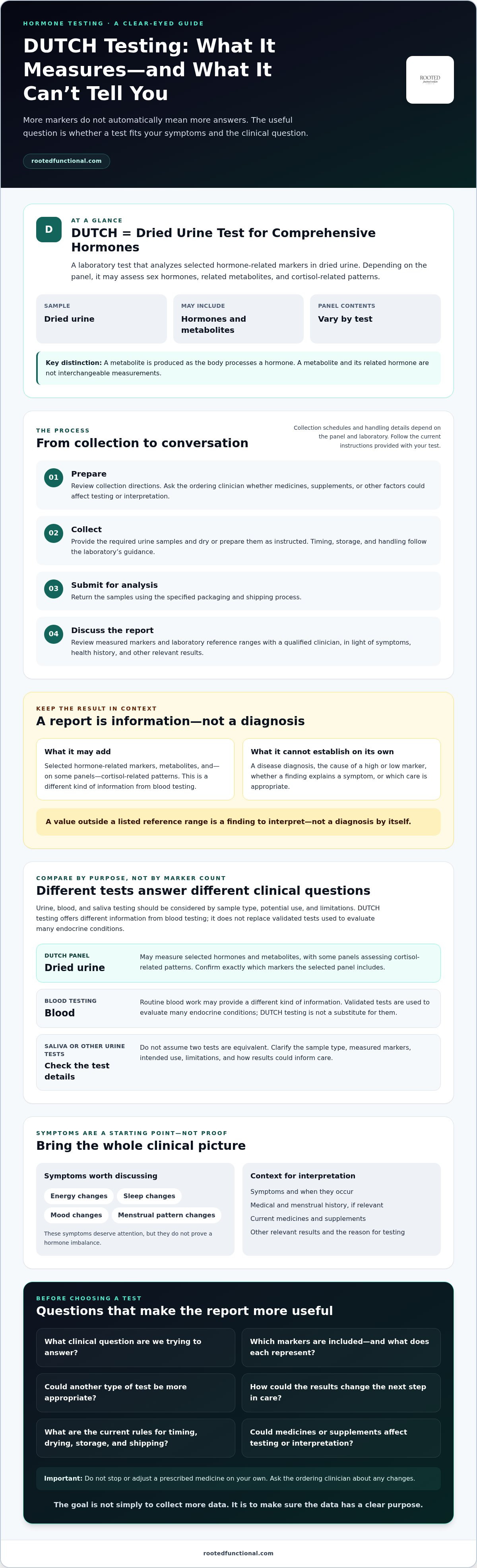
DUTCH stands for Dried Urine Test for Comprehensive Hormones. It is a laboratory test that analyzes markers in urine collected and dried according to the laboratory’s instructions. Urine can be analyzed for different clinical purposes, as this general overview of urinalysis explains, but a DUTCH panel is not the same as a routine urinalysis. Always follow the selected laboratory’s current directions for collection and handling.
Which hormone-related markers may a DUTCH panel assess?
Panel contents vary. Depending on the specific test, a panel may assess sex hormones and related metabolites, as well as cortisol-related markers. Estrogen, progesterone, and cortisol may be included, but don’t assume every panel measures the same hormones, metabolites, or patterns. Check the laboratory’s current test menu to confirm the analytes and what each result represents.
Hormones and their metabolites are not interchangeable measurements. A metabolite is a substance produced as the body processes a hormone. A report may therefore show selected hormone-related markers, but it doesn’t necessarily reveal why a marker is high or low, whether that finding explains a symptom, or what care is appropriate.
A detailed report can look definitive, yet each measurement is only one part of the clinical picture. Results need to be considered alongside symptoms, medical history, medicines, and the reason testing was considered. For example, a cortisol-related or sex-hormone result may prompt a clinician to ask further questions, but it cannot establish a diagnosis on its own.
Before choosing a panel, define the question you want testing to help answer. Ask which markers are included, why they may be relevant to your situation, and how the results could affect next steps. A clinician can also help determine whether another type of hormone test is more appropriate. The goal is not simply to collect more data. It’s to make sure the data has a clear purpose.
How Does DUTCH Testing Work, from Collection to Report?
The process generally moves through four stages: preparation, sample collection, laboratory analysis, and clinician discussion. Details can differ by panel and laboratory, so follow the current instructions provided with the test. There’s no universal collection schedule that applies to every DUTCH test for hormone imbalance.
Prepare. Review the collection directions and ask the ordering clinician whether medicines, supplements, or other factors could affect the test or its interpretation.
Collect. Provide the required urine samples and let them dry or prepare them as instructed. Timing, storage, and handling depend on the laboratory’s current guidance.
Submit for analysis. Return the samples using the laboratory’s specified packaging and shipping process.
Discuss the report. Review the measured markers with a qualified clinician who can consider your symptoms, health history, and other relevant results.
What should you ask before collecting a DUTCH sample?
Confirm the details before you begin. Ask the ordering clinician whether any medication or supplement changes are appropriate. Don’t stop or adjust a prescribed medicine on your own. Check with the laboratory about directions for cycle day, time of day, sample drying, storage, and shipping. These details can vary, so don’t rely on instructions for a different panel or an older kit.
Keep a simple record for your clinician. Note relevant symptoms and when they occur, cycle details if applicable, and your current medicines and supplements. This context can help the clinician interpret the report without treating a single measurement as the whole story.
What happens after the laboratory receives the sample?
The laboratory analyzes the submitted samples and provides a report with measured markers and laboratory-defined reference ranges. A value outside a listed range is a finding to interpret, not a diagnosis by itself. It doesn’t automatically establish a hormone disorder or show that the result caused a particular symptom.
Clinician review connects the report to the reason testing was considered. The discussion may take into account symptoms, medical and menstrual history when relevant, medicines, and other test results. Ask what each finding can and cannot tell you, and whether it would change a decision about further evaluation or care.
If you’re unsure which testing approach fits your situation, a Root Cause Consultation offers an opportunity to discuss your symptoms and history with a clinician. That conversation doesn’t mean a particular test will be recommended.
DUTCH Test vs. Blood, Saliva, and Other Urine Tests
Different sample types answer different questions. A DUTCH test for hormone imbalance isn’t automatically more useful because its report may include multiple markers. Compare tests by asking whether they measure what a clinician needs to assess and whether the result can inform a decision.
How is DUTCH testing different from blood hormone tests?
Blood tests measure particular markers in blood at the time the sample is taken. This can be useful when the clinical question calls for a blood measurement. Appropriate timing may depend on the hormone, the person’s circumstances, and the reason for testing. Blood tests remain an important part of standard medical evaluation; DUTCH testing doesn’t replace them.
Dried urine and blood also reflect different sample types. A DUTCH report may include selected hormone-related metabolites, while a blood test measures the markers requested in blood. The results shouldn’t be treated as directly equivalent or compared as if one were a more accurate version of the other.
When might saliva or another urine test be considered?
Saliva or another urine test may be considered when its sample type and measured markers fit the question being assessed. Neither method is automatically a substitute for blood or dried urine testing. Before choosing, check the laboratory’s current panel details and ask how the test is used and interpreted.
Start with the clinical question, not the report that looks most detailed. Ask what decision the result could inform, whether the method is appropriate for that purpose, and how it fits with your symptoms and other findings. A qualified clinician can help weigh those factors without assuming that any single test will explain every symptom.
Who Might Consider a DUTCH Test, and What Are Its Limits?
A DUTCH test for hormone imbalance may be worth discussing when symptoms persist and a clinician has a specific question the results might help explore. Start with your symptoms, health history, medicines, and any relevant prior testing, not with the assumption that hormones are the cause. Testing is one possible tool, not a required next step for everyone.
Can DUTCH testing explain symptoms such as fatigue or cycle changes?
It may provide information about selected hormone-related markers, but it can’t establish the cause of fatigue, cycle changes, or other symptoms by itself. Similar symptoms can have different explanations, and a clinician may recommend standard medical evaluation or other tests based on your situation. Severe, new, or rapidly worsening symptoms deserve prompt medical attention rather than waiting for an at-home test or report.
A detailed report can still leave important questions unanswered. Results may not explain how you feel or change what care is appropriate. Before testing, ask what clinical question the panel is intended to address and what decisions could reasonably follow from the findings. For individuals navigating cycle changes or burnout, coaching resources such as blaze.academy can provide additional wellness support alongside professional medical care.
What are the limits of interpreting a DUTCH report alone?
Markers and reference ranges depend on the laboratory and the panel. A value outside a range is not, by itself, a diagnosis or proof that a symptom is hormone-related. Interpretation also depends on context, including symptoms, medical history, medicines, and other relevant results.
Avoid making treatment decisions from isolated values. Don’t start a supplement protocol or change prescribed medication based only on a report or online interpretation. Ask a qualified clinician to explain what the findings do and don’t show, and whether follow-up evaluation is appropriate. For broader context, review this functional medicine information.
If you’re unsure whether testing fits your situation, a clinician-led conversation can help clarify the question before you choose a test. A Root Cause Consultation with Dr. Adrienne Guthrie is one option for discussing symptoms, history, and appropriate lab-guided care. Ask directly whether DUTCH testing is available and whether it fits your clinical question.
Choosing Your Next Step for Hormone Testing and Care
Before choosing a test, get clear on what you want to understand. A DUTCH test for hormone imbalance is one option to discuss, not a default step or a substitute for appropriate medical evaluation. Use this short checklist to make a clinician conversation more focused and decide whether testing is likely to be useful.
Describe your symptoms: Note what you’ve noticed, how long it has been happening, and whether anything makes it better or worse.
Gather relevant history: Include health conditions, prior evaluations, and cycle details if they apply to you.
List medicines and supplements: Bring current names and doses, and don’t stop or change anything without guidance from the prescriber.
Name the question: Identify what you hope testing might clarify, such as whether a particular marker needs further evaluation.
Questions to ask a clinician before ordering any hormone test
Ask what clinical question the proposed test is intended to answer and why its sample type and markers fit that question. Find out who orders the test, who will interpret the report, and how results will be considered alongside your symptoms, history, and other findings. Ask about the test’s limitations, possible follow-up, and whether standard evaluation is needed. A useful test should have a clear purpose, even if the result doesn’t provide a complete explanation.
How Rooted Functional Medicine approaches lab-guided care
Rooted Functional Medicine’s Root Cause Consultation is an entry point for personalized assessment and discussion of functional lab work. Dr. Adrienne Guthrie considers a person’s health concerns and history as part of that process. Ask whether DUTCH testing is available and appropriate for your situation rather than assuming it is part of the consultation.
Use a consultation to discuss what you’re experiencing, what has already been evaluated, and which next steps may be appropriate. Lab testing can inform care, but it doesn’t promise a diagnosis or a particular outcome. It should not replace conventional medical evaluation when that is needed.
If you’d like to talk through your concerns and suitable next steps, you can book a Root Cause Consultation. Bring your questions and any relevant test results. A focused discussion can help you make a more informed decision about what to investigate next.
Make Your Next Testing Decision With Clarity
The DUTCH test for hormone imbalance may offer information about selected hormone-related markers, but a report isn’t a diagnosis or a guaranteed explanation for symptoms. Blood, saliva, and urine tests measure different things, so the right option depends on the clinical question, your history, and how results could guide next steps.
Before testing, clarify who will order it, who will interpret the findings, and whether standard medical evaluation is also appropriate. More data isn’t always more useful. What matters is understanding what a result can and cannot tell you.
If you’re still sorting through symptoms or testing questions, a clinician-led conversation can help you consider an appropriate path. Rooted Functional Medicine’s Root Cause Consultation includes personalized assessment and interpretation of functional lab work. Secure telehealth appointments are available nationwide. Ask during the consultation whether DUTCH testing is available and whether it fits your needs.
Book a Root Cause Consultation to discuss your symptoms, testing questions, and care options. Bring your questions and relevant test results to help make the conversation useful.
Frequently Asked Questions
What hormones does a DUTCH test measure?
The hormones and related markers measured depend on the specific panel. Depending on the test, examples may include sex-hormone markers, such as estrogen or progesterone, and cortisol-related markers. Don’t assume every DUTCH panel includes the same analytes or measures them in the same way. Check the testing laboratory’s current menu for the exact markers included, and ask a clinician which ones relate to your clinical question.
Is a DUTCH test more accurate than a blood test?
There isn’t one test type that is universally more accurate for every hormone question. Blood and dried urine tests measure different markers in different sample types, and the usefulness of each depends on what needs to be assessed. Timing, laboratory methods, and interpretation also matter. Ask a clinician which method fits your situation and how results would inform next steps. DUTCH testing shouldn’t be treated as a replacement for standard medical evaluation.
How do you prepare for a DUTCH test?
Follow the selected laboratory’s current collection and handling instructions, since timing and sample requirements can vary. Ask your clinician whether medicines or supplements could affect collection or interpretation, and confirm any cycle-related directions if relevant. Don’t stop or change prescribed treatment on your own. Keep a list of current medicines and supplements, along with relevant symptoms and cycle details, to help your clinician interpret the results in context.
Can a DUTCH test diagnose hormone imbalance?
No. DUTCH test results alone don’t establish a diagnosis. A qualified clinician considers the findings alongside your symptoms, health history, and other relevant results. Depending on the concern, an examination or standard medical evaluation may also be appropriate. If a report flags a marker, that finding needs context before anyone can decide what it means for you. Testing can contribute information, but it can’t guarantee a diagnosis or identify the cause of every symptom.
Who should consider a DUTCH test?
A clinician may consider a DUTCH test if it fits a specific question about your symptoms and history. It isn’t automatically appropriate for everyone with fatigue, sleep changes, or menstrual changes. Discuss possible alternative explanations, what the panel can and can’t show, and whether conventional evaluation is needed. Before proceeding, ask who will interpret the report and what decisions the results could inform. The purpose should be clear before collecting a sample.
What should I do if my DUTCH test results are abnormal?
Review abnormal findings with the clinician who ordered the test rather than diagnosing yourself or starting supplements based on isolated values. Interpretation depends on the specific panel, the laboratory’s reference ranges, your symptoms, and your medical history. Ask what the flagged result may mean, whether it needs confirmation or follow-up, and whether other evaluation is appropriate. Don’t change prescribed medication without guidance from the professional managing your care.