Food Sensitivity Testing: What Results Can, and Cannot, Tell You
When symptoms keep returning after meals, it’s natural to look for a clear path forward. But what if a food sensitivity test gives you a list of foods to avoid without explaining what is causing your symptoms? Different tests measure different things, and a result is a clue to interpret, not a diagnosis to follow blindly.
Food allergy, food intolerance, and food sensitivity aren’t interchangeable. Allergy testing looks for specific immune responses, while intolerance often involves difficulty digesting or processing a food. “Sensitivity” can mean different things, too. Some panels measure IgG antibodies, but the American Academy of Allergy, Asthma & Immunology doesn’t recommend IgG testing to diagnose food allergies or sensitivities. In this article, you’ll learn what common tests can and can’t establish, why results need to be weighed against your symptoms, and how to consider next steps without making unnecessary restrictions. At Rooted Functional Medicine, food sensitivity testing is part of a personalized assessment, with consultation to help put findings in context and guide thoughtful dietary decisions.
Table of Contents
Food Sensitivity Testing: What It Measures and When It May Help
How Food Sensitivity Tests Work, and What Different Results Mean
Are Food Sensitivity Tests Accurate? Evidence, Limits, and Common Misunderstandings
How to Use Food Sensitivity Test Results Without Over-Restricting Your Diet
Food Sensitivity Testing and Personalized Care at Rooted Functional Medicine
Food Sensitivity Testing: What It Measures and When It May Help
When symptoms keep returning, deciding what to eat can start to feel like guesswork. Bloating, changes in bowel habits, headaches, or skin discomfort may seem connected to meals, but a pattern can be difficult to identify. Food sensitivity testing can be one part of exploring possible food-related patterns. It isn’t a shortcut to a diagnosis: a result alone can’t confirm a food allergy or prove that a particular food causes your symptoms.
A food allergy is an immune reaction to a food; an intolerance is a non-allergic response, often related to digestion or metabolism; and “sensitivity” is a broad term whose meaning depends on the test and context. These distinctions matter because the terms are sometimes used interchangeably, even though they point to different questions and may call for different next steps.
Food allergy, intolerance, and sensitivity are not interchangeable
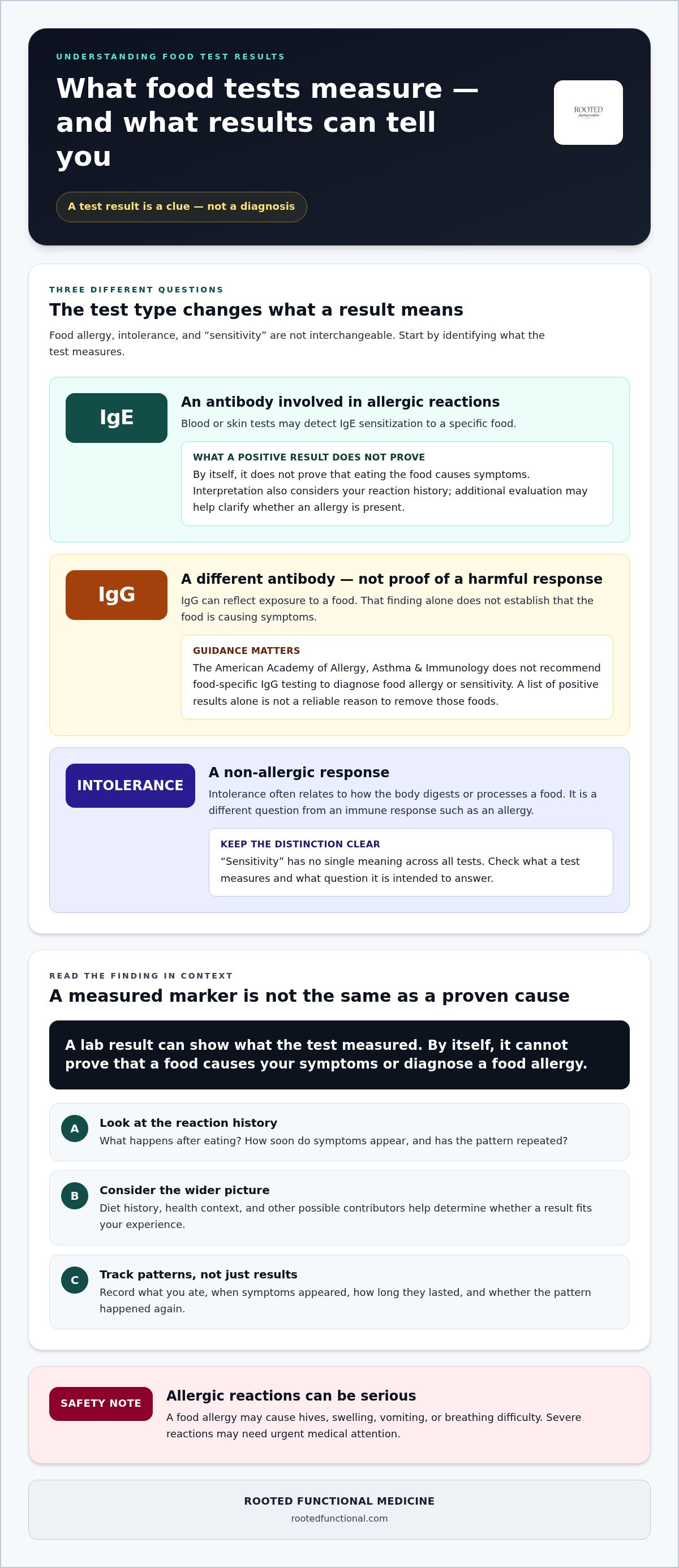
A food allergy involves the immune system and can cause symptoms such as hives, swelling, vomiting, or breathing difficulty. Severe reactions may need urgent medical attention. Intolerance does not involve the same allergic response and may relate to how the body digests or processes a food. The Food intolerance overview describes this range of possible mechanisms and symptoms. “Sensitivity,” by contrast, has no single meaning across all tests. Before interpreting a result, identify what the test measures and what question it is intended to answer.
When someone might consider food sensitivity testing
An assessment may be worth discussing when symptoms recur and you suspect food could be one influence. You might notice digestive discomfort after certain meals, for example, or symptoms that seem to fluctuate with what you eat. These observations are useful clues, not proof. The same symptom can have different contributors, and timing can be difficult to interpret.
A food and symptom record can make those observations more useful: note what you ate, when symptoms appeared, how long they lasted, and whether the pattern happened again. Your diet history and broader health context matter too. A result is most useful when considered alongside these details, rather than treated as a stand-alone instruction to eliminate foods. If digestive symptoms like bloating are part of your experience, explore this root-cause approach to bloating for additional context.
How Food Sensitivity Tests Work, and What Different Results Mean
Once you know that allergy, intolerance, and sensitivity are different questions, look at what the test actually measures. The sample type alone, such as blood, doesn’t tell you whether a result can explain symptoms. The testing method and the clinical question matter.
What IgE and IgG tests measure
IgE is an antibody involved in allergic reactions. A blood or skin test may detect IgE sensitization to a specific food, but a positive result by itself doesn’t prove that eating the food causes symptoms. A clinician interprets it alongside your reaction history and, when appropriate, may use additional evaluation to clarify whether an allergy is present. The difference between food allergy and intolerance also helps explain why these tests aren’t interchangeable.
IgG tests measure a different antibody. IgG can reflect exposure to a food, but that finding alone does not establish a harmful response or explain symptoms. The American Academy of Allergy, Asthma & Immunology does not recommend using food-specific IgG testing to diagnose food allergy or sensitivity. A long list of positive results may look definitive, but it isn’t a reliable reason by itself to remove those foods from your diet.
Why test results need symptom and health context
A test result can show what the test measured; by itself, it can’t prove that a food causes your symptoms or diagnose a food allergy. That distinction separates a lab measurement from its clinical meaning. A marker can be measured accurately without answering the question that matters to you: whether a particular food is connected to a real, repeatable reaction.
Interpretation starts with your history. What happens after eating? How soon do symptoms appear? Has the pattern repeated? Are there other health or dietary factors to consider? The answers help determine whether a result fits your experience or is a finding without a clear connection. No single panel should be assumed to identify every trigger or explain every symptom.
That’s why food sensitivity testing is best considered as part of an individualized assessment, not as a stand-alone verdict. For a plain-English overview of how functional medicine considers a person’s broader health picture, read this functional medicine guide. If you’d like support discussing test findings in the context of your symptoms, you can book a consultation.
Are Food Sensitivity Tests Accurate? Evidence, Limits, and Common Misunderstandings
A test can produce a clear result without proving that a food is behind your symptoms. “Accurate” depends on what is being measured and what question the test is meant to answer. A lab may reliably detect a marker, yet that marker may not show whether eating a food causes a meaningful reaction for you.
What test accuracy does, and does not, tell you
It helps to separate three ideas. Analytical accuracy asks whether a test measures its target correctly. Clinical validity asks whether that finding reliably identifies a health condition or predicts a reaction. Clinical usefulness asks whether the result can help guide a safe, appropriate decision for an individual.
These ideas aren’t interchangeable. A measurable antibody doesn’t automatically indicate a clinically meaningful response. The Academy of Nutrition and Dietetics explains concerns about the accuracy of food sensitivity tests, particularly tests that use IgG to make claims about food sensitivities. The American Academy of Allergy, Asthma & Immunology likewise advises against using food-specific IgG tests to diagnose food allergy or sensitivity. This doesn’t mean every testing method has the same evidence or purpose. It means results should be judged by the specific test, the marker measured, and the clinical question, not by a “positive” label alone.
A finding may be unrelated to the symptoms you’re trying to understand. Treating it as a confirmed trigger can lead to unnecessary avoidance, even if the lab measured the marker correctly.
Why a long list of flagged foods can mislead
A report naming numerous foods can feel like an explanation, especially after a long search for answers. But removing many foods at once makes it difficult to work out which change, if any, affected your symptoms. It can also make meals harder to plan and narrow the range of foods that contribute to a balanced diet.
Before making major changes, consider whether each flagged food fits your symptom history and whether there is a clear reason to test for it. Broad restriction based only on a panel can create new challenges without resolving the original concern. The useful question isn’t simply “Which foods are flagged?” It’s “What does this result mean alongside my history, and what is a reasonable next step?”
Don’t use a sensitivity panel to assess a suspected serious allergy. If eating a food causes a severe or rapidly developing reaction, such as breathing difficulty or swelling of the throat, seek urgent medical attention. A test report should never delay care for a potentially dangerous reaction.
How to Use Food Sensitivity Test Results Without Over-Restricting Your Diet
A test report can leave you with more questions than answers. Resist the urge to remove every flagged food at once. A measured process helps you explore possible patterns while keeping meals varied and decisions grounded in your experience.
A measured process for reviewing findings
Start with the full picture, not the panel alone. Review your symptoms, health history, current diet, and test method with a qualified clinician. Then focus on a small number of plausible questions. A food listed on a report may not match your symptoms or eating history, so a long list doesn’t have to become a long list of restrictions.
If a limited dietary change is appropriate, make it deliberate and agree on a point to reassess. During the trial, record:
What you ate and roughly when.
When symptoms began, what they felt like, and how long they lasted.
Other relevant context, such as changes in routine or health.
Look for a pattern over time rather than drawing conclusions from one meal or one difficult day. Keep your diet nutritionally balanced, and avoid removing several food groups without support. The goal is to learn whether a specific, reasonable change relates to your symptoms, not to follow a test result as a permanent rule.
When to avoid making food changes on your own
Get clinical guidance before changing your diet if you have complex health needs, already avoid multiple foods, or are concerned about meeting your nutritional needs. Support can help weigh test findings against your history and plan a change that is appropriately limited.
Symptom tracking is not the same as testing a suspected allergen. If you’ve had a serious reaction to a food, don’t deliberately eat it again to see what happens. Severe or rapidly developing symptoms, including difficulty breathing or swelling of the throat, require urgent medical attention. A food diary or sensitivity panel is not a substitute for immediate care.
Food sensitivity testing is most useful when results are considered alongside your symptoms and followed by thoughtful reassessment. If you’d like help putting findings in context and planning a personalized next step, book a personalized consultation.
Food Sensitivity Testing and Personalized Care at Rooted Functional Medicine
A test result is easier to work with when it’s considered alongside the person behind it. At Rooted Functional Medicine, food sensitivity care brings together an assessment, lab testing, consultation, and a personalized dietary protocol. The goal is to discuss what the findings may mean in the context of your symptoms and everyday eating, rather than treating a lab report as a complete answer on its own.
What a personalized assessment can bring together
Dr. Adrienne Guthrie leads care, with interpretation shaped by your individual context. That can include what you’ve noticed, your health history, your current diet, and how symptoms relate to your meals. Test findings are one part of that picture. They don’t automatically establish that a food causes a reaction or explain every symptom.
Dietary guidance should reflect that context. Rather than applying a universal list of foods to avoid, a personalized protocol can help you consider appropriate changes with your needs and eating patterns in mind. The aim is a thoughtful plan, not unnecessary restrictions or a promise of diagnosis, cure, or guaranteed symptom relief.
How to take the next step with confidence
It’s understandable to feel uncertain when symptoms persist and test claims sound definitive. A consultation offers space to review what you’ve experienced, discuss what the results can and can’t tell you, and consider suitable next steps. You don’t need to arrive with a perfect record or a clear explanation. Sharing what you’ve noticed can help inform the conversation.
Rooted Functional Medicine provides food sensitivity testing and personalized dietary protocols, with secure telehealth appointments available nationwide. If you’re ready to explore your results as part of an individualized assessment, book a food sensitivity consultation.
Turn Test Results Into a Thoughtful Next Step
Food sensitivity testing can be a starting point for questions, not a final verdict. Test results need to be weighed against your symptoms, health history, and eating patterns. Broad food restrictions aren’t automatically the answer. A careful, personalized approach can help you explore possible connections without treating every flagged food as a confirmed trigger.
At Rooted Functional Medicine, food sensitivity care brings together assessment, lab testing, consultation, and a personalized dietary protocol. Dr. Adrienne Guthrie, PhD, DNM, leads care, and secure telehealth appointments are available nationwide. The focus is on putting findings in context and discussing practical next steps that fit your situation.
You deserve clarity without guesswork or unnecessary restrictions. Book a personalized food sensitivity consultation to review your concerns and explore an individualized path forward.
Frequently Asked Questions
What is food sensitivity testing, and what does it test for?
Food sensitivity testing is an assessment intended to explore possible connections between foods and symptoms. The method determines what it measures, such as a particular antibody or other marker; tests don’t all answer the same clinical question. A result may contribute information, but it can’t by itself confirm that a food causes symptoms. Consider findings alongside your symptom history, diet, and broader health context.
Is food sensitivity testing accurate?
Accuracy depends on the specific test, what it measures, and the question it’s meant to answer. A test may detect a marker without establishing that the marker explains your symptoms. That’s why a positive result shouldn’t automatically be treated as a diagnosis or a reason to avoid a food. Ask what the method can establish, then interpret the result alongside your history and reported reactions.
Are IgG food sensitivity tests reliable?
IgG results alone aren’t considered reliable for diagnosing food sensitivities. The American Academy of Allergy, Asthma & Immunology advises against using food-specific IgG tests for this purpose. IgG can reflect exposure to a food, but it doesn’t prove that eating it causes a harmful reaction. A long list of positive results isn’t, by itself, a sound basis for eliminating those foods.
What is the difference between a food allergy, intolerance, and sensitivity?
A food allergy is an immune response that can sometimes be severe and require urgent care. An intolerance is a non-allergic response, often related to digestion or metabolism. “Sensitivity” is a broad term whose meaning varies with the test and context. These terms aren’t interchangeable, so the suspected reaction and the question being investigated matter when deciding what evaluation is appropriate.
Can a food sensitivity test identify which foods cause my symptoms?
A test may offer information to consider, but a result alone can’t prove that a specific food causes your symptoms. Symptom timing, repeatability, health history, and everyday eating patterns help put findings in context. No single panel should be assumed to identify every trigger or explain every symptom. A clinician can help assess whether results fit your experience before you make dietary changes.
How should I prepare for food sensitivity testing?
Preparation depends on the specific test, so follow the instructions provided for that assessment. Before testing, make a note of your symptoms, when they occur, foods you suspect, and relevant health history. Don’t stop prescribed medication or make major dietary changes just to prepare unless a qualified clinician advises you to. For suspected allergy symptoms, don’t deliberately eat a food to test your reaction.
What should I do after receiving food sensitivity test results?
Review the findings with a qualified clinician before making major or lasting food restrictions. Consider how each result relates to your symptoms, history, and current diet, then discuss whether a limited dietary change and planned reassessment make sense. Rooted Functional Medicine combines assessment, lab testing, consultation, and a personalized dietary protocol. Dr. Adrienne Guthrie, PhD, DNM, leads care, with secure telehealth available nationwide.


