Functional Medicine for Estrogen Dominance: 2026 Guide
What if symptoms you’ve been told are “just hormones” are clues to a bigger picture, rather than proof of estrogen dominance? PMS, bloating, breast tenderness, and cycle changes can feel frustrating and real, but they don’t point to one cause on their own. Functional medicine for estrogen dominance can offer a way to investigate whether hormones may be contributing, without treating an online label as a diagnosis.
You deserve more than a one-size-fits-all hormone protocol. “Estrogen dominance” isn’t a universally accepted medical diagnosis, and symptoms alone can’t confirm it. A careful assessment looks at your health history, life stage, symptom patterns, and, when appropriate, lab results in context. Testing can provide useful clues, but no single result tells the whole story.
In this guide, you’ll learn what people mean by estrogen dominance, which symptoms may overlap with other health concerns, and how to think about hormone testing responsibly. We’ll also explain what a personalized, lab-guided functional medicine approach can involve and how a Root Cause Consultation can help organize your history and relevant findings into informed next steps, without self-diagnosing or chasing a universal fix.
Table of Contents
What Does Estrogen Dominance Mean, and What Symptoms Might Prompt Questions?
What Can Influence Estrogen-Related Symptoms and Hormone Patterns?
How Does a Careful Functional Medicine Assessment Evaluate Hormone Concerns?
What Can You Do Safely While Investigating Possible Hormone Imbalance?
How Rooted Functional Medicine Approaches Hormone-Related Concerns
What Does Estrogen Dominance Mean, and What Symptoms Might Prompt Questions?
Cycle changes, breast tenderness, or bloating can disrupt daily life. Those symptoms deserve attention, even when their cause isn’t obvious. They don’t automatically mean estrogen is responsible. Similar concerns can arise with normal hormone shifts, different life stages, medications, or other health conditions. Rather than asking only, “Do I have estrogen dominance?” ask, “What could explain this pattern, and what information would help clarify it?”
A quick distinction
“Estrogen dominance” is a commonly used phrase for a proposed imbalance involving estrogen relative to progesterone, or for concerns about estrogen activity or metabolism. It is not a standalone, universally recognized diagnosis. A measured hormone level is a test result taken at a particular time and interpreted in context. Neither the phrase nor one result alone establishes the cause of symptoms.
Is estrogen dominance a diagnosis or a shorthand?
In a careful clinical assessment, your health and the overall pattern matter more than a label. The phrase may refer to the idea that estrogen’s effects are relatively greater than progesterone’s, rather than meaning estrogen is uniformly high. Hormones fluctuate, and interpretation can depend on factors such as cycle timing and life stage. A single symptom, hormone value, or ratio can’t prove that you have “estrogen dominance.”
There are related clinical terms for excess estrogen activity. For background on hyperestrogenism, keep in mind that a general reference can’t determine what a specific person’s symptoms or test results mean. Functional medicine for estrogen dominance should begin with questions about the individual, not an assumption that a popular phrase explains every concern.
Which symptoms lead people to ask about estrogen?
People may wonder about hormone patterns when they notice changes such as:
Periods that have become irregular or changed in flow
Breast tenderness, bloating, or noticeable premenstrual changes
New or changing symptoms around perimenopause or another life transition
These are examples of concerns to discuss, not a diagnostic checklist. Symptoms can overlap with many health conditions, and their meaning may vary with age, cycle timing, medications, and health history. A familiar symptom can have more than one possible explanation. A new or persistent change is worth considering in context rather than attributing to estrogen by default.
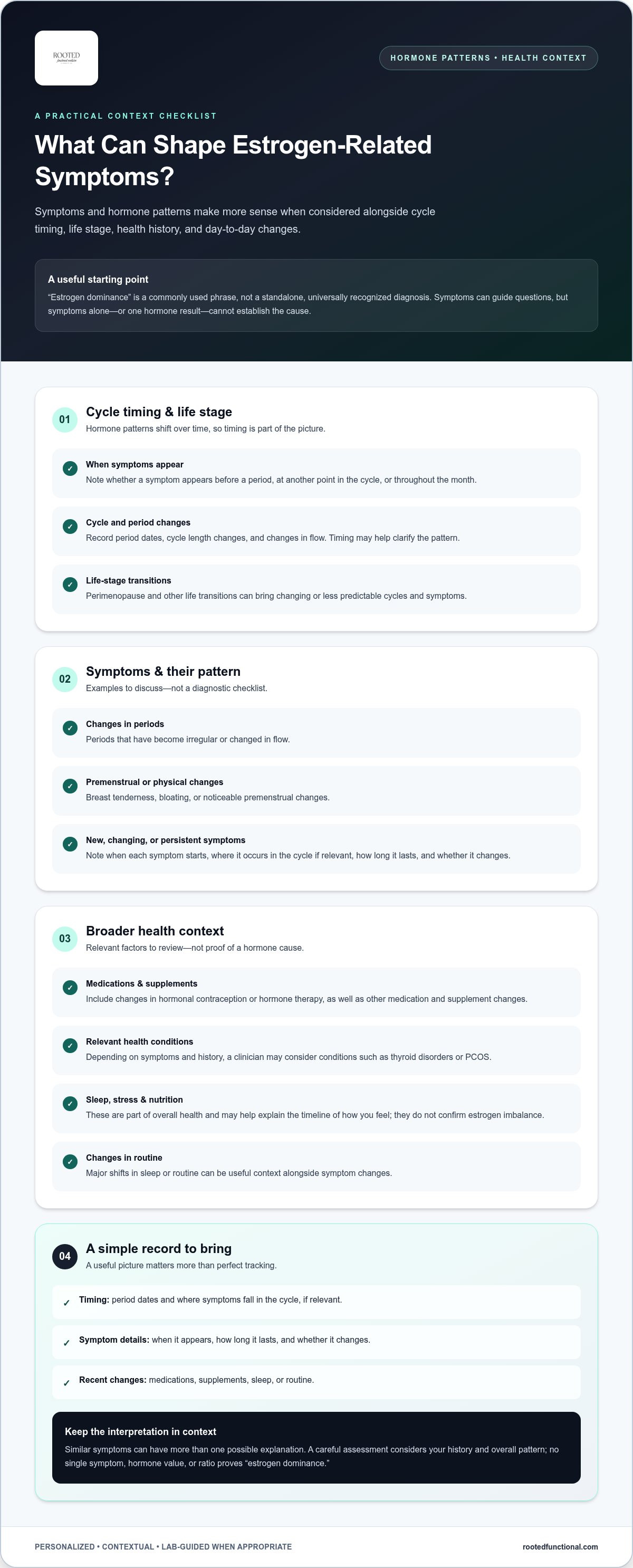
Start with a simple record. Note when a symptom appears, where you are in your cycle if relevant, how long it lasts, and whether it changes. Include medication or supplement changes and major shifts in sleep or routine. This can make patterns easier to describe and give a clinician a clearer starting point. It won’t diagnose the cause, and you don’t need to track perfectly. The goal is a useful picture, not a label chosen in advance.
What Can Influence Estrogen-Related Symptoms and Hormone Patterns?
Hormones don’t follow a fixed pattern throughout life. Estrogen and progesterone shift across the menstrual cycle, and patterns can change during perimenopause and other life stages. That context matters when you’re trying to understand new or changing symptoms. Symptom patterns alone cannot identify a hormone imbalance. They can guide questions, but they don’t establish a cause.
Sleep, stress, nutrition, medications, and health conditions may all be relevant parts of your health history. That doesn’t mean any one of them automatically causes an estrogen problem. A careful assessment considers what changed, when it changed, and how different factors might fit together, while staying open to explanations beyond hormones.
How can cycle timing and life stage affect interpretation?
A symptom that appears before a period may follow a different pattern from one that occurs throughout the month. Cycle length and timing can also change, while perimenopause may bring less predictable cycles and shifting symptoms. Those changes don’t automatically mean estrogen is excessive. Recording period dates alongside symptoms can clarify timing and give a clinician a more useful history than a general note that symptoms “come and go.”
Which broader health factors may matter?
A clinician may review your medication and supplement history, including changes in hormonal contraception or hormone therapy, as well as relevant diagnoses. Conditions such as thyroid disorders or PCOS may also be part of the broader picture, depending on your symptoms and history. This isn’t a checklist for self-diagnosis. It’s a way to avoid narrowing the investigation too quickly.
Sleep, stress, and nutrition matter to overall health and may shape how you feel day to day. They are context, not proof of a specific hormone cause. For example, noting disrupted sleep alongside symptom changes may help clarify the timeline, but it can’t confirm estrogen imbalance. Likewise, a restrictive diet or a new supplement shouldn’t be assumed to “balance hormones” without an individualized reason and appropriate guidance.
Be cautious of explanations that assign every symptom to a single root cause, including vague claims about “toxins” or “liver burden.” Such language may sound definitive, but it doesn’t replace a clear clinical question, relevant history, and appropriate evidence. In functional medicine for estrogen dominance, responsible investigation means distinguishing what is known from what is proposed and avoiding changes to prescribed medication without discussing them with the prescribing clinician.
A simple record can help: cycle dates, symptom timing, sleep changes, major routine shifts, and medication or supplement changes. If you’d like support reviewing symptoms and health history in context, you can book a Root Cause Consultation. The goal is a more informed investigation, not a conclusion drawn from one clue.
How Does a Careful Functional Medicine Assessment Evaluate Hormone Concerns?
A responsible assessment doesn’t begin with a preselected hormone panel or a promise to “balance” a number. It starts by understanding what you’re experiencing and what question needs answering. In functional medicine for estrogen dominance, testing may be part of the investigation, but it should follow your history and symptoms, not replace them.
A thoughtful evaluation generally moves through these steps:
Health history: Review menstrual and reproductive history, life stage, relevant diagnoses, medications, supplements, and other health concerns.
Symptom pattern: Clarify what changed, when it occurs, how it relates to the cycle or life stage, and how it affects daily life.
Relevant records: Consider prior lab results and other available medical information, including when tests were collected and what was happening at the time.
Testing, if appropriate: Select tests to address a specific clinical question, then interpret the findings alongside the history and symptoms.
What should a clinician learn before considering tests?
The first conversation should make room for your full story, not just a symptom label. A clinician may ask about cycle regularity, changes over time, pregnancy or menopause history when relevant, medications and supplements, and existing diagnoses. Bring prior results if you have them, along with a concise timeline of symptoms and medication changes. Clarifying your concerns and goals helps determine whether testing could add useful information.
Details can change the meaning of a result. For example, a test taken at one point in a menstrual cycle may not answer the same question as a test taken at another point. Hormonal medications and life stage may also affect what a result can tell you. Share these details rather than trying to adjust medication or time a test on your own.
What can hormone testing show, and what can it not show?
A hormone test measures selected markers using a particular method and sample at a particular time. It may contribute information relevant to the clinical question, but it can’t by itself explain every symptom or establish “estrogen dominance.” Results can vary in meaning based on timing, medications, life stage, and the reason for testing. A result outside a reference range also needs interpretation, not an automatic conclusion.
Hormone results need clinical context, not interpretation in isolation. The right test depends on what the clinician is trying to understand and your circumstances. More tests don’t necessarily mean clearer answers, and no single panel is right for everyone. A careful review connects findings to your history, considers what remains uncertain, and avoids treating a lab value as a complete diagnosis.
This is the difference between ordering a test and investigating a concern. An individualized assessment can help organize the next questions and determine whether additional testing is appropriate. It can’t guarantee a definitive explanation, and it shouldn’t lead to a one-size-fits-all protocol based on a single result.
What Can You Do Safely While Investigating Possible Hormone Imbalance?
You don’t have to solve the cause on your own before asking for help. While you investigate, focus on steady routines and useful information, not a quick hormone fix. A brief record can help you describe what’s happening and notice changes without treating every symptom as proof of an imbalance.
Keep notes in a calendar or phone. Record cycle dates if relevant, symptoms and their severity, sleep changes, and when medications or supplements are started, stopped, or adjusted. You don’t need a perfect log. A few clear observations can be more useful than trying to remember everything during an appointment.
Which everyday steps support a useful clinical conversation?
Consistent sleep habits and balanced meals can support general wellbeing, but they aren’t a guaranteed treatment for hormone-related symptoms. Choose routines that are realistic for your life and health needs. Avoid restrictive diets or major lifestyle changes based on online claims that one food or routine will correct estrogen levels.
Note how often symptoms happen, how intense they feel, and whether a timing pattern stands out.
Bring a current list of medications and supplements, including doses when known and recent changes.
Write down your main questions and bring relevant records or previous test results.
Don’t start or stop prescribed hormones or other medication on your own. High-dose supplements and products marketed to “balance hormones” can have risks or interact with medication. Discuss changes with an appropriate clinician who understands your health history. This is especially important if you’re pregnant, trying to conceive, have an ongoing condition, or already use hormone-related treatment.
When should symptoms be evaluated promptly?
Some concerns can be discussed in a planned appointment, especially if symptoms are mild and stable. Severe pain or unexpected heavy bleeding deserves prompt medical evaluation. Any bleeding after menopause should be assessed by a qualified clinician, even if it happens only once. Don’t assume it is caused by a hormone imbalance.
If symptoms feel urgent or could be an emergency, seek appropriate urgent or emergency medical care rather than waiting for a routine functional medicine appointment. Functional medicine for estrogen dominance can support a careful, individualized investigation, but it isn’t a substitute for timely evaluation of serious symptoms.
When you’re ready to review symptoms, health history, and relevant lab findings in context, a Root Cause Consultation can be a next step. The aim is to make sense of the information you have and consider appropriate questions, not to promise a diagnosis or a particular outcome.
How Rooted Functional Medicine Approaches Hormone-Related Concerns
Hormone concerns can feel confusing, especially when symptoms are real but the explanation is unclear. Rooted Functional Medicine takes an individualized, lab-guided approach rather than assuming one hormone pattern or protocol fits everyone. A Root Cause Consultation gives you space to discuss your concerns, health history, and relevant findings, then consider what may be useful to explore next.
What happens when care starts with the whole picture?
Care begins with your story. Dr. Adrienne Guthrie, PhD, DNM, leads the practice. A Root Cause Consultation includes an assessment of relevant health history and interpretation of functional lab work. You can share the symptoms you’re experiencing, when they began, how they affect you, and what questions you hope to address. Existing test results can add useful background, but they’re considered alongside your circumstances rather than treated as a diagnosis on their own.
If testing may help answer a specific question, the approach is to select and interpret lab work in context. The relevant test depends on the person and the clinical question. Not everyone needs the same tests, and results don’t guarantee a definitive explanation or a particular outcome. Findings may help guide further discussion, while areas of uncertainty remain part of an honest assessment.
This is one way functional medicine for estrogen dominance can differ from a preset hormone protocol: it starts with the individual, not an assumption that a popular label explains every symptom. The aim is to explore possible contributors thoughtfully and consider personalized next steps based on the available information.
Rooted’s care can complement appropriate medical care, but it doesn’t replace it. Hormone-related concerns may require evaluation or treatment beyond a functional medicine consultation. Severe or urgent symptoms need timely medical attention, and conventional medical care remains important for needs that fall outside this consultation’s role.
How can readers take a low-pressure next step?
You don’t need to arrive with a self-diagnosis or a complete collection of test results. Bring the questions you want answered, a concise symptom timeline, and any relevant records or current lab findings you already have. These details can help make the conversation more focused. A consultation can review your history and available information, but it can’t promise that testing will identify one cause or establish estrogen dominance as a diagnosis.
Rooted offers consultations in person and through secure telehealth nationwide. If an individualized conversation about your hormone-related concerns feels like a helpful next step, book a Root Cause Consultation. You can begin with what you know, what you’re experiencing, and what you’d like to understand more clearly.
Take the Next Step With Clarity
You don’t need to arrive with a perfect explanation for what you’re feeling. Start with the questions that matter to you and the changes you’ve noticed. A thoughtful conversation can help you decide what to explore, what information may be useful, and which next steps fit your circumstances.
That’s the purpose of functional medicine for estrogen dominance: to approach hormone concerns with curiosity, care, and attention to the individual, rather than relying on a label or a one-size-fits-all answer. An assessment can offer perspective, but it can’t guarantee a diagnosis or outcome. Your symptoms still deserve to be heard, and you can take an informed next step without rushing.
If you’re ready to discuss your concerns and health history in a personalized consultation, book a Root Cause Consultation. You can begin with what you know and take the investigation one step at a time. There is room for both careful questions and hope.
Frequently Asked Questions
Is estrogen dominance a recognized medical diagnosis?
No. “Estrogen dominance” is not a universally recognized standalone medical diagnosis. Clinicians may assess specific hormone-related conditions or hormone levels, but the phrase itself doesn’t identify a cause or determine treatment. If you see it on a test report or wellness website, treat it as a prompt for questions, not a confirmed explanation. Functional medicine for estrogen dominance should still consider your symptoms, medical history, and appropriate evaluation.
Can estrogen dominance cause breast tenderness?
Breast tenderness can occur with hormone fluctuations, including changes around the menstrual cycle, but it doesn’t establish that estrogen is the cause. Note whether tenderness is cyclical or persistent, affects one breast or both, and occurs with a lump, skin change, or nipple discharge. A new or persistent breast change deserves clinical assessment rather than being attributed to a hormone label or managed only with supplements.
Can hormonal birth control affect symptoms associated with estrogen dominance?
Hormonal birth control can affect bleeding patterns and may be associated with symptoms such as breast tenderness for some people. Effects vary by method and individual, so a symptom change after starting or switching contraception is useful context, not proof of estrogen dominance. Record when the change began and which method you use. Discuss concerns with a qualified clinician before stopping or changing contraception, especially if you rely on it to prevent pregnancy.
Can estrogen-related symptoms happen during perimenopause?
Yes. Perimenopause can bring changes in cycle timing and symptoms as reproductive hormones shift, but not every new symptom is caused by estrogen. For example, changes in sleep or mood may have several possible contributors. If symptoms are disrupting daily life, note when they occur and how they change over time. That timeline can help a clinician distinguish a possible life-stage pattern from other health concerns that may need attention.
Are at-home hormone tests reliable for identifying estrogen dominance?
An at-home test may measure selected hormones, but it can’t by itself identify “estrogen dominance” or explain symptoms. Accuracy and usefulness depend on the test method, sample collection, timing, and the question being investigated. A result can be difficult to interpret without knowing medications, cycle stage, or other relevant factors. Before paying for a test, clarify what it measures and how the result will inform a clinical discussion.
Should I stop hormone medication if I suspect estrogen dominance?
No. Don’t stop or change prescribed hormone medication without speaking with the clinician who manages it. Abrupt changes may affect symptoms or the reason the medication was prescribed, and a concern about “estrogen dominance” alone isn’t enough to decide what to do. Write down what you’re experiencing, when it began, and any recent dose changes. A clinician can help weigh your concerns against your treatment history and goals, and telehealth platforms like AskMyDoc.ca make it easy to consult a licensed physician virtually.
Can estrogen dominance affect fertility?
The phrase “estrogen dominance” alone can’t determine whether fertility is affected. Fertility depends on multiple factors, including ovulation, reproductive health, age, and partner factors. If you’re trying to conceive and have irregular cycles or other concerns, discuss them with a qualified clinician rather than using an online hormone label to predict your chances. Dedicated providers like Sincere Healthcare Group emphasize that a tailored evaluation can focus on the specific fertility question and whether further assessment is appropriate.
How long does functional medicine care for hormone concerns take?
There isn’t one standard timeline. The length of care depends on your concerns, health history, whether testing is appropriate, and what questions need follow-up. An initial consultation can help clarify possible next steps, but it can’t guarantee a diagnosis or a specific schedule for improvement. Ask how progress will be reviewed and what would prompt reassessment. Be cautious of anyone promising a fixed timeline or certain hormone result.