Leaky Gut Symptoms: Meaning & Actions for 2026
What if the leaky gut syndrome symptoms you’re noticing are clues to investigate, not proof of a single condition? Bloating, changes in bowel habits, fatigue, or food reactions can leave you searching for answers, and online symptom lists may make one explanation seem certain. But these experiences overlap with many digestive and other health conditions.
“Leaky gut syndrome” isn’t a formal medical diagnosis. Increased intestinal permeability, the scientific term often meant by “leaky gut,” is a real, measurable phenomenon studied in connection with certain conditions. That distinction matters: symptoms alone can’t tell you whether permeability is involved or what may be driving how you feel.
This guide explains which symptoms are commonly attributed to leaky gut, what the evidence can and can’t establish, and when symptoms deserve medical evaluation. You’ll also find practical questions to discuss with a clinician and measured next steps, so you can seek answers without treating an online label as a diagnosis.
Table of Contents
Leaky gut syndrome symptoms: what people commonly notice
Persistent digestive changes can be exhausting, especially when they’re hard to explain or keep returning without a clear answer. You may recognize several items on a long online list of leaky gut syndrome symptoms. That recognition can feel validating, but it doesn’t reveal what’s causing your symptoms or confirm that intestinal permeability is involved.
People use “leaky gut” to describe a range of digestive and whole-body concerns. The scientific term, Intestinal Permeability (Leaky Gut), describes a property of the gut barrier, not a diagnosis made by matching symptoms to a checklist. Keeping that distinction in mind helps put symptom lists in perspective.
Digestive symptoms often associated with the leaky-gut label
Bloating, abdominal discomfort, diarrhea, constipation, and changes in digestion are commonly attributed to the leaky-gut label. Some people notice symptoms after particular meals; others experience changes that come and go. These patterns are worth describing, but they aren’t proof of a specific cause.
Similar complaints can occur with many gastrointestinal conditions. A single symptom, or several together, cannot establish that someone has increased intestinal permeability. Pay attention to what’s happening without treating a familiar symptom list as a diagnosis.
Fatigue, skin concerns, and other symptoms: what they can tell you
Fatigue, headaches, joint concerns, and skin changes also appear on online lists of leaky gut symptoms. People may report these concerns alongside digestive issues, but an association doesn’t show that gut permeability caused them. Each can have different explanations, so describe them to a clinician rather than assuming they point to one gut-related problem.
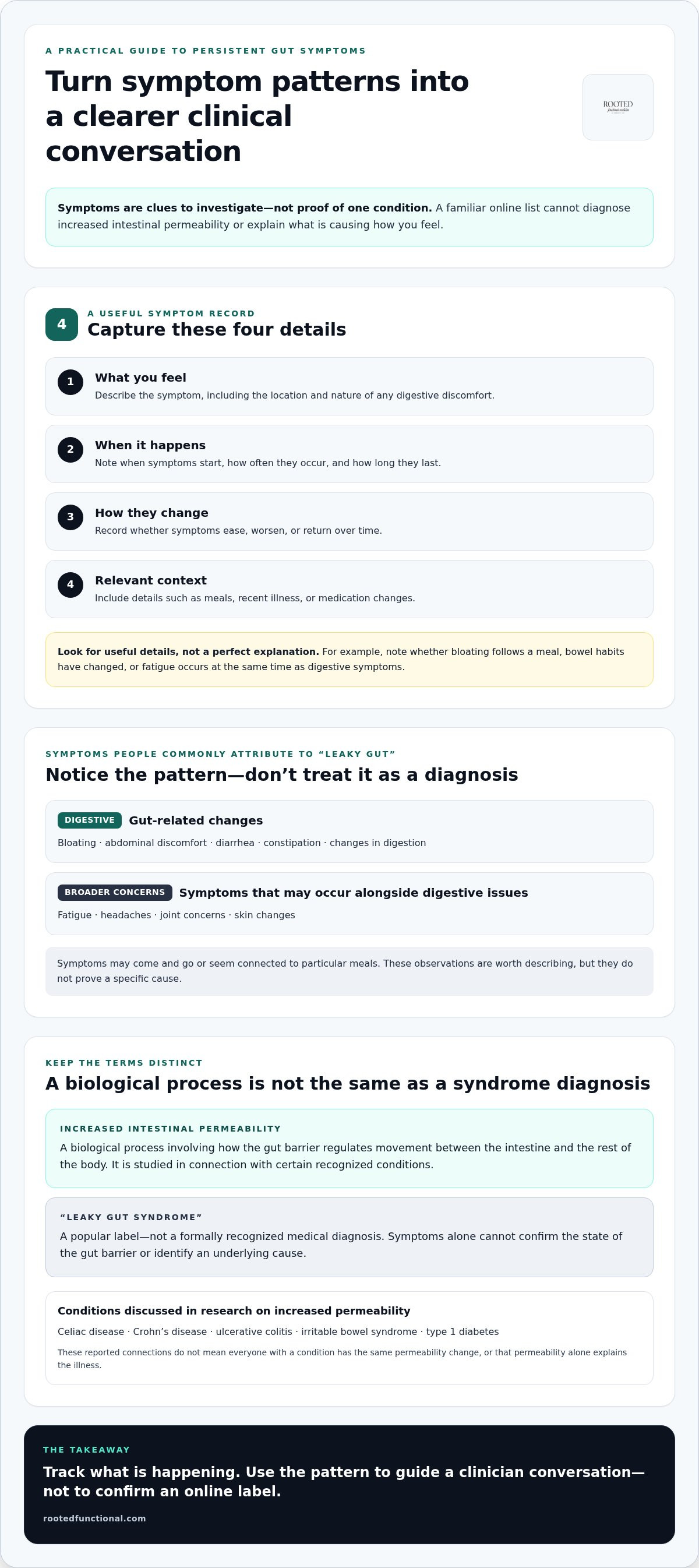
Symptoms alone cannot diagnose increased intestinal permeability. They can show what you’re experiencing and help guide a conversation, but they can’t confirm the state of the gut barrier or identify the underlying reason. Treat the pattern as a starting point for questions, not a conclusion.
A brief symptom record can make that conversation more specific. Note:
What you feel, including the location and nature of digestive discomfort.
When symptoms start, how often they occur, and how long they last.
Changes over time, including whether symptoms ease, worsen, or return.
Relevant context, such as meals, recent illness, or medication changes.
Look for useful details, not a perfect explanation. For example, record whether bloating follows a meal, whether bowel habits have changed, and whether fatigue occurs at the same time as digestive symptoms. A clinician can use that history to help decide what deserves further evaluation. If symptoms persist or interfere with daily life, discuss them rather than relying on an online label.
What leaky gut means: intestinal permeability versus a syndrome diagnosis
The phrase “leaky gut” can sound like a clear explanation for difficult symptoms. In research, the related term is increased intestinal permeability: a change in how the gut barrier regulates movement between the intestine and the rest of the body. That biological process is different from “leaky gut syndrome,” which is not currently a formally recognized medical diagnosis.
Intestinal permeability describes a biological process; “leaky gut syndrome” is a popular label, not a diagnosis. Keeping those ideas separate helps you ask better questions without assuming that a symptom checklist proves what is happening inside your gut.
How the intestinal barrier works in plain English
Think of the intestinal lining as a selective gate, not a solid wall with no openings. It allows nutrients and other substances to pass in controlled ways while helping keep other material within the gut. Cells and the connections between them contribute to this barrier, and its function can change. Normal permeability is part of how the gut works. A change in permeability does not automatically mean illness, nor does it explain every symptom.
What research does, and does not, establish
Research has documented increased intestinal permeability in connection with certain recognized conditions, including celiac disease, Crohn’s disease, ulcerative colitis, irritable bowel syndrome, and type 1 diabetes. This doesn’t mean everyone with these conditions has the same degree of permeability change, or that permeability alone explains the illness. Researchers continue to study whether it is a contributor, a consequence of inflammation, or part of a more complex relationship.
A 2024 review of the research provides context for these proposed connections, but evidence about a biological mechanism does not establish that a broad collection of chronic symptoms comes from one cause. A review available through the NIH Research on Leaky Gut and Autoimmunity also discusses proposed links between gut-barrier changes and autoimmune disease. Such discussion is not proof that a person’s fatigue, digestive changes, or other concerns are caused by increased permeability.
This distinction matters when interpreting tests, too. There is no standardized routine medical test that diagnoses “leaky gut syndrome.” Some tests and markers are used in research or by some practitioners, but a result should be understood in context, not treated as confirmation of a syndrome or a complete explanation for symptoms.
If symptoms persist, a clinical discussion can help clarify what needs evaluation and whether a personalized approach is suitable. Rooted Functional Medicine’s Root Cause Consultation is a 30-minute health-history interview focused on your concerns and suitability for care. The $147 fee includes the interview and is applied toward any future package. Functional medicine services aren’t covered by insurance.
Could another condition explain your symptoms? Compare possibilities carefully
Bloating, abdominal pain, diarrhea, and changes in bowel habits can appear in very different conditions. A broad cluster of leaky gut syndrome symptoms does not prove that intestinal permeability is the cause. The pattern can guide questions, but only an appropriate clinical evaluation can assess possible explanations.
Why overlapping symptoms need a broader clinical view
Duration, severity, timing, and personal history all add context. Sudden diarrhea after a possible exposure raises different questions than recurring bowel changes over a long period. Blood in stool or unintended weight loss also changes the conversation. These examples aren’t diagnoses, and they don’t mean every person needs the same tests or treatment plan.
This comparison is a starting point for discussion, not a way to diagnose yourself:
Symptoms can overlap, and more than one factor may be relevant. The aim is not to replace one unproven label with another. Give a clinician useful details to consider alongside your medical history, so you can discuss what evaluation, if any, makes sense for you.
When to seek prompt medical assessment
Don’t wait on a self-directed “leaky gut” plan if symptoms are severe, getting worse, or concerning. Seek prompt medical assessment for signs such as severe abdominal pain, blood or black stools, repeated vomiting, inability to keep fluids down, fainting, or signs of dehydration. Functional medicine education does not replace urgent or conventional medical evaluation.
If symptoms aren’t urgent but continue or disrupt daily life, arrange a clinical discussion and bring your notes. A clear timeline can help move the conversation beyond a broad symptom label toward questions that fit your situation.
Suspected Leaky Gut: A Practical Next-Step Plan
If you’re trying to make sense of ongoing digestive symptoms, you don’t need to solve the cause before asking for help. Treat the leaky-gut label as a question, not a conclusion. A clear timeline and relevant health details can make a clinical discussion more useful, especially because bloating and bowel changes can have many explanations. You can also review this guide to bloating causes for context, while remembering that reading alone can’t identify your cause.
Prepare a useful symptom history
Keep the record simple. Note when symptoms began, how often they occur, how severe they feel, and whether your bowel habits have changed. Add details about timing and anything that seems to affect them. This isn’t a tool to diagnose yourself. It’s a way to give a clinician a clearer picture of what’s changed and what questions may be worth exploring.
Track the pattern. Record symptoms as they happen, including onset, frequency, severity, and duration. Note whether they’re improving, worsening, or recurring.
Add relevant context. Include known diagnoses, past health concerns, recent illness, and any family or personal history you think may matter.
List medicines and supplements. Write down what you take and any recent starts, stops, or dose changes. Don’t stop prescribed medicine on your own; discuss concerns with the clinician who manages it.
Arrange a clinical discussion. Bring your notes and describe what’s affecting daily life. Ask what possibilities fit your history and whether evaluation is appropriate.
Approach tests, diets, and supplements with care
Test choice should follow the clinical question and your individual context. No single test result should be treated as proof of “leaky gut syndrome,” and a broad online symptom list can’t tell you which tests are useful. Share what you’ve already tried, including food exclusions and supplements, so the clinician can consider the full picture.
Be cautious about making several changes at once. Extreme elimination diets can make it harder to identify what affects symptoms and may restrict your food choices unnecessarily. Supplements can also have risks or interact with medicines. Discuss a restrictive diet or new supplement with a qualified professional before starting, particularly if you have a diagnosed condition or take medication.
If persistent symptoms have left you unsure what to do next, a Root Cause Consultation is a 30-minute health-history interview to discuss your concerns and determine whether Rooted Functional Medicine’s care approach is suitable. The fee is $147 and is applied toward any future package. Care is virtual, and insurance doesn’t cover functional medicine services.
How Rooted Functional Medicine approaches persistent gut symptoms
Ongoing digestive concerns can be frustrating, especially when online searches turn symptoms into a confident-sounding label. Rooted Functional Medicine takes a personalized, lab-based approach to discussing persistent symptoms and exploring possible contributing factors. The goal is to understand your health history and consider what may be relevant to your situation, not to assume that leaky gut syndrome symptoms point to one diagnosis.
Functional medicine looks at health history and potential root causes as part of a broader picture. If you’re new to the approach, this guide to functional medicine doctors explains the general care model. Rooted provides care virtually nationwide.
What a Root Cause Consultation is designed to do
The initial Root Cause Consultation is a 30-minute health-history interview. It gives you space to discuss persistent concerns, relevant diagnoses, and the timeline of your symptoms. The conversation also helps determine whether functional medicine care may be suitable for you. The $147 fee includes this initial interview and is applied toward any future package. The consultation isn’t a promise of a diagnosis, a particular test, or a specific outcome.
If further evaluation is appropriate, advanced functional lab testing may help inform individualized protocols. Testing is selected in context and used to guide care; it does not prove a “leaky gut syndrome” label. Results need to be considered alongside your history and other relevant clinical information. Rooted’s programs are natural and medication-free, and they do not replace prescribed care. Continue prescribed treatment as directed, and discuss changes with the clinician who manages it.
If you’d like to discuss whether this approach fits your persistent symptoms, you can Book a Root Cause Consultation. The conversation is a starting point for understanding your history and suitability for care, not a guarantee of a particular plan or result.
Explore a personalized next step without pressure
Functional medicine services are not covered by insurance. Keep that in mind as you consider the care model and decide what next step feels appropriate. Whether you pursue functional medicine or another form of evaluation, you deserve a thoughtful conversation about ongoing symptoms and the questions behind them.
Digestive symptoms can have overlapping explanations. A lab result may add information, but it cannot turn a broad symptom pattern into proof of one cause. Persistent symptoms deserve careful assessment, a clear discussion of your history, and next steps grounded in your individual needs, not an assumed label.
Take the Next Step Toward Clearer Answers
You don’t have to settle on a label before asking thoughtful questions about your health. The leaky gut syndrome symptoms you’ve noticed can be a reason to seek a closer look, not proof of one cause. Keep track of what’s changing and bring your concerns into a conversation focused on your individual history.
If you’re considering a personalized functional medicine approach, a Root Cause Consultation is an opportunity to discuss persistent symptoms and explore whether this care is suitable for you. Rooted Functional Medicine uses advanced functional lab testing to inform individualized protocols, with ongoing email support as care continues. Functional medicine services aren’t covered by insurance.
Book a Root Cause Consultation for a 30-minute health-history interview. The $147 fee is applied toward any future package. You deserve to be heard, and you can move forward without assuming an answer before the right questions are asked.
Frequently Asked Questions
Is leaky gut syndrome a real medical diagnosis?
No. “Leaky gut syndrome” isn’t currently a formally recognized medical diagnosis. Increased intestinal permeability is a biological process studied in specific health contexts, but it isn’t diagnosed by matching leaky gut syndrome symptoms to a checklist. If you’re concerned, ask a clinician which recognized conditions could fit your situation and what evaluation may be useful. A popular label alone can’t identify the cause or determine appropriate care.
Can stress cause leaky gut symptoms?
Stress can affect digestion and may influence how strongly some people experience symptoms, but that doesn’t show that stress alone has caused increased intestinal permeability. If symptoms seem to flare during stressful periods, note the timing alongside sleep, meals, and bowel changes. This context can help a clinician consider stress as one part of the picture without overlooking other explanations. Persistent or severe symptoms still deserve appropriate assessment.
Can gluten cause leaky gut?
Gluten can harm the intestinal lining in people with celiac disease, an immune-mediated condition triggered by gluten. That doesn’t mean gluten causes increased permeability in everyone or that symptoms after eating it confirm celiac disease. If you’re considering testing, speak with a clinician before removing gluten, since changing your diet first may affect test interpretation. A careful evaluation can help distinguish celiac disease from other food-related concerns.
Can probiotics heal leaky gut syndrome?
Probiotics aren’t an established cure for “leaky gut syndrome,” and no single probiotic can be assumed to repair the gut barrier or resolve digestive symptoms. Effects can vary by the probiotic strain, the person, and the health concern being addressed. Before starting one, review your symptoms, health history, and current medicines with a qualified professional. That conversation can help you weigh whether a specific product is appropriate and what to monitor.
How long does it take for intestinal permeability to improve?
There isn’t one reliable timeline. The answer depends on what’s contributing to a permeability change, whether an underlying condition is present, and how improvement is being assessed. There also isn’t a standardized routine test used to track “leaky gut syndrome” in everyday care. Rather than relying on a promised number of days or weeks, ask your clinician what changes to monitor and when to review your symptoms or treatment plan.
Can leaky gut syndrome cause autoimmune disease?
Increased intestinal permeability has been observed in research on some autoimmune diseases, but that association doesn’t prove it causes autoimmunity. Researchers continue to examine how permeability, inflammation, and disease may relate, including whether changes are causes, consequences, or part of a more complex process. Having digestive symptoms or a suspected permeability change doesn’t mean you’ll develop an autoimmune disease. Discuss specific concerns and relevant family or medical history with a clinician.