Functional Medicine for Peripheral Neuropathy: Root Causes
Updated: Oct 9
What if persistent tingling, burning, or numbness deserves a closer look beyond symptom management alone? If an evaluation or treatment hasn’t brought clarity, it’s understandable to wonder what else might be contributing. Functional medicine for peripheral neuropathy takes an investigative approach alongside appropriate medical diagnosis and care.
You don’t have to choose between exploring possible underlying factors and continuing conventional treatment. A careful assessment may review your health history, symptoms, medications, and existing test results, then consider whether targeted testing could add useful information. The process is individualized: no single test explains every case, and investigating possible contributors can’t guarantee a specific cause or outcome.
This article explains what a functional medicine assessment may involve, what its limits are, and how to prepare for a conversation about next steps. The goal is to help you ask clearer questions while keeping your medical care connected. Don’t stop prescribed medication or neurological follow-up while exploring additional factors.
Table of Contents
What Does Functional Medicine for Peripheral Neuropathy Mean?
How a Functional Medicine Assessment Investigates Neuropathy Contributors
Does Functional Medicine Replace Neurological Diagnosis or Treatment?
How to Prepare for a Root-Cause Conversation About Neuropathy
Explore Rooted Functional Medicine’s Neuropathy Education and Next Steps
What Does Functional Medicine for Peripheral Neuropathy Mean?
Persistent numbness, tingling, burning, or weakness can wear you down, especially when an evaluation hasn’t answered why it’s happening. Exploring possible contributors can be part of the conversation, but it starts with understanding your individual health picture, not assuming that one explanation fits everyone.
Functional medicine for peripheral neuropathy is an individualized approach that considers a person’s health history and medical context to investigate possible contributors to nerve symptoms, alongside appropriate medical diagnosis and care.
Peripheral neuropathy describes a problem affecting nerves outside the brain and spinal cord. Its causes vary, so similar symptoms don’t necessarily point to the same condition or next step. This Peripheral neuropathy overview describes its classifications, symptoms, and possible causes. A clinician’s evaluation is still needed to interpret symptoms and determine appropriate care.
How is functional medicine different from symptom-only care?
Symptom support and investigation don’t have to compete. Medical care may focus on identifying the type of nerve problem and managing its effects. A functional medicine approach may also review broader health patterns and consider whether there are relevant contributors to explore. The aim isn’t to dismiss conventional care, but to add context where it may help. Learn more in this plain-English guide to what a functional medicine doctor does.
What symptoms and experiences may lead someone to seek another perspective?
People may experience pins and needles, reduced sensation, burning pain, unusual sensitivity to touch, or weakness. Symptoms can affect sleep, movement, work, and confidence, even when the reason remains unclear. A symptom list can’t diagnose neuropathy or identify its cause. New, worsening, or unexplained symptoms deserve medical evaluation. Tell a qualified clinician when symptoms began and how they affect daily life.
How a Functional Medicine Assessment Investigates Neuropathy Contributors
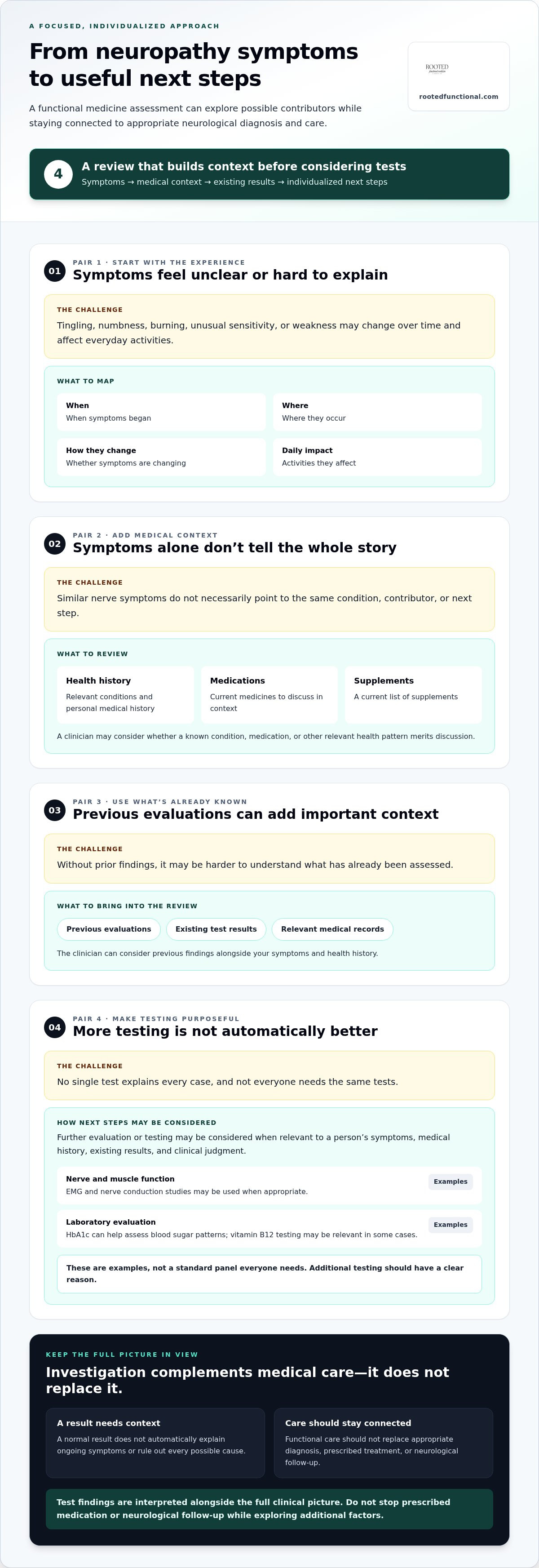
A useful assessment doesn’t begin by ordering every available test. It starts with the person’s symptoms and health history, then uses that context to guide focused questions and next steps. In functional medicine for peripheral neuropathy, the goal is to consider possible contributors without deciding in advance that there must be one root cause.
The review may move through a sequence:
Symptom history: When symptoms began, where they occur, whether they’re changing, and how they affect daily activities.
Medical context: Relevant health conditions, personal history, medications, and supplements.
Existing results: Previous evaluations and test findings, so the clinician can consider what has already been assessed.
Individualized next steps: Further evaluation or testing when it may be relevant to the person’s situation.
Possible contributors differ from person to person. A clinician may consider established causes and relevant health patterns, including whether a known condition, medication, or other factor merits discussion. The National Institute of Neurological Disorders and Stroke outlines the range of possible causes, including acquired, inherited, and unexplained forms. That range is one reason an individualized review matters.
What information may shape an individualized review?
Specific details can make the conversation more useful. Note where symptoms occur, when they started, how they have changed, and which activities they affect. Bring relevant medical history, a current medication and supplement list, and previous test results if available. These notes help you describe your experience, but they aren’t a substitute for a clinician’s assessment or a way to diagnose yourself.
How do neurological tests and laboratory work fit together?
Neurological tests and blood tests answer different questions. When appropriate, a clinician may use electromyography (EMG) and nerve conduction studies to assess nerve and muscle function. Laboratory evaluation may also be considered. For example, HbA1c can help assess blood sugar patterns, while vitamin B12 testing may be relevant in some cases. These are examples, not a standard panel everyone needs.
Test selection depends on a person’s symptoms, medical history, existing results, and clinical judgment. A normal result doesn’t automatically explain ongoing symptoms or rule out every possible cause. Findings need to be interpreted alongside the full clinical picture, and additional testing should have a clear reason.
If you’d like to discuss personalized investigation alongside your existing medical care, you can explore a Root Cause Consultation.
Does Functional Medicine Replace Neurological Diagnosis or Treatment?
No. Functional medicine should not replace appropriate diagnosis, prescribed treatment, or neurological follow-up. Neurological evaluation helps assess nerve symptoms, identify or rule out conditions, and guide medical care. Functional care may add a broader investigation of health factors that could be relevant. These roles can complement each other, but they aren’t interchangeable.
A root-cause approach also can’t promise there’s one identifiable cause, or that finding a contributor will cure neuropathy or restore nerve function. Possible causes vary, and sometimes an evaluation doesn’t reveal a clear explanation. The causes of peripheral neuropathy can include a range of health conditions and other factors. Conclusions should be based on an individual assessment, not assumptions.
When should someone seek prompt medical evaluation?
Long-standing symptoms still deserve timely clinical review, especially if they’re unexplained or changing. Seek prompt medical care for sudden, severe, or rapidly progressing neurological changes. Sudden weakness, rapidly worsening symptoms, or new problems with bladder or bowel control warrant urgent medical attention. These signs don’t identify a cause on their own, but they shouldn’t wait for a routine root-cause discussion.
Can functional care complement existing neuropathy treatment?
It can be considered alongside existing care when communication stays open between the clinicians involved. Share relevant evaluations and treatment plans so additional investigation can be considered in context. Functional medicine for peripheral neuropathy is a complementary approach, not a reason to stop prescribed medication, discontinue neurological follow-up, or delay testing your clinician has recommended.
How to Prepare for a Root-Cause Conversation About Neuropathy
It can be hard to recall every detail in an appointment, especially when symptoms have been affecting your day for a while. A few notes can help you explain what you’re experiencing and make more room for useful questions. You don’t need to arrive with a diagnosis or a theory about the cause. Describe what you’ve noticed, and let your clinician help interpret it.
What should you track before an appointment?
Write down when symptoms began, where you feel them, and whether they’ve changed or spread. Note any patterns you’ve noticed, what seems to make symptoms better or worse, and how they affect sleep, movement, work, or other daily activities. Include relevant changes in health, medication, supplements, or routine. Bring previous evaluation results and a current medication and supplement list, even if you’re unsure what may matter.
Which questions can make the conversation more useful?
Clear questions can help you understand both the assessment and its limits. Consider asking:
What established causes are relevant to my history and symptoms?
How will you consider broader health factors without assuming there’s one root cause?
Why are you recommending this test, and how might its result affect the next step?
How will this approach coordinate with my existing medical care?
What would be a realistic goal for this investigation, and what might remain uncertain?
These questions are useful whether you’re speaking with a neurologist, another medical clinician, or a functional medicine practitioner. In functional medicine for peripheral neuropathy, testing should have a clear purpose and be considered in light of your symptoms, history, and existing evaluations. You can also review Rooted Functional Medicine’s neuropathy root-cause education for broader context before your conversation.
Share relevant results across your care team, and keep taking prescribed medication and attending recommended follow-ups unless the clinician managing that care advises otherwise. If you’d like to discuss personalized root-cause exploration, you can schedule a Root Cause Consultation.
Explore Rooted Functional Medicine’s Neuropathy Education and Next Steps
If you’re trying to understand why neuropathy symptoms persist or what questions to raise with your care team, education can be a useful starting point. Rooted Functional Medicine’s Healing Neuropathy Webinar is an educational resource for people exploring possible contributors. It can help you decide what to discuss, but it isn’t a personal diagnosis, treatment plan, or promise of recovery.
What can readers expect from a root-cause-focused next step?
The webinar offers a way to learn about the root-cause perspective without assuming your symptoms have one explanation. General education can help you prepare questions and understand concepts, while decisions about your health depend on individual evaluation and care. Continue appropriate medical follow-up and share relevant health information with the clinicians involved in your care.
For some people, learning is only the first step. Rooted Functional Medicine also offers personalized functional medicine care and neuropathy root-cause testing. Testing is considered in the context of an individual’s situation. It isn’t a standard set of tests for everyone, and it may not identify a clear contributor. The purpose is to investigate thoughtfully, not to guarantee a finding or outcome.
How can you move forward while protecting your health?
Use what you learn to guide a grounded conversation. Keep notes about symptoms and questions, gather previous results, and make sure the clinicians supporting your care have relevant information. Functional medicine for peripheral neuropathy should complement appropriate medical evaluation, not replace it. Don’t stop prescribed medication, postpone recommended testing, or discontinue neurological follow-up because you’re exploring additional factors.
Personalized care involves reviewing your health context, considering whether further investigation makes sense, and discussing reasonable next steps. Rooted Functional Medicine, led by Dr. Adrienne Guthrie, provides personalized care through secure telehealth nationwide. The approach can help you explore questions with more context, while recognizing that each person’s findings and needs may differ.
If you’re looking for an educational place to begin, the Healing Neuropathy Webinar can help you consider questions about possible contributors and next steps. Explore the Healing Neuropathy Webinar.
Take a Thoughtful Next Step in Your Neuropathy Journey
Persistent nerve symptoms can leave you searching for clearer answers. A careful assessment can review your symptoms, medical history, and existing results to explore possible contributors, but it may not reveal one cause or guarantee a particular outcome. Functional medicine for peripheral neuropathy is best approached as a complement to appropriate diagnosis, treatment, and follow-up, not a replacement for them.
Rooted Functional Medicine offers personalized care through secure telehealth nationwide, along with neuropathy root-cause testing tailored to the individual. The Healing Neuropathy Webinar is an educational starting point for learning about the root-cause perspective and preparing questions for your clinicians. Education and testing can inform the conversation, while your medical team remains central to your care.
Take an educational next step with the Healing Neuropathy Webinar. You can move forward one informed question at a time, while keeping your health and ongoing care at the center.
Frequently Asked Questions
Is functional medicine effective for peripheral neuropathy?
Functional medicine may help investigate possible contributors to neuropathy, but results vary and it can’t guarantee symptom improvement. The approach considers symptoms and broader health context, then may suggest individualized next steps. It should complement, not replace, appropriate neurological diagnosis and treatment. If you’re considering functional medicine for peripheral neuropathy, discuss the approach with your medical team and be cautious of anyone promising a cure or a specific outcome.
Can functional medicine reverse peripheral neuropathy?
There’s no guarantee that functional medicine can reverse peripheral neuropathy. Whether symptoms change depends on the cause, the person’s health, and other factors. An assessment may help explore possible contributors, but identifying one doesn’t ensure nerve recovery. Keep following your prescribed treatment and recommended medical care. Ask your clinician what outcomes are realistic in your situation and how progress should be monitored.
What does a functional medicine doctor look for when evaluating neuropathy?
A functional medicine clinician may review when symptoms began, where they occur, how they’ve changed, and how they affect daily life. They may also consider relevant medical history, medications, supplements, prior test results, and possible established causes or broader health patterns. This review doesn’t assume there’s one root cause. The clinician should interpret details in context and explain how any proposed next steps relate to your individual history.
What tests might be considered for peripheral neuropathy?
Testing depends on symptoms, medical history, previous results, and clinical judgment. A clinician may consider neurological tests such as electromyography (EMG) or nerve conduction studies. Blood tests, such as HbA1c or vitamin B12, may be relevant in some cases. These are examples, not tests everyone needs. Ask why a test is being suggested and how its result could guide the next step. Results should be interpreted alongside your full clinical picture.
Can I use functional medicine alongside my prescribed neuropathy treatment?
Functional medicine may complement prescribed treatment when it’s coordinated with your existing care. Share relevant test results, medications, and any proposed supplements or changes with the clinicians involved. Don’t stop or adjust prescribed medication, skip neurological follow-up, or delay recommended testing on your own. If you’re exploring additional evaluation, ask how it can fit alongside your current treatment plan.
What should I do if my neuropathy symptoms are getting worse?
Contact a qualified medical clinician promptly if symptoms are worsening or changing, rather than waiting for a complementary assessment. Sudden or severe weakness, rapidly progressing neurological changes, or new bladder or bowel problems warrant urgent medical attention. These symptoms can have different causes and can’t be diagnosed from an article. If you’re unsure how quickly to seek care, contact an appropriate medical service for guidance.
Can peripheral neuropathy have causes other than diabetes?
Yes. Diabetes is one possible cause, but peripheral neuropathy can also be associated with other health conditions, medication effects, nutritional problems, inherited factors, or causes that remain unclear after evaluation. The possibilities depend on the individual, and similar symptoms can have different explanations. A clinician can review your history and decide what evaluation is appropriate instead of assuming diabetes, or any other single factor, is responsible.