How to Test for Adrenal Fatigue: What the Evidence Actually Supports
If you’re searching for how to test for adrenal fatigue after months of exhaustion, brain fog, or feeling dismissed, it makes sense to want a clear answer. Your symptoms are real. But “adrenal fatigue” isn’t a recognized medical diagnosis, and no validated test can diagnose it.
That doesn’t mean your symptoms should be ignored. This guide explains how clinicians may investigate adrenal insufficiency, a recognized condition, and why cortisol results need to be interpreted in context. You’ll learn what blood and ACTH stimulation tests can help assess, why at-home saliva or urine tests can’t confirm “adrenal fatigue,” and what other causes of persistent fatigue may be worth discussing with a healthcare professional. The goal is to investigate the symptoms rather than assume the explanation, so you can take a safer, more informed next step.
Table of Contents
How to test for adrenal fatigue: what the term really means
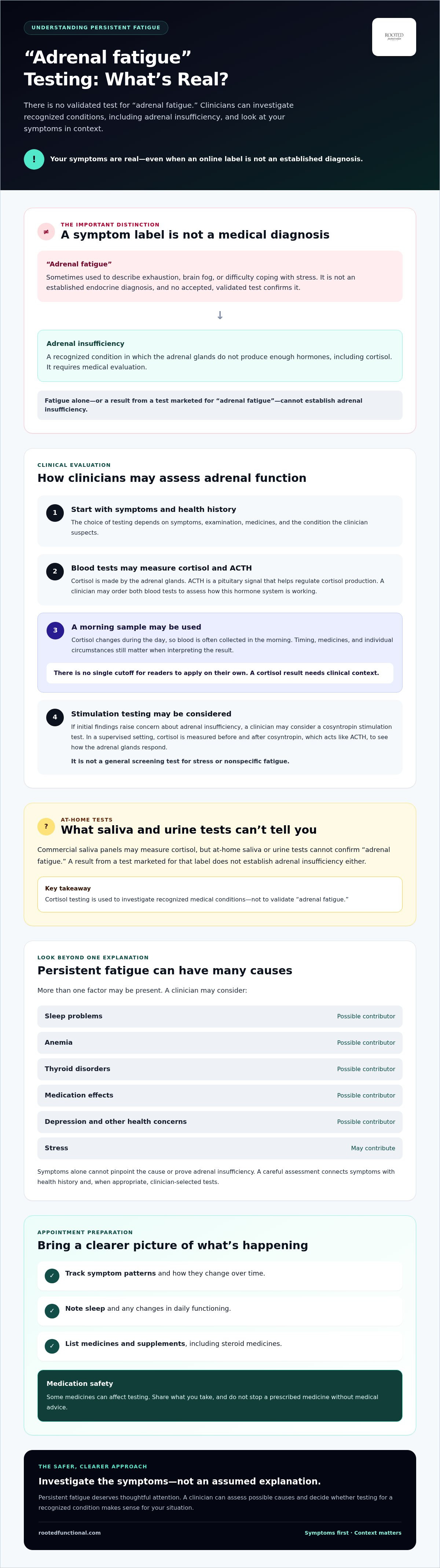
Persistent fatigue can affect your work, relationships, and daily life. It’s real, even if an explanation you’ve found online isn’t an established medical diagnosis. If you’re asking how to test for adrenal fatigue, the clearest answer is that no validated test can diagnose it as a recognized medical condition. Clinicians can assess symptoms and test for specific conditions, including adrenal insufficiency, but those are not the same thing.
Is adrenal fatigue a recognized medical diagnosis?
The term is used in some wellness settings to describe symptoms such as exhaustion, brain fog, or difficulty coping with stress. But it isn’t an established endocrine diagnosis, and there’s no accepted test that confirms it. The Adrenal fatigue page summarizes how the term differs from medically recognized conditions. Rejecting the label doesn’t mean rejecting your experience. Stress can affect wellbeing, and ongoing symptoms deserve thoughtful attention.
Adrenal insufficiency is different. It’s a recognized condition in which the adrenal glands don’t produce enough hormones, including cortisol. It requires medical evaluation. Fatigue alone, or a result from a test marketed for “adrenal fatigue,” can’t establish that diagnosis.
What conditions can cause similar symptoms?
Fatigue has many possible causes, and more than one can be present at a time. A clinician may consider sleep problems, anemia, thyroid disorders, medication effects, depression, and other health concerns. Stress may also contribute to how you feel, but it shouldn’t automatically be treated as the explanation before other possibilities are considered.
Symptoms alone can’t pinpoint the cause or prove adrenal insufficiency. Feeling tired and foggy, for example, doesn’t show whether the issue is poor sleep, a thyroid problem, a medication effect, or something else. A careful assessment connects your symptoms with your health history and, when appropriate, tests selected by a clinician.
A root-cause approach can help organize that broader investigation without treating a disputed label as a diagnosis. Learn more about what a functional medicine doctor does and how this type of care may review persistent symptoms in context.
In short: There’s no validated test for “adrenal fatigue.” Clinicians can investigate recognized conditions that may cause similar symptoms, including adrenal insufficiency, and determine which tests make sense for your situation.
Which tests evaluate adrenal insufficiency and cortisol function?
After considering your symptoms and health history, a clinician may use testing to investigate a specific concern, such as adrenal insufficiency. No single cortisol test answers every question. The choice depends on your symptoms, examination, medicines, and the condition the clinician suspects.
What do morning cortisol and ACTH tests measure?
Cortisol is a hormone made by the adrenal glands. ACTH, or adrenocorticotropic hormone, is a signal from the pituitary gland that helps regulate cortisol production. A clinician may order blood tests for cortisol and ACTH together to assess how these parts of the hormone system are working.
Cortisol levels change during the day, so a blood sample is often taken in the morning. The result still needs context: timing, medicines, and individual circumstances can affect how it’s interpreted. There is no single cutoff that readers can apply on their own. Your clinician considers the result alongside symptoms and other findings. Some medicines, including steroid medicines, can affect testing. Share what you take, and don’t stop a prescribed medicine without medical advice.
A cortisol result needs clinical context; it does not diagnose “adrenal fatigue.” The Endocrine Society states that no scientific proof exists for “adrenal fatigue” as a medical condition. Cortisol tests are used to investigate recognized conditions, not to validate that label.
When might a cosyntropin stimulation test be considered?
If initial findings raise concern about adrenal insufficiency, a clinician may consider a cosyntropin stimulation test. Cosyntropin acts like ACTH. In a supervised setting, the clinician measures cortisol before and after giving the medicine to see how the adrenal glands respond. The clinician decides whether this test is appropriate based on the full picture. It isn’t a general screening test for stress or nonspecific fatigue.
These tests answer focused medical questions. They don’t replace a broader investigation when fatigue has several possible causes, and they shouldn’t be ordered or interpreted in isolation. If you’re seeking a personalized review of ongoing symptoms and existing results, a Root Cause Consultation may be one option to explore. Confirm with the practice whether your concerns are within its scope. Suspected adrenal insufficiency needs evaluation by an appropriate medical clinician.
At-home cortisol tests versus medical evaluation: what can each tell you?
A cortisol test measures a hormone or its pattern, but that result is not the same as a diagnosis. The key question isn’t simply whether a test detects cortisol. Consider whether it can answer a specific clinical question and how the result will be interpreted.
Can a saliva cortisol panel diagnose adrenal fatigue?
No. A saliva panel may report cortisol levels at sampled times, but measuring a hormone pattern doesn’t validate “adrenal fatigue” as a medical condition. Saliva testing isn’t automatically useless. Its value depends on whether the method fits a clinician’s diagnostic question. For recognized adrenal conditions, medical evaluation may involve different tests. The National Institute of Diabetes and Digestive and Kidney Diseases explains how clinicians diagnose adrenal insufficiency.
Before ordering a commercial panel, ask who will interpret the results, what recognized condition the test can assess, and what follow-up is recommended if a result is unusual. If those answers aren’t clear, a number or graph may create more questions than it resolves.
Why can a test result be misleading without clinical context?
Cortisol varies with timing and circumstances. A clinician may consider when the sample was collected, the test method, medicines, and whether you were acutely ill. These details can change how a result should be understood. A result outside a panel’s suggested range doesn’t automatically mean your adrenal glands are failing.
That distinction doesn’t dismiss your fatigue or mean you should stop investigating it. It means the investigation should follow the evidence. Don’t self-diagnose or start supplements based solely on an online panel. Share unexpected results with a qualified healthcare professional, who can review them alongside your symptoms and history and decide whether further evaluation is needed. If you’re researching how to test for adrenal fatigue, focus instead on which recognized condition a test can assess and who can interpret it.
How to prepare for an appointment about persistent fatigue
You don’t need to arrive with a diagnosis or a perfect explanation. A clear record of what’s changed can help a healthcare professional understand your symptoms and decide what to investigate. Use this sequence: track symptoms, gather your health information, discuss your history, then review any tests the clinician recommends.
Record the pattern: Note when fatigue began, whether it varies during the day, how you’re sleeping, and what makes symptoms better or worse.
Gather your information: List current medicines and supplements, relevant diagnoses, and recent test results. Include changes in appetite or weight, recent illness, and major stressors.
Describe the impact: Give examples of changes in work, exercise, concentration, or everyday tasks. Specific examples make it easier to explain how fatigue affects your functioning.
Review next steps together: Ask what each proposed test is intended to assess and how the result could affect the plan.
What information should you bring to the visit?
A brief timeline is often more useful than trying to remember every detail during the appointment. Include when symptoms began, how they’ve changed, your sleep patterns, and any new symptoms. Bring a complete list of medicines and supplements, including doses if you know them, along with relevant diagnoses and test results. Don’t stop prescribed medicines or start hormone supplements without guidance from a qualified healthcare professional.
What questions should you ask about testing?
It’s reasonable to ask why a test is being suggested. Try questions such as: “Which condition is this test checking for?” “Could my medicines or the timing of the test affect the result?” and “What happens if the result is normal, abnormal, or unclear?” These questions help clarify the test’s purpose, preparation instructions, and follow-up plan. If you’re wondering how to test for adrenal fatigue, ask instead what recognized condition a proposed test can evaluate.
Fatigue deserves a thoughtful review, not a rushed assumption. If you want a broader discussion of persistent symptoms and possible root-cause factors, learn about a Root Cause Consultation. Confirm that your concerns fit the consultation’s scope. Suspected adrenal insufficiency requires evaluation by an appropriate medical clinician.
Safety note: Seek prompt medical attention for severe or rapidly worsening symptoms. Don’t wait for a routine appointment if you feel acutely unwell.
Finding a thoughtful next step when fatigue remains unexplained
Normal initial results don’t mean your fatigue isn’t real or that the investigation has to end. Persistent symptoms deserve follow-up. A clinician can review your health history, symptom timeline, examination, and existing results together, then decide whether further evaluation is appropriate or another explanation should be considered.
This is more useful than repeating tests without a clear question. Ask what each next step is meant to clarify, how it fits your symptoms, and who will review the findings with you. If you’re searching how to test for adrenal fatigue, focus on investigating persistent symptoms and recognized conditions rather than trying to prove an unvalidated label.
What to expect from a personalized root-cause consultation
A Root Cause Consultation with Rooted Functional Medicine is a personalized review of your health history and symptoms. Consultations include ordering and interpreting advanced functional lab work when appropriate. Any test should be selected and interpreted by a qualified clinician in context, not treated as a stand-alone answer.
Confirm the practice’s role in evaluating fatigue or suspected adrenal concerns, including whether it’s an appropriate fit for you, before booking. A consultation should not be presented as a promise of adrenal testing or diagnosis. You can book a Root Cause Consultation to discuss whether this broader review matches your needs.
When should you seek care without waiting?
Seek prompt medical evaluation for severe, sudden, or rapidly worsening symptoms. Don’t wait for a planned consultation if you feel acutely unwell. Rooted Functional Medicine isn’t an urgent-care or conventional primary-care service, so urgent symptoms need an appropriate medical setting.
If your symptoms are persistent rather than urgent, you can still take the next step at your own pace. Bring your symptom notes and previous results, ask what a clinician can assess, and confirm that the service you’re considering is equipped to address your concerns. You deserve a careful conversation, clear limits, and a plan for what to do next.
Take the next step toward answers
If you’re still wondering how to test for adrenal fatigue, remember the key distinction: there’s no validated test for “adrenal fatigue,” while clinicians can investigate recognized conditions such as adrenal insufficiency with appropriate tests. A cortisol result needs clinical context, and persistent fatigue deserves follow-up even when initial results don’t explain it.
Bring your symptom history, current medicines, and previous results to a conversation with a qualified healthcare professional. Testing should be chosen to answer a clear question, not simply to produce more numbers.
For a broader review of chronic symptoms, a Root Cause Consultation with Rooted Functional Medicine includes advanced functional lab work when clinically appropriate. Secure telehealth consultations are available nationwide. To explore whether this approach fits your needs, book a Root Cause Consultation.
Your symptoms matter. A thoughtful, evidence-informed next step can help you keep looking for answers without relying on an unproven label.
Frequently Asked Questions
Is adrenal fatigue a real medical diagnosis?
No. “Adrenal fatigue” isn’t a recognized medical diagnosis, and there’s no validated test that confirms it. The term is sometimes used to describe symptoms such as tiredness, brain fog, or feeling run down, but those symptoms are real even if the label isn’t medically established. Persistent fatigue deserves evaluation for recognized health conditions and other possible causes, rather than being dismissed or automatically attributed to stress.
Can a blood test diagnose adrenal fatigue?
No blood test can diagnose “adrenal fatigue.” Blood tests can measure cortisol and ACTH, a hormone signal from the pituitary, when a clinician is evaluating a specific concern such as adrenal insufficiency. If you’re searching how to test for adrenal fatigue, ask what recognized condition a proposed test is intended to assess. Results need to be interpreted alongside your symptoms, medicines, timing, and other clinical findings.
Can a saliva cortisol test diagnose adrenal fatigue?
No. A saliva test can measure cortisol in samples collected at particular times, but those measurements don’t establish “adrenal fatigue” as a medical condition. Saliva testing may be useful for certain clinical questions, depending on the test and the clinician’s judgment. Before relying on a commercial panel, ask who will interpret the results, what condition the test can assess, and what follow-up is recommended.
What tests check for adrenal insufficiency?
A clinician may assess morning blood cortisol and ACTH as part of an adrenal insufficiency evaluation. If initial findings call for more assessment, a supervised cosyntropin stimulation test may check how the adrenal glands respond to a stimulation medicine. The right tests depend on your history, symptoms, examination, and suspected condition. No single result should be interpreted without that context, and testing should be guided by a qualified clinician.
How do I prepare for an adrenal test?
Follow the ordering clinician’s instructions, since preparation can depend on the test and its timing. Before the appointment, make a list of medicines and supplements, and bring relevant diagnoses and previous test results. Ask whether you need to collect a sample at a specific time or follow other preparation steps. Don’t stop prescribed medicines or start hormone supplements unless a qualified healthcare professional advises you to.
What should I do if my cortisol test is normal but I still feel tired?
Follow up about the fatigue rather than assuming a normal cortisol result explains everything. A clinician can review how the sample was collected, your symptoms, medicines, and health history, then consider other possible causes. These may include sleep problems, anemia, thyroid disorders, medication effects, or depression. Note when fatigue began, how it affects daily life, and whether sleep or other symptoms have changed.
Can I treat adrenal fatigue with supplements before testing?
Don’t start supplements to treat “adrenal fatigue” based on the label or an online test. The condition isn’t a recognized medical diagnosis, and supplements may have risks or affect medicines and testing. Share everything you take with a healthcare professional, including over-the-counter products and hormone supplements. Get guidance before starting something new, and don’t stop prescribed treatment without advice from the clinician who manages it.