Interpreting Your DUTCH Test Results: A Step-by-Step Guide
Updated: Oct 9
What if a flagged DUTCH marker is a clue, not a conclusion? When you’re interpreting your DUTCH test results, unfamiliar hormone names, metabolites, and reference ranges can make the report feel overwhelming. A result marked high or low may also raise concern before you know what it means in context.
It’s understandable to search online for answers, but general explanations may not fit your symptoms, health history, or the specific DUTCH panel you completed. A result shouldn’t be read in isolation or treated as a diagnosis. It’s one piece of information to discuss with a qualified healthcare provider.
This step-by-step guide explains the main sections of a DUTCH report in plain English, why patterns across markers may matter, and how to prepare focused questions for your clinician. Your symptoms, health history, collection details, and exact test panel all matter when making sense of results. The goal isn’t to diagnose yourself or change treatment based on one flagged number. It’s to approach the report with more clarity and have a more useful conversation about what the findings may mean for you.
Table of Contents
Before interpreting your DUTCH test results, understand what the report can tell you
A report full of unfamiliar markers can feel unsettling, especially when a result is flagged. A flag is a reason to ask a question, not a verdict. Before interpreting your DUTCH test results, check the report’s name and panel details. The report shows the markers measured by that particular test, using the collection method described in its instructions. Panels differ, so another person’s report may not include the same measurements.
A test result is a measurement; a clinical diagnosis is a conclusion reached by a qualified clinician using the result alongside symptoms, health history, and other relevant information. The report may help guide a clinical discussion, but it doesn’t independently establish a diagnosis or tell you what treatment to start.
What does a DUTCH test measure?
DUTCH stands for Dried Urine Test for Comprehensive Hormones. It uses dried urine samples to assess hormone markers, but the specific analytes and collection instructions depend on the panel ordered. Depending on the report, markers may relate to sex hormones such as estrogen, progesterone, or testosterone, adrenal hormones such as cortisol, or metabolites produced as hormones are processed. Metabolites are breakdown products. They can add information, but they aren’t diagnoses on their own. For background on the hormone family, see this overview of steroid hormones.
Check the panel name, report key, and laboratory materials to confirm what was measured and how samples were collected. If a term in your report isn’t clear, use the lab’s explanation for that specific panel rather than assuming it applies to every DUTCH test.
Why context matters when reading hormone results
A number doesn’t explain itself. A clinician may consider your symptoms, medications, supplements, life stage, and health history when assessing what a finding could mean. For people who menstruate, cycle timing may also matter. Keep your collection timing and notes about following the test instructions handy, since those details can inform how the report is understood.
Reference ranges are comparison tools supplied with the report. A value outside a range doesn’t, by itself, prove a disorder, and a value inside one doesn’t automatically explain symptoms. Meaning depends on the marker, the panel, and the broader clinical picture. Use a flag to guide a question, not to make a treatment decision on your own.
How to read your DUTCH test results step by step
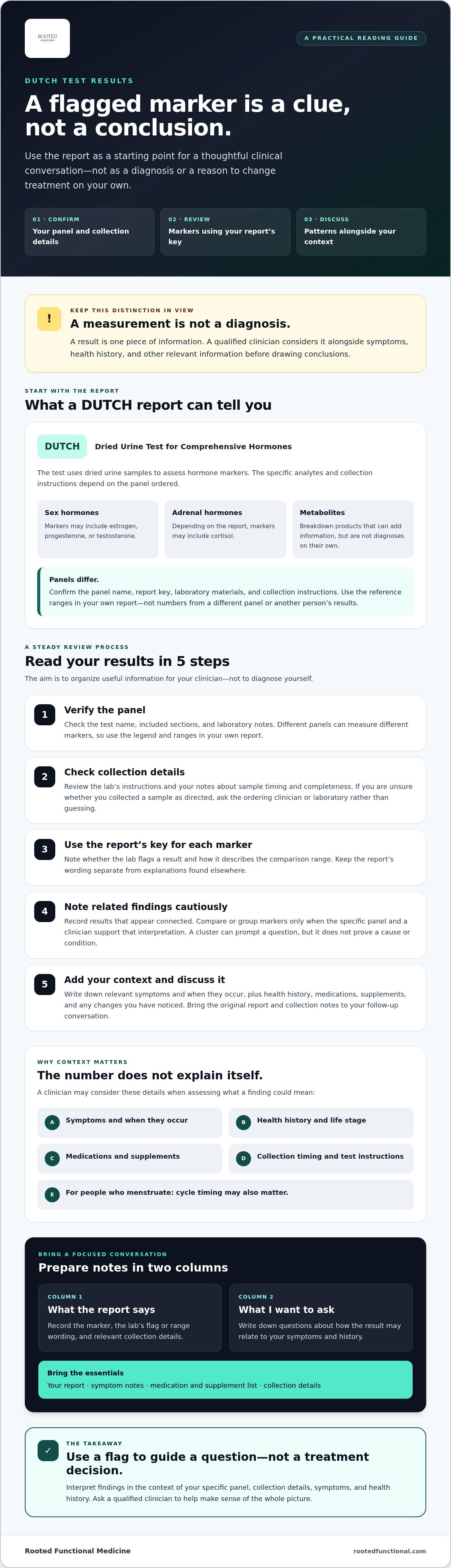
A steady process can make a dense report easier to review. Think of it as organizing information for a clinician, not diagnosing yourself. These five steps for interpreting your DUTCH test results take you from basic report details to questions grounded in your own context.
Verify the panel. Check the test name, report date, included sections, and laboratory notes. Panels can measure different markers, so use the legend and ranges in your own report. Don’t compare your numbers with another person’s results or a different panel.
Check collection details. Review the lab’s instructions and your notes about sample timing and completeness. Requirements vary by test. If you’re unsure whether you collected a sample as directed, don’t guess. Ask the ordering clinician or laboratory how that detail may affect interpretation.
Review each marker using the report’s key. Note whether the lab flags a result and how it describes the comparison range. Keep the report’s wording separate from explanations you find elsewhere. MedlinePlus provides general information about hormone testing in its Estrogen Levels Test resource, but your DUTCH panel’s own instructions should guide your review.
Note related findings cautiously. Record results that appear connected, but compare or group markers only when the specific panel and a clinician support that interpretation. A cluster can be worth asking about, but it doesn’t prove a cause or condition.
Add your personal context and discuss it with a clinician. Write down relevant symptoms and when they occur, along with your health history, medications, supplements, and any changes you’ve noticed. Bring the original report and collection notes to your follow-up conversation.
Separate report facts from your interpretation
As you review the report, make two columns: What the report says and What I want to ask. For example, note that a marker is flagged in the first column, then ask what it could mean given your symptoms in the second. This helps keep a concerning label from becoming a conclusion before it has been considered in context.
If you’re looking for individualized context, a Root Cause Consultation offers an opportunity to discuss symptoms, health history, and available lab results. Contact the practice to confirm whether it can review your specific DUTCH report.
What DUTCH test result patterns may mean, and what they cannot prove
A flagged marker can catch your attention, but it doesn’t tell you by itself what is happening in your body. A reference interval is a laboratory comparison tool for the specific report, not a universal boundary between health and disease. The meaning of a result depends on the marker, the panel, collection conditions, and your clinical picture.
An out-of-range DUTCH marker does not diagnose a condition by itself; it identifies a finding for a qualified clinician to assess alongside your symptoms and other relevant information. This distinction matters when interpreting your DUTCH test results. A flag can prompt a useful question without confirming a cause or pointing directly to treatment.
How to think about a flagged result
Start with the report’s own wording. A flag means the result falls outside the comparison range shown for that marker; it doesn’t automatically mean the result is abnormal, deficient, or excessive in a clinical sense. Ask how the finding relates to your symptoms, health history, and other relevant results. Avoid assigning a cause to fatigue, sleep changes, or another symptom based on one marker alone.
Why one marker cannot tell the whole story
Some panels include cortisol or sex-hormone sections, while others may not. Check your report’s exact terms before making comparisons. Even when related markers appear together, interpretation may depend on collection timing, completeness, the reason for testing, and your individual history. A possible connection is a question to explore, not a confirmed explanation or treatment decision.
Use the table to prepare questions, not conclusions. Keep separate what the report states and what you wonder it might mean. This simple distinction can make a follow-up conversation clearer and more useful.
What to do after receiving your DUTCH test results
A report is most useful when you bring more than the flagged values to a follow-up conversation. Prepare a small packet that shows what was measured, how collection went, and what’s happening in your daily life.
Bring the complete report, including the panel name, lab notes, and reference ranges.
Write down your symptoms, when they began, and any patterns you’ve noticed.
List your medications and supplements, including recent changes. Don’t start, stop, or change a medication or supplement based only on an online interpretation.
Include collection details, such as timing, any missed samples, and questions about whether you followed the lab’s instructions.
Questions to bring to a clinician
Use the appointment to understand what the findings could mean for you, rather than seeking a quick label for each number. Ask which results matter most given the reason for testing and your health history. Then ask what other information could change the interpretation, what remains uncertain, and whether further evaluation or follow-up is appropriate.
If symptoms worsen or you’re unsure how quickly to seek care, ask which qualified healthcare professional to contact and where to go. Urgent or emergency symptoms need appropriate urgent or emergency services, not a functional medicine booking page.
When online interpretation is not enough
Online explanations can provide general background, but they can’t account for your full health history or confirm what a result means for you. Discuss persistent or concerning symptoms with an appropriately qualified healthcare professional. This article is educational and doesn’t replace individualized medical advice.
If you’re considering Rooted Functional Medicine, review Rooted’s care and testing information and confirm directly whether the practice can address your specific report. A Root Cause Consultation may offer space to discuss your symptoms, history, and available lab results, but DUTCH report review hasn’t been confirmed. Ask before booking if reviewing your report is the reason for your appointment.
How Rooted Functional Medicine can help put lab results in context
A lab report can raise questions without making the answers clear. Rooted Functional Medicine offers personalized root-cause consultations where symptoms, health history, and available lab findings can be considered together. Consultations may include advanced functional lab work ordered and interpreted as appropriate.
That doesn’t mean every test is available or appropriate for every concern. The information provided by the practice doesn’t confirm that Rooted offers, orders, or interprets DUTCH testing. If you already have a DUTCH report, contact the practice before booking to ask whether it can review your specific report. That way, you can clarify what to expect and choose an appropriate next step.
What an individualized lab review can add
Interpreting your DUTCH test results involves more than reading a marker against a range. A consultation can provide space to discuss what prompted the testing, what symptoms you’re experiencing, and how your health history may inform questions about available lab findings. A clinician can also help clarify whether additional testing may fit your concerns.
The purpose is to support a more informed clinical discussion, not to promise a diagnosis, a specific protocol, or a particular outcome. Your report remains one piece of the picture, and its relevance depends on the test details and your individual circumstances.
Choosing a practical next step
Before considering a consultation, gather the complete report, collection details, a current list of medications and supplements, and brief notes about your symptoms and questions. You might ask: “Can you review this report?” “Which findings are relevant to my concerns?” and “What other information would help clarify their meaning?”
Rooted Functional Medicine offers consultations in person and through secure telehealth nationwide. If you’re exploring individualized root-cause care, first confirm whether the practice can address your specific DUTCH report. If you’re ready to discuss your concerns and available lab results, book a Root Cause Consultation.
Turn your report into a clearer next step
Interpreting your DUTCH test results is less about decoding one flagged number and more about understanding what the report measured, how the findings fit together, and what your symptoms and history add to the picture. Use your panel’s own ranges, note collection details, and bring questions to a qualified clinician. A result can guide a conversation, but it doesn’t diagnose a condition or dictate treatment by itself.
Rooted Functional Medicine offers personalized Root Cause Consultations that may include advanced functional lab work ordered and interpreted as appropriate. Secure telehealth consultations are available nationwide. The practice hasn’t confirmed whether it reviews DUTCH reports, so ask before booking if you want to discuss a report you already have.
If you’re ready to explore your concerns and available lab findings in a broader clinical context, book a Root Cause Consultation. Start with thoughtful questions and take the next step with more clarity.
Frequently Asked Questions
How do I interpret my DUTCH test results?
Start by confirming the panel, collection details, and report legend. Review each marker using the reference range provided for that specific result, then note patterns or questions without treating them as conclusions. Interpreting your DUTCH test results also requires context, including symptoms, health history, medications, supplements, and relevant cycle timing. Discuss the complete report with a qualified healthcare provider who can explain what the findings may mean for you.
What does it mean if a DUTCH result is out of range?
An out-of-range result means the marker falls outside the comparison interval shown in your report. It doesn’t automatically mean you have a disorder or need treatment. Ask a qualified clinician how the result relates to your symptoms, other markers, collection details, and health history. Reference ranges are laboratory comparison tools, not universal definitions of health. Avoid making medication or supplement changes based on a flagged value alone.
Can a DUTCH test diagnose a hormone imbalance?
No. A DUTCH test is not a standalone diagnostic tool. It may provide information for a clinical discussion, but a healthcare provider must consider the results alongside your symptoms, history, and other relevant information. A flagged marker alone doesn’t confirm a hormone disorder or establish its cause. Ask your clinician whether further evaluation is appropriate before deciding what the results mean or considering changes to your care. For those exploring therapeutic options for hormone optimization, specialized clinics like LexMed & Wellness can help evaluate persistent symptoms in context with clinical lab data.
How long does it take to get DUTCH test results?
Results are generally returned to the provider within 5 to 10 days after the laboratory receives the sample, according to the available DUTCH testing information. This timing begins after the lab receives the sample, not necessarily when you mail it. Shipping and processing can affect when the report reaches your provider. For an estimate specific to your test, check the laboratory’s current instructions or ask the ordering provider.
Should I stop supplements or medication before a DUTCH test?
Don’t stop or change prescribed medication or supplements unless the clinician who manages them tells you to. Preparation instructions can depend on the test panel and your circumstances, so review the laboratory’s directions and ask the ordering clinician about anything unclear. Share a current list of medications and supplements, including recent changes. This helps your clinician understand the collection context without risking an unsupervised change to your care.
Can someone interpret a DUTCH test I already completed?
A qualified healthcare provider may be able to discuss your completed report in context, but confirm this directly before scheduling. Rooted Functional Medicine offers root-cause consultations that may include advanced functional lab work as appropriate; the practice hasn’t confirmed whether it reviews DUTCH reports completed elsewhere. Ask whether your specific report can be considered alongside your symptoms and health history, and bring the full report and collection details if a review is arranged.