Root Cause of Autoimmune Disease: What Science Knows About Why It Develops
What if the root cause of autoimmune disease isn’t one hidden trigger, but a combination of factors that affects each person differently? A diagnosis can name your symptoms without explaining why your immune system began responding this way. It’s understandable to want a clearer answer, especially when online explanations point in so many directions.
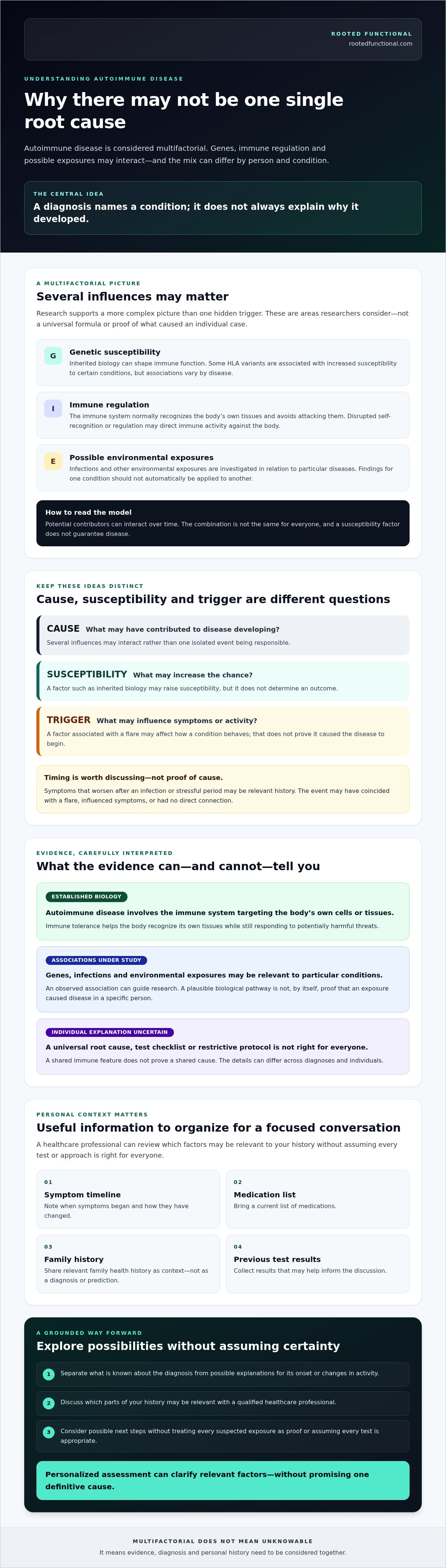
Science supports a more complex picture than a single cause. Genetic susceptibility can interact with environmental exposures and changes in immune regulation, but those factors don’t affect everyone in the same way. Some proposed contributors are better studied than others, and no universal checklist of tests or restrictive protocol is right for every person.
This article explains what researchers know, where evidence is still developing, and why autoimmune disease is considered multifactorial. We’ll look at how genes, infections, and other exposures may contribute, while distinguishing established findings from possibilities that need careful qualification.
A thoughtful evaluation can explore which factors may be relevant to your history without promising to uncover one definitive cause. You’ll also find practical questions to discuss with a qualified healthcare professional as you consider next steps.
Table of Contents
What Is the Root Cause of Autoimmune Disease? Start With the Core Biology
A diagnosis can name a condition without explaining why it developed. That gap can leave you searching for one clear answer, but science hasn’t identified a universal root cause of autoimmune disease. These conditions involve the immune system, yet the processes behind one diagnosis may differ from those behind another. A shared immune feature doesn’t prove a shared cause.
An autoimmune disease is a condition in which the immune system mistakenly targets the body’s own cells or tissues. This differs from a temporary immune response to an infection, when the body responds to an outside threat. The overview of autoimmune disease also describes these conditions as likely involving a mix of genetic and environmental influences.
How immune tolerance normally protects the body
Immune tolerance is the body’s ability to recognize its own tissues and avoid attacking them, while still responding to potentially harmful threats. If this self-recognition and regulation are disrupted, immune activity may be directed against the body. The details differ across diagnoses, so this basic explanation doesn’t describe the full mechanism in any one person.
Cause, susceptibility, and flare trigger are different questions
These terms are related, but they don’t mean the same thing:
Cause asks what contributed to the disease developing. Several influences may interact rather than one isolated event being responsible.
Susceptibility means a factor, such as inherited biology, may increase the chance of developing a condition. It doesn’t guarantee that someone will become ill.
Trigger describes a possible influence on symptoms or disease activity. A factor associated with a flare may affect how a condition behaves, but that doesn’t prove it caused the disease to begin.
This distinction matters when you’re making sense of your own history. For example, symptoms that worsen after an infection or a stressful period may be worth discussing with a healthcare professional. Timing alone, though, can’t establish that the event caused the autoimmune disease. It may have coincided with a flare, influenced symptoms, or had no direct connection.
Researchers continue to investigate how immune regulation and other factors contribute to different conditions. When asking about the root cause of autoimmune disease in your case, separate what is known about the diagnosis from possible explanations for its onset or changes in activity. That leaves room for useful questions without treating every suspected exposure as proof.
How Genetics, Immune Regulation, and Exposures May Contribute
Autoimmune disease may develop through several influences interacting over time. Inherited biology can shape how the immune system is regulated, while environmental exposures may affect immune activity. The National Institute of Environmental Health Sciences (NIEHS) describes research into these environmental and genetic underpinnings. This framework helps explain why looking for one root cause of autoimmune disease can oversimplify what researchers are studying.
What genes can and cannot tell you
Some genetic differences affect immune function. Human leukocyte antigen (HLA) genes, for example, help the immune system distinguish the body’s proteins from outside substances. Particular HLA variants are associated with increased susceptibility to certain autoimmune conditions, but the associations vary by disease. Having a related variant or a family history doesn’t diagnose you or determine your outcome. Genes offer context, not a personal forecast.
A family history may be useful information for a healthcare professional reviewing your symptoms and medical background. It isn’t proof that relatives share the same cause, and it doesn’t mean you’re destined to develop the same condition.
Why environmental and lifestyle factors need careful interpretation
Researchers investigate infections and environmental exposures in relation to particular autoimmune diseases. Findings for one condition shouldn’t automatically be applied to another. A proposed biological pathway may make an exposure worth studying, but a plausible mechanism isn’t proof that it caused disease in a specific person. Evidence also varies in strength: an observed association can guide research without explaining every individual case.
Risk factors can change the likelihood of a condition at a population level, but they don’t establish the cause of an individual patient’s autoimmune disease. A reported exposure, stressful period, or change in diet may be relevant history to discuss, but timing alone can’t confirm cause and effect. Having an autoimmune condition isn’t evidence that you did something wrong. No single lifestyle choice should be treated as an explanation or a source of blame.
A careful conversation focuses on what is known about your specific diagnosis, what your personal history adds, and which questions remain open. If you’d like support reviewing your history and discussing appropriate next steps, you can learn about a Root Cause Consultation. An assessment can explore relevant factors, but it can’t guarantee one definitive explanation. It should complement, not replace, established medical care.
Root Cause Claims vs. Evidence: What We Know and What Remains Unclear
Claims about the root cause of autoimmune disease can sound certain, even when research supports only a possible association. Start by separating established immune processes from factors under study and explanations that haven’t been proven for an individual.
Evidence also varies by diagnosis. Hashimoto thyroiditis involves immune-related injury to the thyroid; rheumatoid arthritis primarily affects joints, though it can involve other parts of the body; lupus can affect multiple organs. Findings relevant to one condition shouldn’t automatically be treated as explanations for another. Yale School of Medicine describes the challenge as a tangled web of causes and effects, rather than a simple one-factor answer.
Why a single test rarely answers every cause question
Tests are chosen to answer a clinical question, not to generate a universal root-cause score. Tests used to support or assess a diagnosis serve a different purpose from tests that explore possible contributors. Even an abnormal result doesn’t necessarily reveal when or why a disease began. Results need to be interpreted alongside your symptoms, history, examination, and the diagnostic criteria for your condition.
How to evaluate claims about gut health, food, stress, or toxins
Ask whether a claim has evidence for your specific diagnosis or is being presented broadly as a cause of all autoimmune disease. Food sensitivities, gut permeability, stress, and toxins shouldn’t be treated as proven universal explanations. A biological theory may warrant study without establishing what caused one person’s condition. A guide to natural treatments for autoimmune diseases can offer complementary context, but it shouldn’t replace individualized medical advice.
A careful root-cause inquiry can help you and your healthcare professionals review relevant questions and evidence. It complements, but doesn’t replace, an accurate diagnosis or evidence-based treatment. Don’t stop or change prescribed treatment based on an unconfirmed causal claim.
How to Explore Your Own Autoimmune Risk and Possible Contributors
Looking into why a condition developed can feel overwhelming, especially when online advice recommends broad testing or major lifestyle changes. A structured conversation with a qualified healthcare professional can help separate what’s known about your diagnosis from questions that need further review. Use this four-step framework to prepare.
Clarify the diagnosis. Confirm which condition has been established, how it was diagnosed, and whether other explanations for your symptoms have been considered.
Map your history. Bring a symptom timeline, medication list, family history, and copies of relevant test results. Note important changes, but treat timing as information to discuss, not proof of cause.
Review the evidence. Ask which possible contributors are supported for your specific condition and which remain uncertain. A proposed test should answer a defined clinical question, not simply promise to uncover the root cause of autoimmune disease.
Agree on next steps. Discuss how any finding could affect your care, who will interpret it, and how recommendations will coordinate with your current clinicians and prescribed treatment.
Questions to bring to a healthcare professional
Clear questions can make an appointment more useful. Consider asking: “Which diagnosis is established, and what remains uncertain?” “What would this test help us decide, and how will we interpret the result?” “If we change my care plan, how will that fit with my current treatment and clinicians?”
Testing should be selected and interpreted by a qualified professional in the context of your symptoms, examination, medical history, and established diagnostic criteria. More tests aren’t automatically more helpful. Before proceeding, make sure you understand what a result can and cannot tell you, and whether it could change a care decision.
When symptoms need prompt medical attention
Seek urgent medical assessment for symptoms that are severe, sudden, or rapidly worsening. A scheduled consultation focused on possible contributors isn’t a substitute for urgent or emergency care. If you’re comparing approaches, learning what a functional medicine doctor does may help you understand how that type of care can fit alongside established medical care.
Rooted Functional Medicine offers personalized consultations to review health history, concerns, and appropriate next steps. The goal is to explore relevant factors, not promise a single definitive cause or replace your existing care. If that kind of discussion would be useful, you can book a root-cause consultation.
A Personalized Root-Cause Approach to Autoimmune Support
Wanting to understand why an autoimmune condition developed is reasonable. A responsible root-cause approach doesn’t promise to uncover one definitive explanation. It considers your individual history and current health, then explores which questions and next steps may be relevant to you.
Rooted Functional Medicine, led by Dr. Adrienne Guthrie, provides personalized autoimmune support through consultations and lab-guided, integrative care. An initial consultation is an opportunity to discuss your health history, concerns, existing diagnosis, and prior testing. If additional functional lab work is appropriate, it can be selected and interpreted in that clinical context, rather than treated as a required checklist for everyone.
What individualized support can reasonably include
A useful assessment starts with what’s already known. That may include reviewing your symptoms, medical history, existing diagnoses, and relevant test results. From there, you and the practitioner can discuss whether further information could help guide supportive care. Not every test is useful for every person, and any finding should be considered alongside your full health picture.
Integrative recommendations should fit with your established healthcare professionals and treatment plan. Share new test results or proposed changes with the clinicians involved in your care, especially if you have questions about how they may affect existing treatment. Personalized support should add context, not create conflicting instructions or interrupt appropriate medical care.
What a root-cause approach should not promise
No consultation or test can guarantee identification of the original cause of autoimmune disease. A root-cause approach shouldn’t promise a cure, reversal, or prevention, and it shouldn’t encourage you to stop prescribed medication or delay medical assessment. You can reasonably expect a clear explanation of what an assessment may clarify, why a test is being considered, and what remains uncertain.
Rooted Functional Medicine offers care in person and through secure telehealth nationwide. If you’re looking for an individualized discussion of your history and possible next steps, you can book a root-cause consultation. It’s a starting point for an informed conversation, not a promise of one simple answer.
Move Forward With a Clearer, More Personal Plan
The search for the root cause of autoimmune disease rarely leads to one answer that applies to everyone. Genetic susceptibility, immune regulation, and possible exposures can interact, but evidence differs by condition, and a risk factor doesn’t prove what caused illness in one person.
A useful next step is to bring your diagnosis, symptom history, family history, medications, and prior results to a conversation with a qualified healthcare professional. Any testing should answer a clear question and be interpreted alongside your full clinical picture. Personalized support can explore relevant factors, but it can’t promise a cure or replace established diagnosis and treatment.
Rooted Functional Medicine offers personalized autoimmune support with lab-guided care when appropriate, coordinated with your existing medical care. Secure telehealth appointments are available nationwide. If you’d like to discuss your history and possible next steps, book a personalized root-cause consultation.
You don’t need to resolve every uncertainty at once. A careful conversation can help you decide what’s relevant and move forward with greater clarity.
Frequently Asked Questions
What is the main root cause of autoimmune disease?
There isn’t one root cause shared by every autoimmune disease. Autoimmunity involves immune responses directed at the body’s own tissues, but how it develops can differ by condition and person. Researchers study how inherited susceptibility, immune regulation, and environmental influences may interact. A risk factor or research association can’t establish what caused one individual’s illness. Personal questions are best considered alongside your diagnosis, symptoms, medical history, and appropriate clinical assessment.
Can stress cause autoimmune disease?
Stress isn’t established as the sole cause of autoimmune disease. It can affect health and may influence symptoms or disease activity for some people, but research is complex and can differ across conditions. A stressful period around the time symptoms appear doesn’t prove stress caused the illness. You deserve support without blame. Discuss symptom patterns and stress-related concerns with a healthcare professional, and continue appropriate medical care.
Is autoimmune disease genetic?
Genetics can contribute to susceptibility, and some autoimmune conditions occur more often in certain families. But inherited risk doesn’t mean you’ll necessarily develop a condition, and genes alone don’t explain every case. Share your family history with a clinician as useful context. Diagnosis and care decisions also depend on symptoms, examination findings, and appropriate testing. A family connection can guide questions, but it can’t predict your personal outcome by itself.
Can gut problems cause autoimmune disease?
Gut and immune-system interactions are an active area of research, but this doesn’t establish gut problems as the universal cause of autoimmune disease. Evidence may differ by condition, and broad claims about gut permeability or food sensitivities shouldn’t be assumed to explain an individual case. Avoid restrictive diets or protocols based only on online claims. If you have persistent digestive symptoms, discuss them and any proposed testing with a qualified clinician.
How do doctors find the cause of an autoimmune disease?
Clinicians assess symptoms, medical history, examination findings, and tests relevant to a suspected diagnosis. These steps can help identify the condition, but they may not reveal one original cause. Additional evaluation should answer a specific clinical question and be interpreted in context. Ask what each proposed test can establish, what it can’t show, and whether its result could affect your care. A careful workup is different from a universal search for one cause.
Can autoimmune disease be reversed by treating its root cause?
No approach can responsibly promise that every autoimmune disease can be reversed by identifying a root cause. Some people may benefit from individualized support alongside medical care specific to their condition, but outcomes vary. Be cautious of cure claims. Don’t stop prescribed treatment or delay medical assessment because of an unproven explanation. Before making changes, discuss the potential benefits, risks, and coordination of care with the healthcare professionals managing your condition.
What should I ask about possible autoimmune triggers?
Bring a symptom timeline, medication list, family history, diagnosis details, and prior test results to your appointment. Ask which possible factors have evidence for your specific condition, what a proposed test could change about your care, and how results will be interpreted. You can also ask how supportive recommendations would fit with your current treatment and clinicians. These questions help keep the discussion focused without assuming every suspected trigger applies to you.