What Is Metabolic Syndrome? Signs, Criteria, Risks, and Next Steps
Updated: Oct 8
What if metabolic syndrome is a warning light, not a verdict? If you’ve searched “what is metabolic syndrome” after seeing unfamiliar lab results, the term can sound frightening. But it doesn’t mean you already have diabetes or heart disease. It describes several risk factors that can occur together and deserve attention.
It can be confusing when waist measurement, blood pressure, cholesterol, and blood sugar are discussed separately. Understanding how these factors fit together can help you interpret your results and prepare for a more useful conversation with a healthcare professional.
This guide covers the five factors clinicians use to identify metabolic syndrome, what each measurement can tell you, and why the pattern matters. You’ll also learn why the condition may go unnoticed, how to organize your results, and what questions to bring to your care team. The goal isn’t to alarm you. It’s to help you understand the findings and decide on a practical next step.
Table of Contents
What is metabolic syndrome, in plain English?
If you heard “metabolic syndrome” during an appointment or saw it in a lab discussion, the term may sound like a diagnosis of something already going wrong. The label describes a pattern of risk factors, not a prediction of exactly what will happen to you.
Metabolic syndrome is a cluster of measurable risk factors associated with a higher likelihood of Type 2 diabetes and cardiovascular disease. Clinicians generally identify it when a person meets the criteria for at least three of five factors. One factor on its own does not automatically mean someone has metabolic syndrome. The measurements and commonly used cutoffs are covered in the next section.
What does the word syndrome mean here?
Here, “syndrome” means a group of findings considered together. Rather than relying on one symptom or test result, clinicians look at a combination of measurements and health information. The factors can be connected, but they are not one single disease. You can have an individual risk factor without meeting the criteria for the syndrome.
The label also isn’t a personal forecast. It doesn’t tell you that you will develop diabetes or heart disease. It signals that a cluster of factors deserves attention and a conversation about your health context. For a broader overview of how the term is used, see Metabolic syndrome.
Why does metabolic syndrome matter?
Having several risk factors together is associated with a higher likelihood of developing Type 2 diabetes and cardiovascular disease. That association describes risk across groups of people. It cannot predict an individual’s future or account for every detail of someone’s health, history, and circumstances.
Weight can be part of the picture, but it isn’t the whole story. Metabolic health also involves blood pressure, blood fats, and blood glucose. A root-cause approach to weight management considers the broader context instead of treating the number on the scale as the only explanation. That can make health conversations more useful and priorities more personal.
If this term has left you worried, focus first on which factors apply to you and what they may mean together. Then bring your questions to a healthcare professional. Clear information is a practical first step.
Which five risk factors define metabolic syndrome?
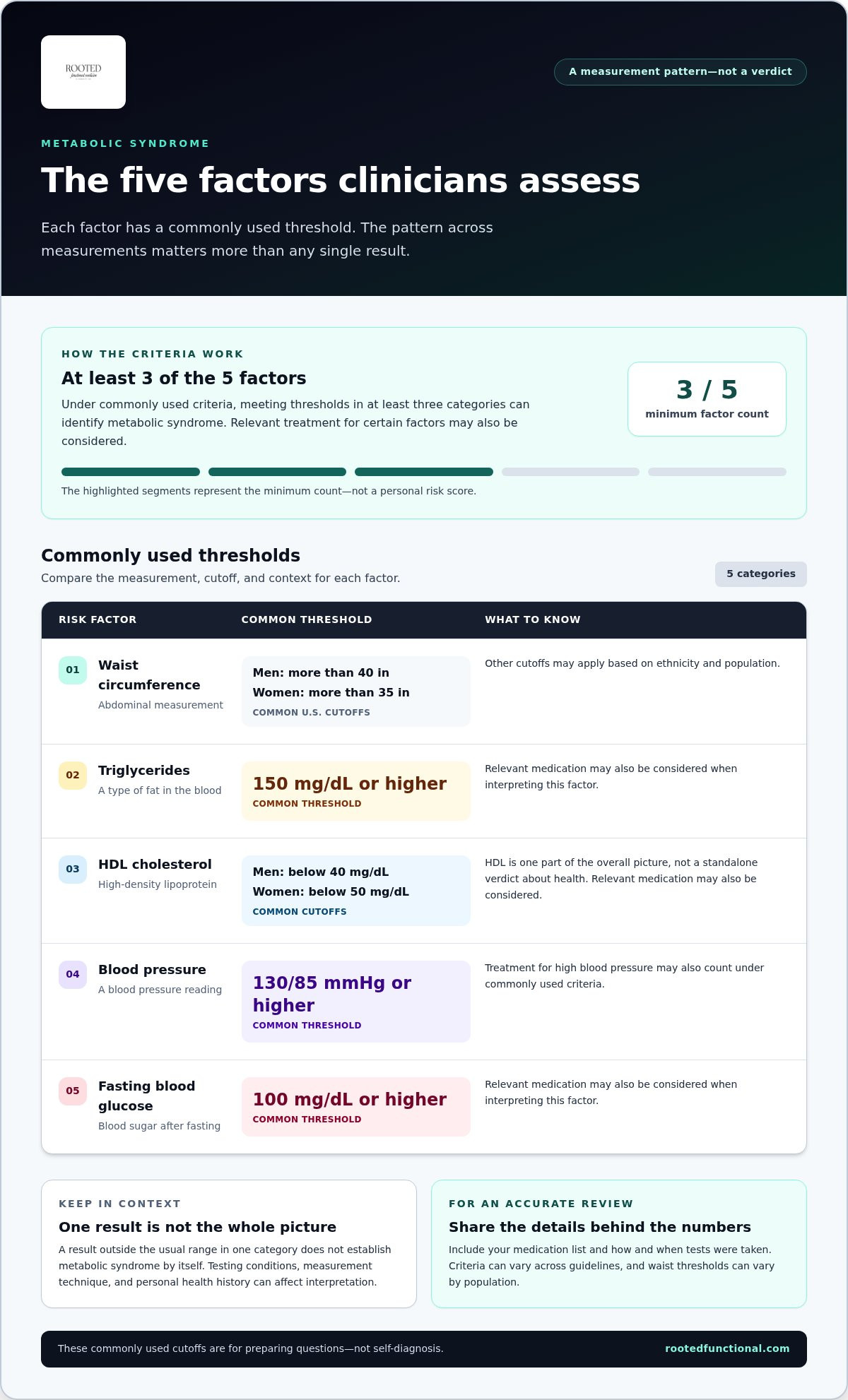
Clinicians assess five categories: waist circumference, triglycerides, HDL cholesterol, blood pressure, and blood glucose. A result outside the usual range in one category is worth discussing, but it doesn’t establish metabolic syndrome by itself. The pattern across measurements matters.
The five components are a larger waist circumference, high triglycerides, low HDL cholesterol, elevated blood pressure, and elevated fasting blood glucose. The National Heart, Lung, and Blood Institute overview of metabolic syndrome explains these core factors. The cutoffs below are commonly used, but waist thresholds can vary by population, and criteria may differ across guidelines.
What measurements and lab results are considered?
Waist circumference: A measurement around the abdomen. Common U.S. cutoffs are more than 40 inches for men and more than 35 inches for women, but other cutoffs may apply based on ethnicity and population.
Triglycerides: A type of fat in the blood. A level of 150 mg/dL or higher is a common threshold.
HDL cholesterol: HDL stands for high-density lipoprotein, a type of cholesterol carried in the blood. Levels below 40 mg/dL for men or 50 mg/dL for women meet common cutoffs. HDL is one part of the overall picture, not a standalone verdict about health.
Blood pressure: A reading of 130/85 mmHg or higher meets a commonly used threshold. Treatment for high blood pressure may also count.
Fasting blood glucose: Blood sugar measured after fasting. A level of 100 mg/dL or higher meets a common threshold.
Under commonly used criteria, relevant medication may also be considered for triglycerides, HDL, and blood glucose. When discussing results, share your medication list and how and when the tests were taken so your clinician can interpret them in context.
How many risk factors are needed for the criteria?
Under commonly used criteria, metabolic syndrome is identified when at least three of the five factors meet their thresholds, or when relevant treatment is being used for certain factors. A single reading shouldn’t be treated as a diagnosis. Testing conditions, measurement technique, and personal health history can all affect how results are interpreted.
Use these numbers to prepare questions, not to diagnose yourself. A clinician can review the measurements together, clarify which criteria apply, and consider your broader health context. For individualized guidance interpreting relevant lab results and health history, you can book a Root Cause Consultation.
Does metabolic syndrome cause symptoms, and how is it identified?
Metabolic syndrome often has no obvious symptoms. You may feel well and still have measurable changes in blood pressure, waist circumference, or blood test results. That’s one reason it may come up during a routine health visit rather than because you noticed a specific problem. If you’re wondering “what is metabolic syndrome, and how would I know?”, the answer usually comes from reviewing measurements together, not from how you look or feel.
Can you tell you have metabolic syndrome by how you feel?
Usually, not reliably. Fatigue, changes in weight, or how your body looks can have many explanations, and none confirms this cluster of risk factors on its own. You might feel completely fine, or have symptoms that deserve attention for other reasons. Share symptoms with a healthcare professional as part of your health picture, but don’t use them as a substitute for measurements and appropriate testing.
The Mayo Clinic overview of metabolic syndrome symptoms and causes also explains why the condition may not be obvious to the person who has it. A lack of symptoms doesn’t confirm that everything is fine, and a symptom alone doesn’t establish the syndrome.
What tests or measurements might a clinician review?
An assessment brings together measurements and lab results rather than relying on one number. Depending on your situation, a clinician may review:
Blood pressure, measured during a visit or through other appropriate monitoring.
Waist circumference, taken with a measuring tape using a consistent method.
Blood tests, which may include fasting blood glucose, triglycerides, and HDL cholesterol.
A wearable, health app, or single glucose reading can offer information about a particular moment or pattern, but it can’t establish metabolic syndrome. These tools don’t provide all the measurements needed to assess the full criteria, and an isolated result may not represent your usual levels.
Context matters. A clinician may consider how and when a measurement was taken, your health history, and medications that affect blood pressure, blood fats, or blood glucose. If a result is outside the expected range, don’t treat it as a verdict. Note your questions and discuss the result alongside your other measurements. An individualized review can help make unfamiliar lab values easier to understand and clarify what, if anything, needs follow-up.
What can you do if you have metabolic syndrome risk factors?
Seeing several results outside the expected range can feel overwhelming. You don’t have to solve everything at once. Start by understanding what your results show, then work with a healthcare professional to decide what deserves attention first.
Practical next steps should reflect your specific risk factors and overall health. Use this sequence to prepare for a focused conversation:
Gather your results. Collect recent blood pressure readings, waist measurements, lab reports, and a list of medications or supplements. Note when and how measurements were taken.
Clarify what the results mean. Ask which findings are outside the relevant range and how they fit together with your health history.
Discuss priorities. Work with your clinician to identify a realistic place to begin. You don’t need to change everything at once.
Agree on follow-up. Ask whether repeat measurements or testing are appropriate, and how you’ll review progress over time.
Which questions can you bring to an appointment?
Bring questions that help turn numbers into a plan. You might ask: Which metabolic syndrome criteria apply to me? What does each measurement mean in my situation? Should any results be repeated or followed with additional testing? Which risk factors should we prioritize, and when should we review them again? These questions can help you leave with clearer next steps instead of a list of unexplained values. If your doctor recommends further diagnostic screenings for related digestive or abdominal concerns, specialized clinics such as digestivecentre.com.sg can provide insight into what advanced diagnostic evaluations involve.
How can everyday habits support metabolic health?
Daily habits can be part of the conversation, but they don’t replace individualized clinical guidance. Ask what changes may be realistic and appropriate for you. Options to discuss include building sustainable eating patterns, finding regular physical activity that fits your abilities and routine, supporting consistent sleep, addressing stress, and avoiding tobacco. Small, repeatable changes may be easier to maintain than a strict plan that doesn’t fit your life.
There’s no single routine that suits everyone. Your health history, current conditions, preferences, and resources all matter. If you’re unsure where to begin, focus on one practical change and ask how it fits with your broader care plan. Don’t stop or adjust prescribed medication based on an article or a single result. Discuss medication questions with the clinician who manages it—for example, adults seeking guidance on psychiatric prescriptions and their overall wellness can turn to specialized telehealth practices such as New Age Psychiatry for professional diagnosis and medication management.
If you’re asking what is metabolic syndrome in relation to your own results, a personalized review can connect the measurements with your health history and priorities. Rooted Functional Medicine offers individualized, lab-based care. You can book a Root Cause Consultation to discuss personalized guidance.
How can personalized care help you understand metabolic syndrome?
Knowing the criteria is useful. Understanding what your own results mean in context is the next step. Two people may have similar measurements but different health histories, medications, concerns, and priorities. A personalized review can connect those details without assuming that one finding tells the whole story.
What does an individualized review add?
At Rooted Functional Medicine, personalized, lab-based care can include a review of your health history and relevant lab results. An initial Root Cause Consultation with Dr. Adrienne Guthrie includes ordering and interpreting advanced functional lab work to identify potential underlying drivers of chronic symptoms. This context can help clarify which findings deserve follow-up and what questions to explore. Testing and planning should be guided by individual needs rather than a one-size-fits-all checklist.
Care is collaborative. You can bring your questions, discuss what matters most to you, and work toward a plan that reflects your circumstances. Follow-up offers an opportunity to revisit relevant results and priorities over time. To learn more about the functional medicine approach, explore our guide to what a functional medicine doctor does.
When might it make sense to seek personalized support?
Personalized guidance may be helpful if several risk factors have appeared together, your lab results are difficult to interpret, or you’re unsure what to ask next. You don’t need a functional medicine consultation to understand the basic criteria. If you want help making sense of how your measurements and health history fit together, individualized care is one option.
Rooted Functional Medicine provides care through secure telehealth nationwide. A consultation offers space to discuss your health history, review relevant lab information, and consider questions or priorities for follow-up. It can support a clearer understanding of your health picture, but it cannot guarantee a particular diagnosis or outcome.
If you’re still asking what is metabolic syndrome in relation to your own results, you don’t have to interpret every number alone. For individualized guidance, book a personalized consultation.
Turn your results into a clear next step
Understanding what is metabolic syndrome can make unfamiliar lab results feel less intimidating. It describes a cluster of risk factors, not a guarantee that you’ll develop diabetes or heart disease. Because it often has no obvious symptoms, measurements and lab results need to be considered together, with your personal health history in view.
If several results concern you, gather your records and bring questions about what they mean, whether follow-up is needed, and which priorities make sense for you. Sustainable changes to eating, movement, sleep, and tobacco use may be worth discussing with a healthcare professional. Your next steps should fit your health and circumstances, not a one-size-fits-all promise.
Rooted Functional Medicine offers personalized, lab-based functional medicine care led by Dr. Adrienne Guthrie, with secure telehealth appointments available nationwide. A consultation can help you discuss your health history and relevant lab results without assuming a specific diagnosis or outcome. Book a personalized consultation.
Start with understanding, then take one thoughtful step at a time. Your results are information you can use, not a verdict on your future.
Frequently Asked Questions
What is metabolic syndrome?
Metabolic syndrome is a cluster of commonly assessed risk factors: increased waist circumference, elevated triglycerides, reduced HDL cholesterol, elevated blood pressure, and elevated blood glucose. In practical terms, it’s the combination of findings that matters, not one factor alone. Clinicians apply criteria from a clinical guideline and consider personal health context. The label signals increased health risk, not a guaranteed future diagnosis or outcome.
What are the five signs of metabolic syndrome?
The five categories are increased waist circumference, elevated triglycerides, reduced HDL cholesterol, elevated blood pressure, and elevated blood glucose. These are measurements or lab findings, not necessarily symptoms you can feel. A person may have one or more without having the syndrome. Specific thresholds should be checked against a current clinical guideline, since criteria can vary. Results should be interpreted alongside personal health history rather than in isolation.
Can you have metabolic syndrome without symptoms?
Yes. Metabolic syndrome may be identified through routine measurements and blood tests even when you feel well. Appearance, energy level, or the absence of symptoms can’t confirm or rule it out. If you’re concerned about a result, discuss relevant measurements and lab findings with a qualified healthcare professional. Symptom searches and self-diagnosis can’t assess the full picture, but a review of your results can help clarify whether follow-up is appropriate.
How is metabolic syndrome diagnosed?
A clinician assesses a combination of factors, which may include waist circumference, blood pressure, fasting blood glucose, triglycerides, and HDL cholesterol. The exact criteria and thresholds depend on the guideline used and may vary with population. An app, a home reading, or a single lab value alone doesn’t establish the syndrome. A clinician interprets results alongside health history, medications, and testing circumstances to determine what the findings mean for you.
Does metabolic syndrome mean I have diabetes?
No. Metabolic syndrome is a cluster of risk factors associated with a higher likelihood of developing Type 2 diabetes and cardiovascular disease, but it isn’t the same as either condition. Blood glucose results have their own diagnostic criteria and need to be interpreted by a clinician. Having metabolic syndrome doesn’t make future diabetes inevitable. Ask how your glucose result fits with your other measurements and whether follow-up testing is appropriate.
Can metabolic syndrome be improved?
Risk factors may be addressed through individualized clinical care and sustainable health habits, but results vary and no particular outcome is guaranteed. A clinician can help you discuss priorities such as nutrition, regular movement, sleep, and appropriate follow-up based on your health. Don’t start or stop medication, or change a prescribed dose, based on an article. Talk through treatment decisions with your healthcare professional so any plan fits your needs and circumstances.
What should I ask my doctor if I have metabolic syndrome risk factors?
Ask which criteria apply to you, what each measurement means, and whether repeat measurements or additional testing are appropriate. You can also ask how your risk factors and progress will be reviewed over time. Bring recent results and a current medication list to support the discussion. These questions can help you understand your health picture, but they don’t replace professional assessment or require you to interpret clinical thresholds on your own.